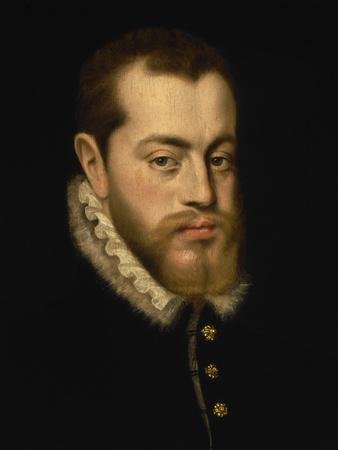
Philip by Netherlandish portrait painter Anthonis Mor
Philip II was King of Spain (1556–1598), King of Portugal (1580–1598), and ruler of Naples, Sicily, Milan, and the Netherlands. He was also jure uxoris King of England and Ireland (1554–1558) through his marriage to Mary I.
Early Life and Education (1527–1548)
Philip II was born on May 21, 1527, in Valladolid, Spain, to Emperor Charles V and Isabella of Portugal. Raised in the Castilian court, Philip was deeply influenced by Spanish traditions and governance. His education was overseen by humanist scholars such as Juan Martínez Siliceo and Juan Cristóbal Calvete de Estrella, ensuring he had a strong grasp of Latin, Spanish, and Portuguese. Unlike his father, he never mastered multiple languages fluently, which affected his ability to govern non-Spanish territories effectively.
At the age of 16, Philip was entrusted with the regency of Spain while his father focused on the Holy Roman Empire. This early exposure to governance shaped his conservative and meticulous ruling style, emphasizing centralized authority and Catholic orthodoxy.
Philip’s Accession and Early Reign (1556–1560)
Philip inherited a vast empire in 1556 when Charles V abdicated. His dominions included Spain, the Netherlands, Naples, Milan, and Spanish territories in the Americas. One of his immediate challenges was managing the empire’s sprawling bureaucracy and financial difficulties. His reign was characterized by strict administration and an intense focus on Catholic orthodoxy.
During this period, Philip faced his first major economic crisis. Despite the wealth flowing from the Americas, Spain defaulted on its loans multiple times, leading to financial instability. The economy remained a persistent challenge throughout his reign, contributing to Spain’s eventual decline.
Marriage Alliances and European Influence
Philip used marriage as a political tool to strengthen Spain’s influence in Europe:
- Maria Manuela of Portugal (1543–1545): This union briefly strengthened Spain’s ties with Portugal but ended with Maria’s death shortly after childbirth.
- Mary I of England (1554–1558): Through this marriage, Philip became King of England and Ireland. However, Mary’s premature death ended Spain’s hold over England and thwarted Philip’s plans for Catholic restoration.
- Elisabeth of Valois (1559–1568): This alliance with France helped stabilize relations between Spain and France, though the peace was short-lived.
- Anna of Austria (1570–1580): His fourth and final marriage produced his successor, Philip III, securing the Habsburg lineage.
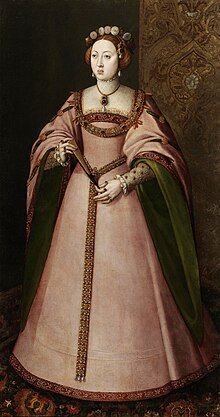
Maria Manuela of Portugal
How did Queen Mary I of England earn the name “Bloody Mary”?
Spanish Expansion and the Golden Age
Philip’s reign marked the height of Spain’s global influence. His empire spanned Europe, the Americas, and Asia, establishing Spain as a dominant global power. The conquest of the Philippines in 1565, named in his honor, expanded Spain’s reach into the Pacific.
Despite his extensive empire, Philip’s reliance on silver imports from the Americas caused inflation and economic strain. The Spanish economy became dependent on this wealth, which led to long-term financial instability.
The Revolt in the Netherlands (1568–1648)
One of the most challenging conflicts of Philip’s reign was the Dutch Revolt. The heavily taxed and Protestant-leaning provinces in the Netherlands resisted Philip’s efforts to impose Catholic rule. His harsh measures, including the execution of noble leaders and military repression, fueled resentment and resistance. In 1581, the northern provinces declared independence, forming the Dutch Republic. The war would continue beyond Philip’s death, lasting until 1648.
War with England and the Spanish Armada (1588)
Philip’s relations with England soured after Elizabeth I supported Protestant rebels in the Netherlands and authorized attacks on Spanish treasure fleets. In 1588, he launched the Spanish Armada, a fleet designed to invade England and overthrow Elizabeth. However, storms and strategic English naval tactics led to Spain’s defeat.
This failure marked the beginning of Spain’s naval decline. Despite subsequent attempts to launch further armadas in 1596 and 1597, Spain failed to secure dominance over England.
Mediterranean and Ottoman Conflicts
Philip II viewed himself as the defender of Christendom against the Ottoman Empire. In 1571, Spain played a crucial role in the Battle of Lepanto, where the Holy League decisively defeated the Ottoman navy. This victory secured Spanish dominance in the Mediterranean for decades, though the Ottomans continued to pose a threat.
The Iberian Union and Rule Over Portugal (1580–1598)
A major success of Philip’s reign was the annexation of Portugal in 1580 after King Henry of Portugal died without an heir. Philip’s claim to the Portuguese throne was contested, but his military intervention secured control. This union expanded Spain’s empire, adding Portuguese territories in Africa, Asia, and the Americas. However, it also burdened Spain with additional financial and military responsibilities.
Religious Policies and the Inquisition
Philip II was a devout Catholic and vigorously enforced religious orthodoxy within his realm. He expanded the Spanish Inquisition, persecuting Protestants, Jews, and Moriscos (Muslims forcibly converted to Christianity). His religious policies alienated many of his subjects, leading to revolts, particularly in the Netherlands and among the Moriscos in Spain.
His intervention in the French Wars of Religion further demonstrated his commitment to Catholicism. He funded the Catholic League in France and sought to place his daughter, Isabella Clara Eugenia, on the French throne, though these efforts ultimately failed.
Economic Challenges and Military Decline
Despite its vast wealth, Spain under Philip faced severe economic difficulties. The continuous wars drained resources, leading to multiple state bankruptcies. The reliance on American silver caused inflation, weakening Spain’s economy. Additionally, Spain’s rigid bureaucratic structure hindered economic innovation and efficiency.
Philip’s military engagements in France, England, and the Netherlands stretched Spain’s forces thin. The defeat of the Spanish Armada and costly wars against Dutch rebels and English privateers diminished Spain’s military prestige.
Philip’s Final Years and Death (1598)
Philip spent his final years in El Escorial, the grand palace-monastery he built as a symbol of Spain’s power and Catholic devotion. He continued to oversee state affairs meticulously, despite declining health. He died on September 13, 1598, leaving the throne to his son, Philip III.
Legacy and Impact
Philip II’s reign defined Spain’s Golden Age, a period of immense territorial expansion, cultural flourishing, and global influence. However, his policies also planted the seeds for Spain’s decline. His rigid governance, economic mismanagement, and relentless military campaigns drained Spain’s resources and weakened its position in Europe.
Despite his failures, Philip’s patronage of the arts led to the flourishing of Spanish culture, with figures such as El Greco, Cervantes, and Sofonisba Anguissola making significant contributions.
Difference between the Spanish Armada and the English Armada
Frequently Asked Questions
How did he inherit the Portuguese throne?
Philip II claimed the Portuguese throne in 1580 after the death of King Henry of Portugal, his maternal uncle. He defeated the rival claimant, António, Prior of Crato, and secured Portuguese recognition in the Cortes of Tomar.
What was Philip II’s role in the Spanish Golden Age?
Philip II presided over the height of Spanish power and influence, promoting arts, literature, and architecture. He completed the construction of El Escorial and patronized figures like Sofonisba Anguissola and El Greco.
Why did Philip II launch the Spanish Armada against England?
He sought to overthrow Protestant Queen Elizabeth I, restore Catholic rule in England, and retaliate against English support for the Dutch Revolt. The 1588 Armada failed due to English naval tactics and severe storms.
How did Philip II’s policies impact the Netherlands?
Philip’s persecution of Protestants and centralization efforts led to the Dutch Revolt (1568–1648). The northern provinces declared independence in 1581, forming the Dutch Republic, while the southern provinces remained under Spanish rule.
What was Philip II’s relationship with the Ottoman Empire?
Philip II continued his father’s war against the Ottomans, achieving a major victory at the 1571 Battle of Lepanto, which weakened Ottoman naval dominance in the Mediterranean.
How did Philip II manage Spain’s vast empire?
Philip ruled through a centralized bureaucracy but faced financial difficulties, declaring state bankruptcies multiple times. His rigid policies and reliance on silver from the Americas strained Spain’s economy.
What was Philip II’s religious policy?
Philip was a staunch Catholic who used the Spanish Inquisition to suppress heresy. He funded Catholic causes across Europe, including the Catholic League in France, and expelled the Moriscos from Granada after their 1569 revolt.





