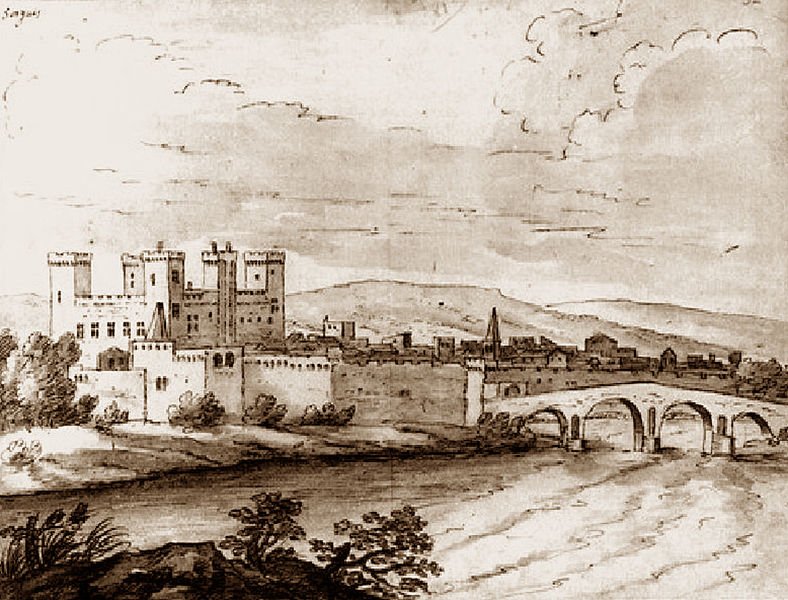
The Palais des Papes of Sorgues, from the Laincel album at the Musée Calvet.
The Palais des Papes of Sorgues holds a crucial place in history as the first official papal residence built during the Avignon Papacy in the early 14th century. Commissioned by Pope John XXII, this grand structure predates the famed Palais des Papes in Avignon by 18 years. Located in the small town of Sorgues, near Avignon, it was a luxurious and fortified residence that influenced the architectural design of subsequent papal and cardinal estates in the region. Though today only ruins remain, the Palais des Papes of Sorgues symbolizes a turning point in the papacy’s temporal and architectural legacy.
Historical Background
The Avignon Papacy began in 1309 when Pope Clement V moved the papal court to Avignon to escape the political instability and factional conflicts in Rome. By the time Pope John XXII succeeded Clement in 1316, the papacy had settled in the region but lacked a permanent and suitably grand residence. Sorgues, being close to Avignon and strategically located near the Rhône River, was chosen as the site for this initial project. The construction of the Palais des Papes of Sorgues reflected not only the growing temporal authority of the papacy but also its intention to solidify its presence in southern France.
Construction and Architectural Features
The construction of the Palais des Papes of Sorgues began under Pope John XXII’s directive in the early 14th century. The design of the residence incorporated both defensive and luxurious elements, blending medieval military architecture with the refined aesthetics expected of a papal home. The structure was likely fortified with thick walls, towers, and a moat, emphasizing security during an era of political tension and territorial disputes. However, it also featured elements of grandeur, such as spacious halls, private chapels, and ornate interiors, which reflected the prestige and authority of the papal office.
The architects and builders drew inspiration from local traditions in Occitan architecture while introducing innovations that would influence later constructions. Many of the features seen in the Palais des Papes of Avignon, such as its robust fortifications and symmetrical layout, were first tested and implemented in the residence at Sorgues.
Role and Function of the Palais
The Palais des Papes of Sorgues was more than just a residence; it was a central hub for the administrative, spiritual, and diplomatic activities of the papacy. The palace housed the pope, his court, and key members of the Roman Curia, serving as a venue for important meetings, theological discussions, and the management of church affairs. Additionally, the fortified nature of the residence made it a secure retreat in times of unrest, ensuring the safety of the pope and his officials.
Beyond its papal use, the residence also set the standard for the construction of cardinal palaces in Avignon and surrounding areas. Cardinals, who wielded considerable influence, sought to emulate the design and grandeur of the Sorgues palace in their own residences, thus spreading its architectural legacy.
Decline and Destruction
By the mid-14th century, with the completion of the Palais des Papes in Avignon, the residence in Sorgues gradually fell out of use as the papal court consolidated its operations in Avignon. Though it retained historical and symbolic significance, the Sorgues palace’s practical role diminished, and it became a secondary property.
The final blow to the structure came during the French Revolution in the late 18th century. Like many religious and royal buildings of the time, the Palais des Papes of Sorgues was targeted for its association with the old regime. The town of Sorgues sold the palace to builders, who dismantled it for its materials. Stones, wood, and other valuable components were repurposed for local construction, leaving the site in ruins. Today, only fragments of the original structure remain, offering a glimpse into its once-imposing presence.
Influence on Avignon and Papal Architecture
Despite its eventual decline, the Palais des Papes of Sorgues played a pivotal role in shaping the architectural and cultural legacy of the Avignon Papacy. The construction techniques, defensive features, and aesthetic principles used in Sorgues provided a model for the Palais des Papes in Avignon, which remains one of the most iconic structures associated with the papacy. Furthermore, the influence extended to the private residences of cardinals, many of whom adopted the Sorgues palace’s design elements in their own homes.
The Sorgues palace also demonstrated the papacy’s ability to integrate local architectural styles with its broader vision of grandeur. This blending of influences helped reinforce the papal court’s authority and establish Avignon as a center of power and culture during the 14th century.
Modern-Day Ruins and Historical Legacy
Today, the ruins of the Palais des Papes of Sorgues stand as a reminder of the papacy’s early years in southern France. Though much of the structure was dismantled during the French Revolution, its historical significance remains intact. The ruins are a testament to the papal court’s ambitions and the transformative period of the Avignon Papacy.
Efforts have been made to study and preserve the remnants of the palace, with historians and archaeologists working to piece together its original design and function. The site continues to attract visitors and scholars interested in the history of the papacy, medieval architecture, and the broader cultural impact of the Avignon era.
Frequently Asked Questions
Why was the Palais des Papes of Sorgues constructed?
It was built to serve as a fortified and luxurious residence for the pope, marking the papacy’s transition from Rome to Avignon.
Where was it located?
The palace was located in Sorgues, a town near Avignon, strategically positioned by the Rhône River.
What architectural features did it have?
The palace combined defensive structures, such as thick walls and towers, with opulent features like spacious halls and private chapels, blending fortification with luxury.
How did it influence later architecture?
It served as a model for the Palais des Papes in Avignon and inspired the construction of cardinal residences in the region.
What happened to the palace?
During the French Revolution, it was dismantled and sold for building materials, leaving it in ruins.
Why is it significant historically?
It marked the beginning of the Avignon Papacy and symbolized the papacy’s political and cultural shift to southern France.





