Times in military history when circumvallation and contravallation were used
Circumvallation and contravallation are military strategies that involve the construction of fortifications to encircle an enemy. Circumvallation refers to the building of a line of fortifications around a besieging army to protect it from attacks from external forces, while contravallation involves the construction of fortifications around the besieged location to prevent its escape or relief.
These tactics have been used throughout military history, notably during sieges, demonstrating the strategic depth and defensive needs of military operations.
Military historians at WHE present some significant instances where these tactics were employed:
Siege of Alesia (52 BC)

Perhaps the most famous example of both circumvallation and contravallation was during Julius Caesar’s siege of Alesia, which marked a decisive moment in the Gallic Wars. Image: Julius Caesar (100 BC – 44 BC).
Perhaps the most famous instance of both circumvallation and contravallation occurred during Julius Caesar’s siege of Alesia in 52 BC, a pivotal episode in the Gallic Wars. Alesia, a fortified hilltop city, was the stronghold of the Gallic chieftain Vercingetorix.
To subdue the city, Caesar’s legions employed a sophisticated military strategy involving the construction of two comprehensive sets of fortifications. The first, a circumvallation wall, encompassed his own forces, providing a defensive barrier against potential attacks from Gallic reinforcements. This wall was outward-facing, designed to fend off assistance from the external Gallic forces rallying to relieve the siege.
Simultaneously, Caesar ordered the construction of a second set of walls, known as contravallation, facing inward towards Alesia. This was intended to thwart any attempts by Vercingetorix and his warriors to break out from the siege.
The result was a formidable double ring of fortifications, trapping the Gauls inside and protecting the Roman besiegers from external attacks. This dual-layered encirclement was crucial, enabling Caesar to maintain a relentless siege that eventually forced the starving defenders to surrender, effectively sealing the fate of Gaul under Roman control.
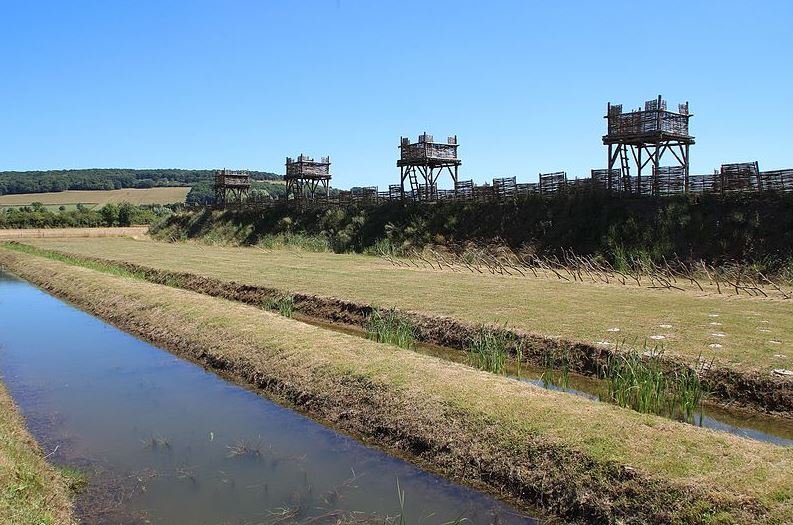
At the Siege of Alesia in 52 BC, Caesar’s forces constructed two sets of fortifications: a set of outward-facing defenses (circumvallation) to protect against Gallic reinforcements, and an inward-facing wall (contravallation) around Alesia to prevent the escape of Vercingetorix and his troops. Image: The reconstructed fortifications of Caesar’s troops in Alesia.
READ MORE: Why did Julius Caesar cross the Rubicon in 49 BC?
Battle of Dyrrhachium (48 BC)
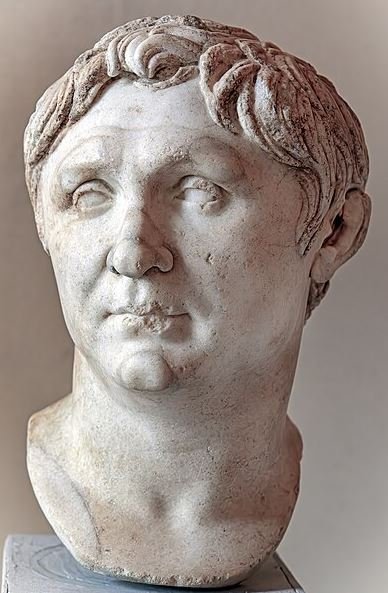
During the Roman Civil Wars, Julius Caesar again used circumvallation at the Battle of Dyrrhachium against Pompey. Image: Pompey (106 BC – 48 BC).
During the Roman Civil Wars, particularly at the Battle of Dyrrhachium in 48 BC, Julius Caesar employed the tactic of circumvallation to fortify his position against Pompey’s numerically superior forces.
Caesar constructed extensive fortifications around his camp, strategically situating it to intercept and disrupt Pompey’s supply lines. This defensive encirclement aimed to protect his troops and maintain a supply blockade against Pompey.
Despite the strategic foresight, the battle culminated in a rare tactical defeat for Caesar. Pompey executed a successful breakout, exploiting weaknesses in Caesar’s stretched and incomplete lines. This maneuver not only relieved his forces but also turned the tide, forcing Caesar to retreat.
The Battle of Dyrrhachium highlighted the risks involved in Caesar’s typically aggressive military strategies and showcased Pompey’s resilience and tactical acumen in face of adversity.

At the Battle of Dyrrhachium, Roman general Julius Caesar built fortifications around his camp near Dyrrhachium to protect his forces from Pompey’s larger army. This tactic was intended to secure his position while he cut off Pompey’s supply lines, although in this instance, it led to a tactical defeat due to a successful breakout by Pompey.
Siege of Constantinople (717-718 AD)
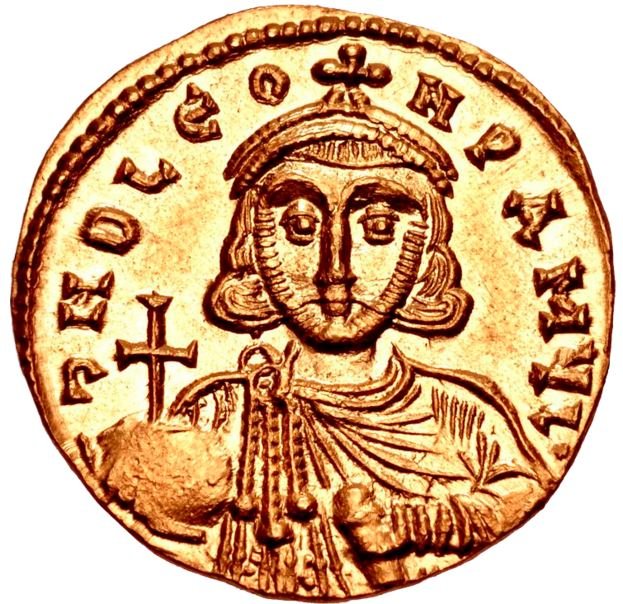
At the Siege of Constantinople the Umayyads were aware of Byzantine Emperor Leo III the Isaurian’s alliance with Bulgaria under Khan Tervel. As a result, they constructed robust stone walls both against the city’s formidable Theodosian walls and the countryside. Image: Nomisma of Leo III.
During the 717-718 Siege of Constantinople, the Umayyad Caliphate aimed to seize the Byzantine capital amid the empire’s internal turmoil. The Umayyads deployed over 100,000 troops and 1,800 ships, demonstrating their significant logistical capabilities.
Forewarned of an alliance between Byzantine Emperor Leo III the Isaurian and Khan Tervel of Bulgaria, the Umayyads strategically constructed robust stone fortifications. These defenses were placed both against Constantinople’s formidable Theodosian walls and extending out into the surrounding countryside. This dual-layer of fortifications served as a defensive measure against the city and as a barrier to intercept any Bulgarian reinforcements.
The setup of the Umayyads effectively secured their encampment between these walls, enabling them to maintain a strong defensive stance while also preparing for offensive maneuvers against the Byzantine and potentially Bulgarian forces. This strategic foresight underscored the Umayyads’ comprehensive approach to siege warfare, though the Byzantine capital ultimately withstood the siege.
Siege of Tenochtitlan (1521)
The Siege of Tenochtitlan, the climactic battle of the Spanish conquest of the Aztec Empire, took place in 1521. Led by Hernán Cortés, the Spanish forces, along with their indigenous allies, laid siege to Tenochtitlan, the capital of the Aztec Empire, now the site of modern-day Mexico City.
The siege marked the final episode in a series of events that began with Cortés’ arrival in Mexico in 1519 and his subsequent clash with the Aztec emperor, Moctezuma II.
Over the course of several months, Cortés’ forces systematically cut off the city’s supplies and access to freshwater by controlling the causeways leading into Tenochtitlan. The Spanish also constructed brigantines to control the surrounding lake, further isolating the city. The siege intensified with fierce urban combat, and the Aztecs, weakened by disease (smallpox) and starvation, were unable to withstand the continuous assaults.
After a brutal final attack, the city fell on August 13, 1521. The fall of Tenochtitlan marked the end of the Aztec Empire and the beginning of Spanish dominion over central Mexico, fundamentally altering the cultural and political landscape of the region.
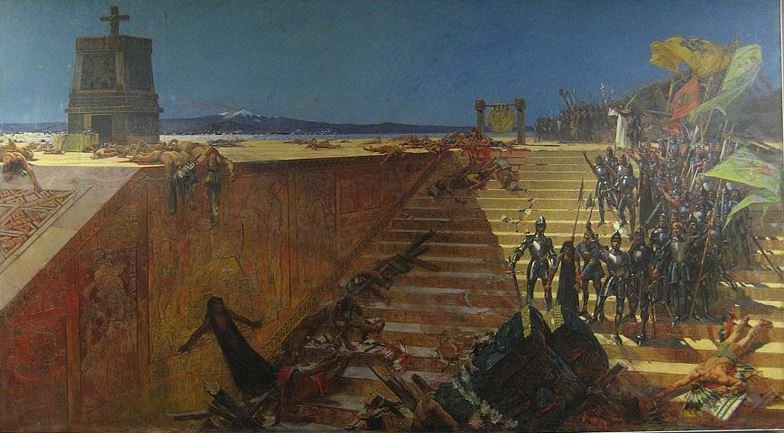
In the final assault on the Aztec capital of Tenochtitlan, Spanish conquistador Hernán Cortés and his indigenous allies constructed a blockade to completely isolate the city. While not a classical example of circumvallation or contravallation, the strategy effectively used natural waterways and constructed barriers to cut off the city from supplies and escape routes. Image: A painting by American artist William de Leftwich Dodge, depicting the final days of Tenochtitlan. This artwork is entitled “The Last Days of Tenochtitlan, Conquest of Mexico by Cortez”.
Great Siege of Malta (1565)
The Great Siege of Malta in 1565 was a pivotal confrontation in the Mediterranean, pitting the Ottoman Empire against the Knights Hospitaller. As the Ottomans sought to consolidate control over the Mediterranean and eliminate the Knights as a threat to their naval dominance, they launched an extensive assault on the small island of Malta, then a crucial stronghold of the Hospitaller knights.
Led by Grand Master Jean Parisot de La Valette, the Knights, alongside a few thousand Maltese soldiers and civilians, faced a massive Ottoman force estimated at over 30,000.
Despite being heavily outnumbered, the defenders utilized the island’s fortifications, particularly those at Fort Saint Elmo, Saint Michael, and Saint Angelo, to mount a resilient defense.
The siege, which lasted from May to September, was characterized by fierce combat and heavy casualties on both sides. The Knights’ staunch resistance and strategic use of their fortifications ultimately exhausted the Ottoman invaders, leading to their withdrawal.
The victory not only secured Malta but also significantly boosted European morale against Ottoman encroachment. The siege remains a legendary episode in military history, symbolizing heroic resistance against overwhelming odds.

The Ottoman Empire attempted to conquer Malta from the Knights Hospitaller. The knights used elements of contravallation by fortifying their positions around key fortresses such as Fort Saint Elmo, Saint Michael, and Saint Angelo. This allowed them to maintain defensive positions and repel the Ottoman forces effectively. Image: A painting showing the major events of siege of Malta.
Siege of Petersburg (1864-1865)
The Siege of Petersburg was a critical campaign of the American Civil War. it spanned from June 1864 to April 1865. This extended military blockade, conducted by Union forces under GeneralUlysses S. Grant, aimed to capture Petersburg, Virginia, a vital rail and supply center just south of the Confederate capital, Richmond.
Grant’s strategy involved cutting off Confederate General Robert E. Lee’s supply lines and forcing him into a prolonged engagement without reinforcements or supplies, effectively weakening the Confederate ability to sustain war efforts. The siege began after initial attempts to take Petersburg quickly failed, leading Grant to decide on encircling the city and laying siege.
Over the nine-month period, Union forces constructed extensive trench networks and fortifications, typical of the “trench warfare” that would later become infamous during World War I. Several key battles, including the Battle of the Crater, where Union troops detonated a mine under Confederate lines, marked the siege but failed to break Confederate defenses decisively.
The siege culminated in early April 1865, when Union forces finally broke through the Confederate lines, leading to the evacuation of both Petersburg and Richmond. Within a week, Lee surrendered at Appomattox Court House, effectively ending the war. The Siege of Petersburg was crucial in sealing the fate of the Confederacy, showcasing the effectiveness of siege warfare and total war strategy.
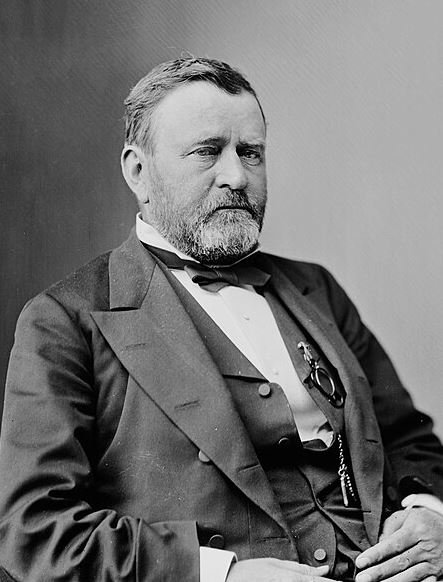
Union forces under General Ulysses S. Grant encircled the city of Petersburg, Virginia, with trench fortifications to cut off Confederate General Robert E. Lee’s Army from supply lines and reinforcements, ultimately leading to the fall of Richmond and the end of the war. Image: Ulysses S. Grant (1822 – 1885).
Siege of Tobruk (1941)
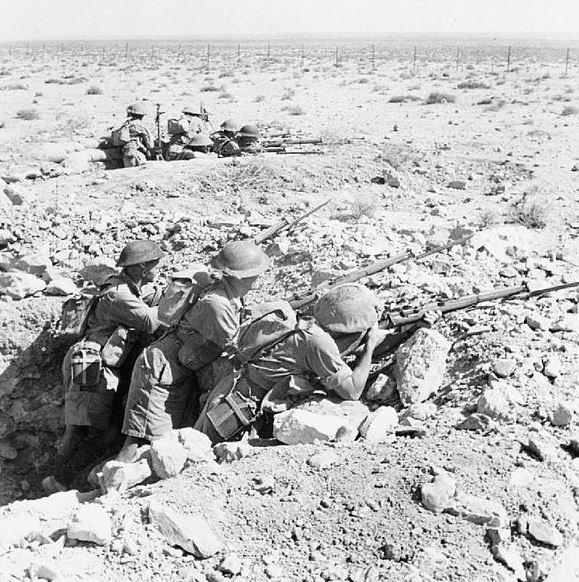
During World War II, the Siege of Tobruk involved Allied forces, primarily Australians, holding out against German and Italian forces for over 240 days. Image: Australian soldiers during the battle.
The Siege of Tobruk was a pivotal confrontation in North Africa during World War II, lasting from April to December 1941. Tobruk, a strategic port in Libya, was defended by Allied forces primarily comprising Australian troops, along with British and Polish units, against the German Afrika Korps led by General Erwin Rommel.
The siege began after Rommel’s rapid advance through Libya was halted at Tobruk. Despite being outnumbered, the defenders utilized the port’s strong fortifications and the naturally defensive terrain to maintain a robust resistance. Tobruk’s defense was critical as it allowed the Allies to maintain a naval supply route to the Eastern Mediterranean, while also denying the Axis powers a vital supply harbor.
Throughout the siege, the defenders, known as the “Rats of Tobruk” by Axis broadcasters, repelled repeated attacks and managed to hold the town for more than eight months. This resistance provided a much-needed morale boost to the Allied forces and was a significant factor in the North African campaign.
The siege was finally lifted in December 1941 when the Allied relief operation, Operation Crusader, broke through the Axis encirclements, forcing Rommel to retreat. The successful defense of Tobruk not only thwarted Axis plans but also marked a turning point in the North African campaign, highlighting the strategic importance of Tobruk and its defenders’ resilience.

Did you know…?
- Athenian historian and general Thucydides highlights the strategic use of circumvallation in the Sicilian Expedition and the Spartan siege of Plataea early in the Peloponnesian War in 429 BC, emphasizing its role in siege warfare.

Thucydides, an Athenian historian and general, authored “History of the Peloponnesian War,” detailing the conflict between Sparta and Athens up to 411 BC. Known as the father of “scientific history,” he emphasized evidence-based analysis and impartiality, excluding divine intervention. Image: Thucydides (c. 460 BC – c. 400 BC).
- Julius Caesar’s Commentaries on the Gallic War (Commentarii de Bello Gallico) detail his effective use of both circumvallation and contravallation at the Siege of Alesia in 52 BC, where he trapped Vercingetorix and his forces with a double ring of fortifications, leading to a decisive Roman victory.
- During the Siege of Jerusalem in 70 AD, the Roman general Titus (later Roman Emperor 79 to 81 AD) implemented circumvallation, constructing a wall that isolated the city and expedited its fall, while also ordering the deforestation of the surrounding area to prevent any escape and to clear ground for Roman operations.
Military Investment during WWII
During World War II, the Siege of Stalingrad vividly demonstrated the enduring principles of military investment, a tactic involving the encirclement and isolation of a target.
Initially, the Germans could not fully encircle Stalingrad, allowing the Soviets to continue supplying their forces via the Volga River. As the battle progressed, the Soviets achieved a complete investment of the city, effectively controlling all access points, including the airspace.
This strategic encirclement prevented the Germans from establishing a sufficient airbridge to deliver supplies, critically weakening the encircled forces. The resulting deprivation and isolation compelled the besieged German troops to surrender, marking a significant turning point in the war. The siege highlighted the effectiveness of total investment in modern warfare, incorporating not only ground forces but also aerial and logistical dominance to compel an enemy’s surrender.
FACT CHECK: At worldhistoryedu.com, we strive for utmost accuracy and objectivity. But if you come across something that doesn’t look right, don’t hesitate to leave a comment below.





