Panama Canal – History & Facts
What is the Panama Canal?
The Panama Canal, which is also known in Spanish as Canal de Panamá, is a long stretch of man-made waterway which links the Atlantic Ocean to the Pacific. Measuring 82 km in total length, the canal joins the two oceans by cutting through an isthmus in Panama – a South American country. Engineering work on the canal was actually completed in August of 1914.
Today, the Panama Canal is recognized as one of the most iconic symbols of 20th-century human ingenuity. It serves as a navigable short route for ships traveling between the eastern coastal harbors and the western coastal harbors of the United States of America. Without using the canal, ships in those regions would have to waste a lot of time and fuel by going round South America – Cape Horn. This would lengthen the journey by 8k nautical miles (15,000 km).
The Panama Canal is an 82-kilometer (51-mile) artificial waterway in Panama that connects the Atlantic Ocean (via the Caribbean Sea) to the Pacific Ocean.
From a North American direction, it has been reported that using the Panama Canal can shorten an inter-coastal voyage between South and North America by a distance of up 3.5k nautical miles (6500 km). The Panama Canal also shortens the sailing distance between Europe and Eastern Asia by 2k nautical miles.
From the above maritime advantages afforded by the canal, it was naturally convincing that governments spent millions and millions of U.S. Dollars to create the artificial waterway. On 31st December 1999, the US handed over the administration of the canal to Panamanian Authorities.
Geographical Location and Navigation
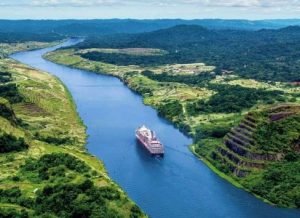
On average, it takes 8–12 hours for a ship to pass through the Panama Canal.
The Canal is situated at the latitudinal coordinate of 9° N. This coincides at the coordinate where the Continental Divide of North America falls to one of its minimum values. From an Atlantic view, the canal takes its entrance from Colon and passes through the Gatun Locks. It then continues its path through the broadest section of Gatun Lake. From here, the canal runs down sharply due east until it meets with the Bay of Panama where it continues to the Pacific. A railway and a highway run parallel to the Panama Canal.
When traveling from the Atlantic side to the Pacific, ships begin their navigation by moving to the approach way in Limon Bay. This stretches about 11 km (7 miles) to the Gatun Locks where 3 different locks take ships 26m to Gatun Lake. In the lake, the channel depth varies from 14 m to 26 m and it spans through a distance of 37 km before reaching Gamboa.
A cut then goes from Gamboa through the Continental Divide. In the cut, the channel depth measures about 13 m and it covers a distance of 13 km before reaching the Pedro Locks. The function of the locks is to lower ships 9 m to the Miraflores Lake. This is at an elevation of 16 m above normal sea level.
The Panama Canal facilitates maritime trade by providing a shortcut, avoiding the lengthy and hazardous route around South America’s southern tip.
To get vessels to normal sea level, the ships pass through a 2 km channel to a 2-stepped Miraflores lock. This is where the ships are lowered to normal sea level.
The ending section of the canal comprises a 7-mile dredged passage, which carries ships to the Pacific Ocean. From end to end, the Panama Canal’s minimum width at the bottom is 150 m.
In 2016, a $5.25 billion expansion added a third set of locks, allowing larger Neopanamax ships to transit and doubling the canal’s capacity.
History of the Panama Canal
The Panama Canal has a long history which dates back to the early 16th century. The Spanish people realized that a canal would be a great navigation solution which would simplify the movement of goods and people across the isthmus in Central America.
Technical decisions and conclusions fell on creating one aquatic path through Panama while Nicaragua would host the other canal. By the mid-19th century, motivation for selecting the Panama route was driven from the American construction of the Panama Railroad. The canal would be built along the railroad.
Panama assumed full control of the canal on December 31, 1999, through the Panama Canal Authority (ACP), following the Torrijos–Carter Treaties.
Failed Earlier Attempts
Initial attempts to create the Panama Canal started in 1881. The government of Colombia awarded the contract to a private construction company under the command of a French man by name Ferdinand de Lesseps. Because of his earlier success in building the Suez Canal, Lesseps gained trust and some funding to execute the Panama Canal project
Unfortunately, Lesseps wasn’t much familiar with the Panamanian topography; it was very different from the Suez project. It took the engineering knowledge of Baron de Brusly and Lepinay to resist Lesseps from attempting to build the canal. Lepinay was well-versed with the Panamanian Isthmus. He proposed a more feasible way to build the canal, taking into consideration the Continental Divide, the land features of Panama and rivers which could be converted into artificial lakes.
Lepinay envisioned the need for a dam to be constructed at Gatun and Miraflores. This would raise the water level to about 25m. The lakes would then be joined together by cutting through the Continental Divide. Locks would connect the canals to the oceans. Unfortunately, Lepinay’s great proposal was not taken.
Lesseps later ran out of ideas, while trying to build the Canal. Construction workers contracted diseases due to the unfavorable Panama jungle conditions. His company collapsed and the canal project wasn’t executed.
It took the intervention of America under President Theodore Roosevelt, to negotiate a treaty with Colombia before construction works on the canal resumed.
Cost of Human Labor and Completion
As mentioned earlier, tropical diseases such as yellow fever and malaria, killed tens of thousands of French workers who attempted the construction of the Panama Canal. Even though the Americans put in adequate measures to reduce the loss of lives, misfortunes, and diseases killed over 5000 workers. A lot of the skilled laborers were American engineers.
The Panama Canal was built to provide a shortcut for ships, avoiding the long and dangerous voyage around the southern tip of South America via Cape Horn or the Strait of Magellan.
Heavy duty machines were used for the construction. Over 100 steam shovels were used to excavate the Culera Cut. Rocks and unstable soil posed huge engineering challenges to the building of the canal. In addition to that, dynamite blasts and landslides further killed more workers.
Upon all the technical challenges and the numerous deaths, the Panama Canal was successfully completed and inaugurated in August 1914. After the first failed attempts, it took more than 30 years for engineers to finish up the project.
The Panama Canal Controversy Under US President Trump

While the canal remains critical to global shipping, its management under Panamanian control has been largely effective since 1999, contrary to Trump’s claims. Image: 45th and 47th US President Donald J. Trump
Trump’s Assertion of U.S. Interests
On December 21, 2024, U.S. President-elect Donald Trump made a controversial statement suggesting that the United States should reclaim control of the Panama Canal. He alleged that Panama was imposing “exorbitant” tolls on American ships, which he claimed violated the Torrijos–Carter Treaties.
Signed in the 1970s, these treaties facilitated the gradual transfer of canal control to Panama, culminating in full Panamanian authority in 1999. Trump’s assertions reignited long-standing debates over sovereignty and strategic control of this crucial trade route.
Concerns About Foreign Influence
A day after his initial remarks, Trump intensified his rhetoric, alleging that the canal was “falling into the wrong hands,” referring specifically to China’s growing influence in global trade and infrastructure. This statement reflected broader concerns within the U.S. about China’s involvement in Latin America, particularly through investments and partnerships in ports, shipping routes, and other strategic assets.
However, Panama’s president, José Raúl Mulino, dismissed these claims, asserting that Panama maintained full control over the canal and underscoring its role as a vital part of the country’s “inalienable patrimony.”
Panama’s Response
President Mulino firmly rejected Trump’s accusations, stating that Panama was neither charging unfair tolls nor relinquishing control to foreign entities. He emphasized the canal’s importance to Panama’s sovereignty and economy, framing it as a matter of national pride. Mulino’s response highlighted the significance of the canal as a revenue source for Panama and as a symbol of its independence following decades of U.S. control.
Escalation of Tensions
On January 7, 2025, in a press conference, Trump escalated his position, vowing to regain U.S. control of the canal. He framed his arguments around “economic security,” portraying the canal as a critical asset for American trade and defense interests. Trump did not dismiss the possibility of using economic pressure or even military action to achieve this goal, marking a significant departure from decades of U.S. respect for the treaties governing the canal.
Renewed Statements of Intent
On January 20, 2025, after assuming the presidency, Trump reiterated his determination to regain control of the canal, further straining relations between the United States and Panama. His repeated statements underscored the geopolitical and economic importance of the canal, while raising fears of potential international conflict over its management.
Implications for International Relations
Trump’s remarks sparked widespread concern about the potential repercussions for U.S.–Latin American relations. Many viewed his stance as a revival of historical U.S. interventionism in the region. Furthermore, the situation drew international attention, with observers warning of the risks posed by any unilateral action to global trade and regional stability. Panama’s steadfast response also highlighted the evolving dynamics of sovereignty and global influence in the 21st century.
Frequently Asked Questions about the Panama Canal
How does the Panama Canal operate?
Ships are lifted and lowered by a series of locks at each end to cross the isthmus. The canal uses Gatun Lake, a freshwater reservoir, to provide water for lock operations. Approximately 200 million liters (52 million gallons) of fresh water are used per ship transit.
Why is the Canal important?
The canal drastically reduces travel time for global maritime trade between the Atlantic and Pacific Oceans, influencing international trade routes and boosting economic development.
Who constructed the Panama Canal?
France initiated construction in 1881 but abandoned it due to financial and engineering difficulties. The United States took over in 1904, completing the canal in 1914. Panama assumed full control in 1999 under the Torrijos–Carter Treaties.
What challenges were faced during construction?
Workers battled tropical diseases like malaria and yellow fever, engineering obstacles such as landslides, and financial constraints. Approximately 22,000 workers died during the French effort, and 5,600 during U.S. construction.
What are Panamax and Neopanamax ships?
Panamax ships are built to the size limits of the original locks (33.5 meters wide). Neopanamax ships are larger vessels accommodated by the canal’s expanded locks, which opened in 2016.
What role does Gatun Lake play?
Gatun Lake provides water for the canal’s locks and acts as a significant part of the navigation route. It was formed by damming the Chagres River.
How does the Panama Canal manage water shortages?
Water-saving basins and reservoirs like Lake Alajuela store water for the canal. However, droughts and climate change pose ongoing challenges to water availability.
What is the economic impact of the canal?
The canal is vital for global trade, handling over 13,000 transits annually. It generates significant revenue for Panama and supports trade between countries like the U.S., China, and Japan.
What expansions have been made?
In 2016, a third set of locks was added to allow larger Neopanamax vessels, increasing capacity and competitiveness. This project cost approximately $5.25 billion.
How has the Panama Canal influenced global trade?
By shortening transit times and providing cost-effective routes, the canal has shifted maritime trade patterns, boosting trade between Asia and the Americas.
What environmental issues does the canal face?
The canal has caused deforestation, water shortages, and the spread of invasive species. Freshwater use and pollution from shipping activities remain significant concerns.





