Cursive hieroglyphs, also referred to as hieroglyphic book hand, represent a fascinating adaptation of the traditional Egyptian hieroglyphic script, which has long captivated historians, archaeologists, and linguists alike.
This particular form of hieroglyphic writing was predominantly used in the transcription of religious texts, especially those that were handwritten as opposed to carved on monuments or stone.
The main characteristic of cursive hieroglyphs is their use of fluid strokes, which made them more practical for use in documents that needed to be written quickly and in larger quantities than the formal, meticulously engraved hieroglyphs seen on ancient temples and tombs.
Below, World History Edu unpacks cursive hieroglyphs by shedding light on the evolution of Egyptian writing and the social, cultural, and religious practices of the ancient Egyptians, particularly during the Ramesside Period when this script was at its height.

Historical Background and Usage
The use of cursive hieroglyphs dates back to Egypt’s New Kingdom era, particularly during the Ramesside Period, a time associated with the reign of the Pharaohs named Ramses. This era is well known for the production of some of the most extensive and intricate religious texts.
Among the documents written using this script are the famous Book of the Dead and the Coffin Texts, which were key components of Egyptian funerary practices. These texts provided instructions and spells for the deceased to navigate the afterlife, ensuring a smooth journey through the underworld and ultimately, acceptance into the afterlife by the gods.
The cursive hieroglyphic script was employed for practical reasons. Unlike the monumental hieroglyphs that were carved or painted on the walls of temples and tombs, cursive hieroglyphs were written with ink on more portable materials such as papyrus, wood, and sometimes even leather. This made the transcription process much faster, while still allowing for the retention of the sacred and symbolic nature of the hieroglyphs.
The process of writing with ink and a reed brush, typical tools in ancient Egypt, contributed to the fluid and more rounded appearance of the characters, making them easier to produce in rapid succession. This was especially advantageous for religious texts, which required a high degree of accuracy but also needed to be produced efficiently.
READ MORE: Life and major accomplishments of Ramesses the Great
Differences Between Cursive Hieroglyphs and Monumental Hieroglyphs
One of the key distinctions between cursive hieroglyphs and the more formal, monumental hieroglyphs lies in their intended use and the medium on which they were applied.
Monumental hieroglyphs were carved into stone or painted on walls for public display, often as part of religious or state-sponsored projects that glorified the gods or the Pharaoh. These hieroglyphs were meticulously detailed, with an emphasis on symmetry, precision, and aesthetic perfection. Each sign in monumental hieroglyphs was a work of art, with clear, carefully defined lines and details. This form of hieroglyphs was primarily used for long-lasting inscriptions that were meant to endure for centuries, such as those found in tombs, temples, and on statues.
In contrast, cursive hieroglyphs were used for more practical, everyday purposes, especially in the transcription of religious texts that would be kept in scrolls or other portable objects. The emphasis in cursive hieroglyphs was not on artistic perfection but rather on speed and efficiency. The characters were simplified and more fluid in their design, often reducing the number of strokes required to write each symbol. This made the script ideal for scribes who needed to produce large volumes of text quickly, such as copying religious manuscripts for use in tombs or for rituals.
While cursive hieroglyphs retained the symbolic meaning of the signs, their forms were often more abstract, allowing scribes to work more rapidly without losing the overall message.
Relationship with Hieratic Script
Cursive hieroglyphs should not be confused with the hieratic script, another form of ancient Egyptian writing that was also used for religious and administrative purposes. Hieratic is considered a fully cursive script, developed from hieroglyphs but distinct in both appearance and function. It was used primarily for more routine writing tasks, such as accounting, record-keeping, and other day-to-day administrative duties. Hieratic was characterized by its extreme simplification of the hieroglyphic symbols, with many ligatures and flowing lines that made it very fast to write, but difficult for those unfamiliar with the system to read.
While both cursive hieroglyphs and hieratic are derived from the same root—traditional hieroglyphs—they served different purposes. Hieratic was a more practical and utilitarian script, designed for rapid writing on papyrus and used in less formal contexts.
Cursive hieroglyphs, on the other hand, retained a closer connection to the sacred and symbolic elements of formal hieroglyphs, being primarily used for religious texts and manuscripts where the preservation of the original symbolic meanings was crucial.
While hieratic may have influenced the visual appearance of cursive hieroglyphs—leading to some simplification and fluidity in the strokes—the two scripts are distinct. Hieratic was always written from right to left in horizontal lines, while cursive hieroglyphs were typically arranged in vertical columns and could be read in either direction, depending on the orientation of the characters.

The usage of Cursive hieroglyphs on papyrus, wood, and other materials made them more accessible and practical for producing large quantities of text, while their flexibility in reading direction and arrangement reflects the adaptability of ancient Egyptian writing practices.
Reading Direction and Orientation
One of the fascinating aspects of cursive hieroglyphs is their flexibility in terms of reading direction. While hieratic and later forms of Egyptian writing, such as Demotic, adhered strictly to a right-to-left reading direction, cursive hieroglyphs could be written either from right to left or from left to right. The direction of reading was often determined by the orientation of the human or animal figures within the text. If these figures faced right, the text would be read from left to right, and if they faced left, the text would be read from right to left. Despite this flexibility, right-to-left was the most common orientation for cursive hieroglyphs, especially in religious manuscripts.
In addition to the reading direction, cursive hieroglyphs were typically arranged in vertical columns rather than the horizontal rows that became more common in later Egyptian scripts. This vertical arrangement is a hallmark of traditional Egyptian writing and reflects the continuity between cursive hieroglyphs and the monumental hieroglyphs from which they were derived. The vertical orientation may also have been influenced by the medium—particularly papyrus scrolls, which were unrolled vertically and made it easier to write in columns rather than rows.
Importance in Religious Texts
The use of cursive hieroglyphs in religious texts cannot be understated. These scripts were crucial in preserving the spiritual and ritualistic knowledge of ancient Egypt, particularly in relation to funerary practices. Texts such as the Book of the Dead and the Coffin Texts were written in cursive hieroglyphs and provided essential information for the deceased’s journey through the afterlife. These manuscripts contained prayers, spells, and instructions meant to protect the soul from harm and guide it through the various challenges it would face in the underworld.
The fact that cursive hieroglyphs retained the symbolic and sacred meaning of traditional hieroglyphs made them particularly suitable for religious texts
The cursive hieroglyphic script allowed scribes to produce these texts efficiently, ensuring that they could be widely distributed and accessible to those who could afford them. The fact that cursive hieroglyphs retained the symbolic and sacred meaning of traditional hieroglyphs made them particularly suitable for religious texts, where precision and spiritual significance were paramount. Unlike hieratic or demotic, which were used primarily for secular purposes, cursive hieroglyphs maintained their close connection to the religious and ceremonial life of ancient Egypt.
Advantages and Evolution
One of the major advantages of cursive hieroglyphs was the speed with which they could be written compared to monumental hieroglyphs. This made them ideal for scribes working in workshops or in temple environments, where large quantities of religious texts needed to be copied. The use of a reed brush and ink allowed for more fluid movements, and the simplified forms of the characters reduced the time needed to transcribe each symbol. This efficiency did not come at the cost of meaning, however; the cursive hieroglyphs still carried the same symbolic weight as their more formal counterparts.
Over time, the use of cursive hieroglyphs declined as other writing systems, such as Demotic, became more widespread. Demotic, a highly simplified script derived from hieratic, eventually became the dominant script for both religious and secular writing in Egypt. However, cursive hieroglyphs remained in use for religious texts for a significant period, particularly in temple environments, where traditional practices were preserved for much longer than in other areas of Egyptian life.
Questions and Answers about Cursive Hieroglyphs
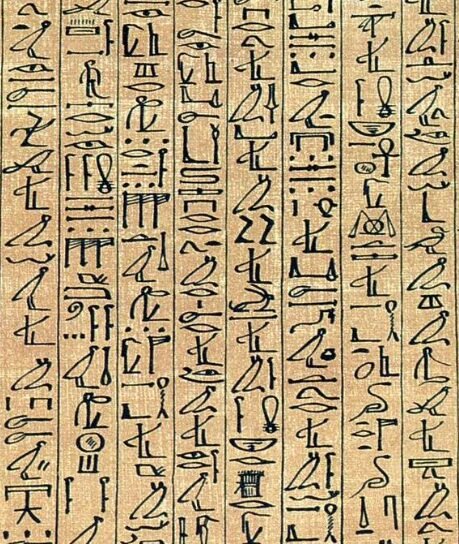
By retaining the symbolic depth of traditional hieroglyphs while adopting a more fluid and simplified style, cursive hieroglyphs became the ideal script for religious texts during the Ramesside Period and beyond. Image: A section of the Papyrus of Ani showing cursive hieroglyphs.
What are cursive hieroglyphs commonly referred to as?
Cursive hieroglyphs are often referred to as the “hieroglyphic book hand.”
For what type of documents were cursive hieroglyphs primarily used?
Cursive hieroglyphs were predominantly used for handwritten religious texts, including works like the Book of the Dead.
What writing instruments and materials were typically used for cursive hieroglyphs?
They were written using ink and a reed brush, with surfaces like papyrus, wood, or leather serving as the writing material.

Why was the cursive hieroglyphic style particularly suited for longer documents?
Its use of ink and brush allowed for faster, more fluid writing, making it more efficient for lengthy documents.
During which period was the use of cursive hieroglyphs especially common?
Cursive hieroglyphs were particularly prominent during the Ramesside Period.

A relief of Ramses II (also known as Ramesses the Great) from Memphis showing him capturing enemies – a Nubian, a Libyan and a Syrian, circa 1250 BC. Cairo Museum
How were cursive hieroglyphs employed in religious literature beyond papyrus?
They were also used on wooden surfaces for religious literature, such as the Coffin Texts.
What is hieratic, and how does it differ from cursive hieroglyphs?
Hieratic is a more streamlined and fully cursive form of Egyptian writing, with many ligatures and unique signs, distinct from the traditional hieroglyphic writing used in cursive hieroglyphs.

The Papyrus of Ani is one of the most well-known documents written in this style.
What is a key difference in the reading direction between hieratic and cursive hieroglyphs?
Hieratic is always read from right to left, while cursive hieroglyphs can be read either from right to left or left to right, depending on the context.
What is the most common reading direction and arrangement for cursive hieroglyphs?
Cursive hieroglyphs are most commonly read from right to left and are typically arranged in vertical columns rather than horizontal rows.
How do cursive hieroglyphs balance the features of formal hieroglyphs and hieratic?
Cursive hieroglyphs retain the detailed, symbolic complexity of formal hieroglyphs while offering a more practical, faster writing style similar to hieratic.
What advantage did cursive hieroglyphs offer compared to traditional hieroglyphic carving?
They offered greater writing efficiency while maintaining the symbolic depth of traditional hieroglyphs.
The format of cursive hieroglyphs allowed for quicker writing without sacrificing the precision needed for religious texts, which would have been more time-consuming if carved or engraved.





