
Empress Theodora, wife of Justinian, is generally regarded as one of the most notable leaders of the Byzantine Empire. Perhaps, her defining moment came when she stepped up to handle the affairs of the state during a fierce insurrection against her husband in 532.
Empress Theodora of the Byzantine Empire (c. 500–548 CE) is both lauded as a heroine and criticized as a controversial leader. Her rise from humble beginnings to one of the most powerful women in Byzantine history showcases her remarkable ambition, intellect, and political acumen. But was she truly a heroine? Examining her life, decisions, and legacy helps illuminate her heroic qualities while also acknowledging the complexity of her character and actions.
Here’s an analysis of her life and the heroic traits she embodied.
Humble Origins and Early Life
Theodora was born into a lower social class in Constantinople, the daughter of a bear keeper in the Hippodrome. When her father died, she and her sisters experienced significant hardship. Despite these humble beginnings, Theodora managed to rise through society, initially becoming an actress—a profession that was viewed with disdain in Byzantine society and associated with the lower class.
She showed resilience and adaptability early in life, using her wit and charisma to navigate a restrictive social landscape. Her early life in the Hippodrome, a hub of social and political discourse, would have given her insight into the workings of society and politics. This background fostered her resilience, strength, and understanding of the people, qualities that would later define her leadership. These formative experiences suggest a capacity for empathy and connection with common citizens, key qualities in any heroic figure.
Marriage to Justinian and Ascent to Power
Theodora’s marriage to Justinian, who would later become Emperor, was not typical. For one, she was an actress, and her background would generally have disqualified her from marrying into the nobility. Yet, Justinian saw her potential and respected her intellect and influence. Their union marked a significant societal shift, as it underscored Theodora’s capacity to transcend the strict class divisions of her time. Justinian even changed laws to allow the marriage, displaying the unique nature of their relationship and the power Theodora wielded from the outset.

Empress Theodora’s husband – Emperor Justinian I
As Empress, Theodora exercised unprecedented influence. She wasn’t merely a consort; she acted as a co-ruler alongside Justinian, often participating in governance and decisions that shaped the Byzantine Empire. Her influence in political, social, and religious matters was profound, indicating not only her capability but also her determination to bring about change, further underscoring her heroic status.
READ MORE: 10 Most Famous Byzantine Emperors and Empresses
The Nika Riots and Theodora’s Heroic Leadership
One of the defining moments of Theodora’s life was her response to the Nika Riots in 532 CE. These riots erupted in Constantinople due to political and social discontent and quickly escalated into violent chaos that threatened Justinian’s rule. At a crucial moment when advisors urged Justinian to flee, Theodora reportedly delivered a powerful speech, expressing her preference to die as an Empress rather than escape in disgrace. This speech not only rallied Justinian and his advisors but also marked a turning point in the suppression of the revolt.
Empress Theodora’s courage during critical events, such as the Nika Riots, where she encouraged Justinian to stay and face the rebellion, further contributes to her reputation as a heroic figure.
Her courage and resolve in the face of danger were heroic, especially given that fleeing would have been the safer choice. Her choice to stand firm saved the empire and demonstrated her commitment to her role and people. This incident encapsulates her heroism, showcasing her bravery, loyalty, and dedication to preserving the stability of the Byzantine state, qualities integral to a heroic leader.
Social Reforms and Advocacy for Women
Theodora was ahead of her time in advocating for women’s rights and improving social conditions for marginalized groups. She recognized the challenges that women, especially those of lower status, faced in Byzantine society. She implemented various reforms aimed at protecting women’s rights, such as laws prohibiting forced prostitution and protecting women from abuse. Additionally, she established safe houses for women and created new legal protections for their property and rights in marriage.
These actions reflect a deep sense of empathy and justice, qualities associated with heroism. Her efforts to uplift and protect vulnerable members of society demonstrate a commitment to social equality, a rare stance for leaders of her era. By addressing these issues, she used her power to create positive societal change, impacting countless lives and securing a legacy as a pioneering advocate for social justice.
Religious Influence and Commitment to Faith
Theodora’s influence extended into the religious sphere, where she played a pivotal role in the ongoing theological debates of her time. She supported the Monophysite Christian faction, which emphasized the divine nature of Christ over his human nature. This stance was controversial, as the official position of the Byzantine Church endorsed the dual nature of Christ (both human and divine), creating a rift within the empire.
While some may criticize her religious involvement as divisive, it’s worth noting that her support for the Monophysites stemmed from her genuine belief and conviction, and she used her influence to provide a voice for a marginalized group within Christianity. This advocacy shows her courage to stand by her beliefs, even when they contradicted the state’s official doctrine, highlighting her dedication to her faith and to supporting those who shared her beliefs.
Did you know…?
Empress Theodora and Emperor Justinian are recognized as saints in the Orthodox Church. Her feast day is commemorated on 14 November by the Eastern Orthodox Church.
Legacy and Heroic Traits
Theodora’s life and legacy reveal many heroic qualities: resilience, courage, empathy, and a commitment to justice. She was a protector of the weak, an advocate for the oppressed, and a champion of social reform, especially for women. Her life story is a testament to her strength in overcoming adversity, her ability to wield power with purpose, and her dedication to her principles.
However, her role as a heroine is not without controversy. Her political maneuvers sometimes led to ruthless outcomes, as she did not shy away from using her power to suppress dissent or remove rivals. Critics might argue that her ambitions sometimes overshadowed her compassion, as she could be uncompromising in her pursuit of power and influence. Yet, these complexities add depth to her character, showing that heroism can coexist with ambition and even moral ambiguity.
Who were the greatest military generals of the Byzantine Empire?
Questions and Answers
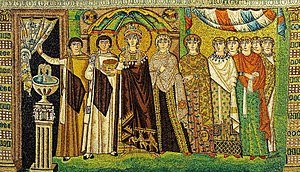
Theodora I was the wife of Emperor Justinian of Byzantium, who reigned from 527-565 CE. She is considered a heroine by some due to her advocacy for women’s rights, her protection of the poor and oppressed, and her influence in political and legal reforms. Image: Empress Theodora – Empress Theodora and attendants (mosaic from Basilica of San Vitale, 6th century)
How did Theodora gain influence in the Byzantine Empire?
Theodora gained influence through her close collaboration with Emperor Justinian, with whom she was thought to act as a co-ruler. Her partnership with Justinian allowed her to impact policies and laws, particularly those advancing women’s rights and protecting the vulnerable, effectively solidifying her role in governance.
What role did Theodora play during the Nika Riots, and how did it affect her reputation?
During the Nika Riots, Theodora urged Justinian to stay and confront the rebellion instead of fleeing, a decision that likely saved his reign. This act of bravery bolstered her reputation as a courageous leader, although critics highlight the bloodshed that ensued. Her willingness to stand firm in a crisis became a defining aspect of her heroic image.
How did Theodora embody Christian virtues, and how does this support her portrayal as a heroine?
Theodora is said to have embodied Christian virtues such as faith, loyalty, charity, and repentance. Historian Warren Treadgold describes her as pious and loyal to Justinian. Her charity toward the poor and her personal repentance, likened to Mary Magdalene, support her image as a Christian heroine, highlighting her empathy and moral values.
Why is Theodora’s character controversial, particularly according to the historian Procopius?
Theodora’s character is controversial partly due to her background as an actress and possibly a prostitute, which Procopius and others saw as scandalous. Procopius, a contemporary historian, harshly criticized her in his Secret History, depicting her as manipulative, unfaithful, and ruthless. Many historians view Procopius’s account as biased, although figures like historian Clive Foss agree that she was far from saintly.
How did Theodora demonstrate her leadership when Justinian fell ill?
When Justinian fell ill during the plague, Theodora effectively ruled in his place. Her decisive leadership and loyalty were evident, showing her capacity to govern independently. This incident highlighted her strength as a leader and her commitment to supporting Justinian’s rule even in difficult times.
Why is Theodora’s advocacy for women’s rights considered significant?
Theodora’s advocacy for women’s rights was significant because it was highly progressive in the patriarchal society of Byzantium. Her support for policies that protected and empowered women challenged social norms and demonstrated her forward-thinking views on gender equality, making her a pioneering figure for women’s rights.
What differing perspectives exist on whether Theodora was a heroine?
Perspectives on Theodora’s heroism vary widely. Critics like Procopius see her as ambitious and ruthless, while those she helped, such as the poor and women, would likely view her as heroic for her courage and reforms. Ultimately, her legacy as a heroine depends on one’s viewpoint and the qualities they associate with heroism.
What are the Byzantine Empire’s Most Important Accomplishments?





