History of Addis Ababa: What is the origin of its name and when was it founded?
Addis Ababa, whose name translates to “New Flower” in Amharic, is Ethiopia’s sprawling capital and most populous city. It has long held significant cultural, political, and diplomatic roles in the country and beyond. The city is home to diverse populations from different regions of Ethiopia and houses several key international organizations, most notably the African Union (AU) and the United Nations Economic Commission for Africa (UNECA).
Founding and Early Development
The establishment of Addis Ababa in the late 19th century is largely credited to Emperor Menelik II and Empress Taytu Betul. Initially, Menelik II based his military operations on the highlands of Mount Entoto, north of the present city.
However, this location proved too cold, lacked water, and offered limited firewood. Empress Taytu Betul proposed a move downhill to the area of Finfinne (known for its hot springs).
In 1886, following her suggestion, the imperial court settled there and built residences near these mineral springs for their leisure and health benefits. Empress Taytu’s house became the nucleus of what soon expanded into a permanent settlement.
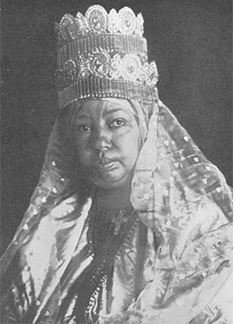
Portrait of Taytu Betul
The name ‘Addis Ababa’ comes from Amharic for “new flower,” chosen by Empress Taytu Betul in 1886, when she encouraged settlement around the hot springs at Finfinne.
Menelik II officially named the burgeoning settlement “Addis Ababa,” first as the capital of the Kingdom of Shewa, and eventually, in 1889, as the capital of the entire Ethiopian Empire after his coronation.
The city’s earliest residences often consisted of circular huts with walls made from mud and straw on wooden frames. Over time, nobles, working-class artisans, foreign visitors, and merchants arrived, prompting a quick rise in population. Though unplanned, this settlement pattern laid a foundation for diverse neighborhoods that would later become integral to the city’s character.
By the turn of the 20th century, Addis Ababa had experienced the beginnings of its first modernization efforts. Menelik II introduced eucalyptus trees to the landscape, partly to reduce the demand for firewood from local forests.
The new city also saw an influx of merchants and artisans, as the emperor’s policies encouraged both trade and construction of public works. These formative years fostered a lasting culture of enterprise and adaptability that still defines Addis Ababa today.
Economic Boom and Early Urbanization
In the 1920s, Addis Ababa witnessed a marked surge in economic growth. Coffee production had become a major source of wealth, enabling the emergence of a local middle class that constructed stone houses furnished with modern items from Europe.
The import of the first automobiles changed the city’s transportation culture, and in turn, roads and related infrastructure began to see improvements. By 1930, the city had hundreds of vehicles, an extraordinary number for the time, spurring the development of more sophisticated banking, commerce, and trade.
Haile Selassie, who assumed the throne in 1930, continued these modernization projects. He introduced new government offices, telephone lines, electricity, and water systems to central parts of the city.
This period also saw the initial expansion of roads intended to link Addis Ababa to other parts of the country and ports abroad. Notably, a road to the French-controlled railway station in Dire Dawa and an agreement with Italy for a road to Assab were thought to enhance connectivity. Although both projects proceeded sporadically, they highlighted Addis Ababa’s growing importance as a hub for commerce.

Haile Selassie in 1970
Haile Selassie, who assumed the throne in 1930, continued these modernization projects. He introduced new government offices, telephone lines, electricity, and water systems to central parts of the city. Addis Ababa became a symbol of an ambitious nation, eager to integrate modern advancements with its centuries-old traditions.
History of Coffee: Origin Story, Discovery, & Some Exciting Facts
Italian Occupation and Master Plans
Between 1936 and 1941, during the Second Italo-Ethiopian War, the Italian army occupied Addis Ababa. The city, spared the heavier aerial bombardments that devastated other areas, was transformed into the administrative seat of Italian East Africa.
Italian architects launched extensive plans to reshape Addis Ababa into a colonial capital, proposing large avenues and monumental buildings to reflect Fascist ideals. While these master plans were partially implemented, their long-term impact on the city’s layout was never fully realized, due to the end of Italian occupation in 1941.
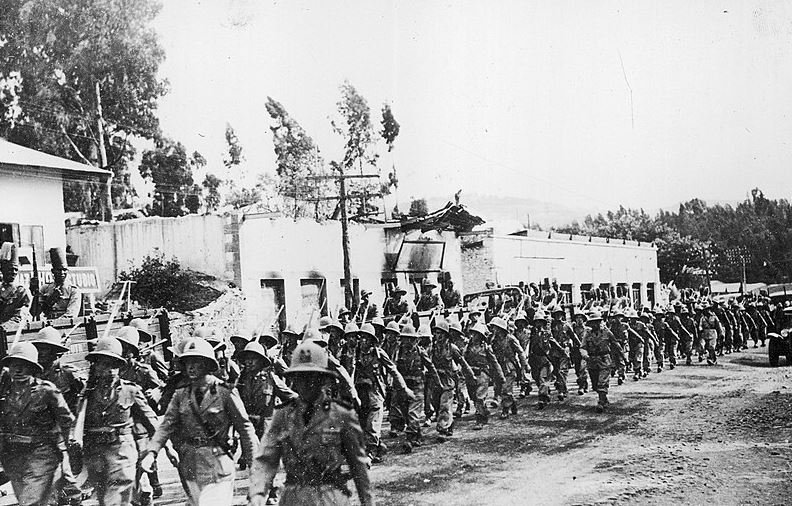
A military parade of Italian troops in Addis Ababa, held in 1936.
Nonetheless, elements of Italian architectural influence remain visible, particularly in certain neighborhoods and older structures. The period left an imprint through some modernized roads and buildings, establishing a partial framework for future urban planning. Italians also introduced infrastructure upgrades such as paved streets, though these were limited to strategic areas serving the occupying forces.
In May 1941, with British and Ethiopian resistance forces reclaiming the country, Haile Selassie re-entered Addis Ababa. The restoration of his government ended the five-year occupation. However, the city’s population had grown considerably during the occupation, as had its infrastructure. The post-occupation government had to grapple with the dual challenge of repairing war damage and finding housing for a rapidly expanding population.
Scramble For Africa: History, Berlin Conference, Outcome, & Facts
Post-Liberation Development and Urban Challenges
After World War II, Addis Ababa underwent another wave of modernization. Emperor Haile Selassie turned his attention to urban planning, commissioning renowned planners like Sir Patrick Abercrombie to design a functional road network and orderly neighborhoods. These initiatives were intended to handle the dramatic population surges Addis Ababa experienced, but they often faced logistical hurdles.
A citywide expansion strategy continued into the 1950s and 1960s. The founding of the Organization of African Unity (OAU) in 1963 boosted Addis Ababa’s diplomatic significance. Many African nations opened embassies, and the city positioned itself as a pan-African capital. The United Nations Economic Commission for Africa, established in 1958, further cemented Addis Ababa’s reputation for international diplomacy.
Despite these advances, the population outpaced the ability of municipal authorities to provide services. Famine in the countryside, combined with rural-urban migration, contributed to overcrowding. Informal settlements sprang up around the periphery. Although several urban master plans were proposed during these decades, both financial constraints and political upheavals limited their success.
In 1974, the Derg—a Marxist military council—overthrew Haile Selassie. The new regime nationalized property and drastically reshaped urban administration. Under the “Proclamation No. 47/1975,” many private residences became state-owned. Neighborhood committees, or kebeles, managed most of these properties, leading to sub-standard housing for many residents. Meanwhile, major expansions of the city were put on hold, though a 1986 master plan was drawn up. Bureaucratic rigidity often stalled meaningful urban development until the Derg itself was overthrown in 1991.
The Contemporary Era: Growth and Restructuring
When the Ethiopian People’s Revolutionary Democratic Front (EPRDF) came to power in May 1991, it enacted a federal constitution. While many regions were reorganized under ethno-linguistic lines, Addis Ababa remained a chartered city accountable directly to the federal government. The new administration also facilitated privatization of certain state-owned properties, accelerating the city’s economic activity.
Addis Ababa has a high literacy rate compared to many other regions of the country, supported by numerous academic institutions, including Addis Ababa University.
Rapid population growth continued, and subsequent administrations attempted to manage urban sprawl through revised master plans. Between 1999 and 2003, the Office for Revision of Addis Ababa Master Plan (ORAAMP) developed strategies to guide the city’s land use. The government built new roads, widened old ones, and licensed a growing number of taxis and buses to meet transportation needs.

Front gate of the Addis Ababa University.
Notable Facts about Addis Ababa
- Positioned at the foot of Mount Entoto and adjacent to the East African Rift Valley, Addis Ababa boasts a high elevation of roughly 2,355 meters (7,726 feet). This altitude moderates the tropical climate, producing mild temperatures year-round.
- Various ethnic groups—including the Amhara, Oromo, Gurage, Tigrayan, and Silt’e—coexist in the city, reflecting Ethiopia’s diverse heritage. Amharic is the most widely spoken language, though Oromo, Gurage, Tigrinya, and others are also commonly heard.
- According to recent data, Addis Ababa’s population stands at over 5.7 million.
- Ethiopian Orthodox Christianity is the predominant faith, followed by Islam and several Protestant denominations. This cultural and religious diversity influences daily life, from the cuisine on offer to the array of holiday celebrations.
- Various theaters and museums—such as the Ethiopian National Theatre, the Hager Fikir Theatre, and the National Museum—nurture an active arts scene. Ethiopian jazz, popularized internationally by musicians like Mulatu Astatke, has strong roots in Addis Ababa. Visual arts also flourish, influenced by both historical traditions and contemporary movements.
Questions and Answers

How did the Addis Ababa develop in its early years?
Early settlers built huts with mud and thatched roofs. Nobles and artisans arrived in large numbers, leading to rapid but unplanned urban growth. The planting of eucalyptus trees and the construction of new roads helped shape the city. By the early 20th century, Addis Ababa experienced an economic boom, with middle-class residents adopting European-style housing and imported goods.
What impact did the Italian occupation have?
During the Italian occupation from 1936 to 1941, Addis Ababa underwent urbanization and modernization based on new master plans. Although it was intended to become a “colonial” city, many of these infrastructure projects continued even after the occupation ended, leaving a lasting influence on the city’s layout.
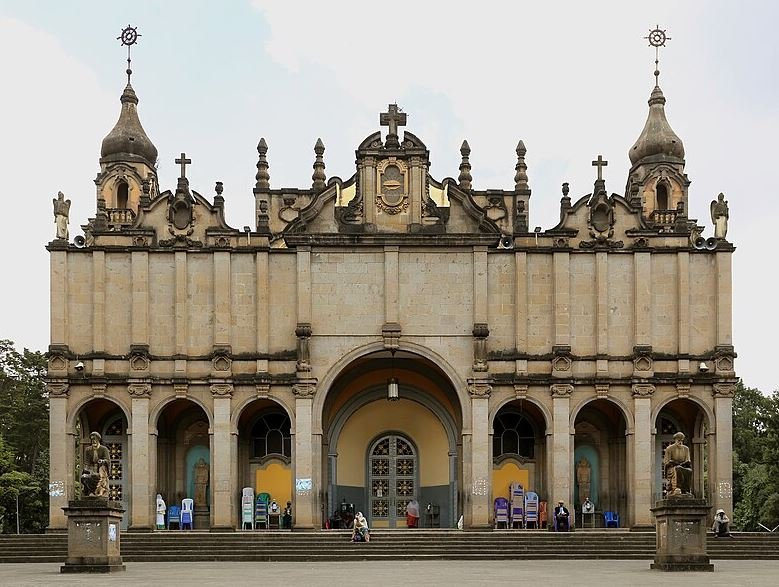
The Holy Trinity Cathedral in the heart of Addis Ababa.
What role does Addis Ababa play in Africa’s diplomacy and politics?
Known as the “political capital of Africa,” Addis Ababa hosts the headquarters of the African Union and the United Nations Economic Commission for Africa. Its historical significance and diplomatic presence make it a major center for pan-African and international discussions.
How is the city administratively structured today?
Addis Ababa is a federally-chartered city under Ethiopia’s constitution, governed by an elected mayor and city council but accountable to the federal government. It is divided into subcities and kebeles (wards), each managing local administration and services.





