
A statue thought to be the Sphinx of Pharaoh Nepherites I, found in 1513 and acquired in 1808 in Italy.
Nepherites I (also known as Nefaarud I or Nayfaurud I) was an ancient Egyptian pharaoh who founded the 29th Dynasty in 399 BC. His reign marked a significant transitional period in Egyptian history, characterized by internal consolidation, architectural achievements, and foreign policy initiatives.
Reign and Accession
Nepherites I, originally a general from Mendes, rose to prominence through decisive military action. In the autumn of 399 BC, he launched a successful rebellion against Pharaoh Amyrtaeus, the last ruler of the preceding 28th Dynasty. After defeating Amyrtaeus in open battle, Nepherites had him executed at Memphis. Following his victory, Nepherites crowned himself pharaoh at Memphis, the traditional seat of Egyptian kingship, and possibly also at Sais.
A notable shift occurred when Nepherites moved the capital from Sais to his hometown of Mendes in the Nile Delta. His decision to adopt the Horus name of Psamtik I and the Golden Horus name of Amasis II—a prominent pharaoh of the 26th Dynasty—demonstrates his intent to align his reign with the golden age of Egypt’s history, invoking the stability and prosperity associated with these earlier rulers.
Building Activities and Monuments
Despite a relatively short reign, Nepherites left a legacy through his construction projects. Evidence of his contributions has been found across Egypt:
Lower Egypt
Nepherites’ name appears in inscriptions and monuments in Thmuis, Buto, Memphis, and Saqqara. A notable statue of him was unearthed in Buto, and an Apis bull burial occurred in Saqqara during his second regnal year. At Mendes, his capital, further traces of his work have been identified.
Middle and Upper Egypt
In Akoris, he ordered the construction of a chapel, while in Akhmim, a statue of him was placed inside a naos (a shrine). At the Karnak temple complex, he added a storeroom and a shrine designed to house a sacred bark.
Artifacts from his reign include a basalt sphinx bearing his name, which is now housed in the Louvre. This sphinx was transported to Europe as early as the 16th century and once adorned the gardens of Villa Borghese in Rome.
Foreign Policy
Nepherites I engaged in active foreign diplomacy, particularly concerning the Persian Empire. Around 396 BC, he allied with the Spartan king Agesilaus in a campaign against Persia. Egypt supplied the Spartans with an impressive amount of resources, including 500,000 measures of grain and materials for 100 triremes (warships). Unfortunately, the supplies were seized by the Persian-aligned admiral Conon of Athens upon arrival in Rhodes, as the island had already been recaptured by Persian forces.
This event underscores the complexities of Nepherites’ foreign policy, as Egypt sought to reassert influence in the Eastern Mediterranean while countering Persian dominance.

Death and Succession
Nepherites I died in the winter of 394/393 BC, after a six-year reign. According to the Demotic Chronicle, his son succeeded him, though no name is explicitly given in the text. Modern scholars generally believe his successor was Hakor, who ruled briefly before being overthrown by Psammuthes. Despite this, Hakor managed to reclaim the throne and establish a more stable reign following Psammuthes’ short-lived rule.
Tomb and Funerary Complex
The tomb believed to belong to Nepherites I was discovered in 1992–93 by a joint team from the University of Toronto and the University of Washington. The identification of the tomb rests on the discovery of a shabti (a small funerary figurine) inscribed with Nepherites’ name. However, definitive proof linking the tomb to him is lacking.
Nepherites I’s construction projects, particularly in Mendes, and his efforts to evoke the memory of earlier prosperous dynasties reflect his dedication to strengthening his rule and legitimizing his authority.
The tomb contained several funerary objects and a large limestone sarcophagus, but it showed signs of destruction, likely during the Persian conquest of Egypt in 343 BC. Notable finds include ceramic vessels and fish-covered stelae, which are thought to represent votive offerings. These items suggest that the tomb site may have previously been occupied by a temple dedicated to Hatmehyt, a fish goddess worshipped in Mendes.
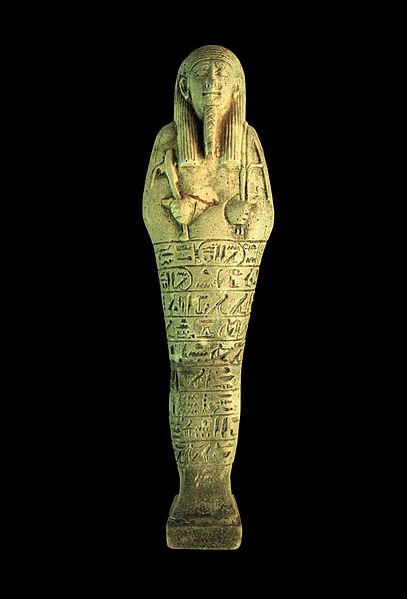
A shabti of Pharaoh Nepherites I.

Frequently Asked Questions
How did Nepherites I come to power?
As a general from Mendes, Nepherites rebelled against Amyrtaeus, defeated him in battle, and executed him in Memphis. He crowned himself pharaoh and made Mendes the capital.
What was Nepherites I’s connection to Egypt’s earlier dynasties?
He adopted the Horus name of Psamtik I and the Golden Horus name of Amasis II, signaling an association with the 26th Dynasty’s ‘golden age.’
What building projects did Nepherites I undertake?
Nepherites conducted building works in Lower, Middle, and Upper Egypt, including a chapel in Akoris, a storeroom and shrine at Karnak, and contributions at Mendes and Saqqara. His basalt sphinx is now housed in the Louvre.
What was Nepherites I’s foreign policy?
He supported Spartan king Agesilaus in a war against the Persians, supplying grain and materials for 100 ships. However, these supplies were seized by Persian forces at Rhodes.
How long did Nepherites I reign?
He reigned for six years (399–394/393 BC), though the highest archaeological record of his rule dates to his fourth year.
Who succeeded Nepherites I?
The Demotic Chronicle mentions his unnamed son, believed to be Hakor. Hakor’s rule was briefly interrupted by Psammuthes before he reclaimed the throne.
What is known about Nepherites I’s tomb?
A tomb believed to be his was discovered in 1992–93. Artifacts such as a shabti bearing his name and fish votive offerings were found, though the site suffered destruction, possibly by the Persians in 343 BC.





