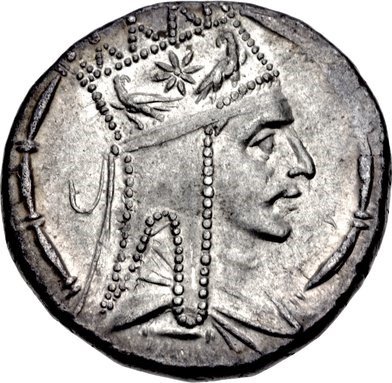
Coin of Tigranes minted in Antioch.
Tigranes II, better known as Tigranes the Great, was the king of Armenia from 95 BC to 55 BC. His reign marked a golden age for the Armenian kingdom as it reached the height of its territorial expansion and influence. Known as “King of Kings,” Tigranes created an empire that became the dominant power in the region for a brief but impactful period. Below, World History Edu delves into the life, achievements, and challenges of Tigranes, shedding light on his political, military, and cultural contributions.
Early Life and Rise to Power
Tigranes was born around 140 BC, likely as the son or nephew of King Artavasdes I. During his youth, Armenia fell under the suzerainty of Parthia, and Tigranes was taken hostage by the Parthian King Mithridates II. This captivity not only shaped his early life but also exposed him to Parthian culture and politics. Upon his release in 96/95 BC, Tigranes ascended the throne and ceded a region known as the “seventy valleys” to Parthia, either as a pledge of loyalty or due to pressure. Initially a vassal of the Parthians, Tigranes soon sought to consolidate his rule and free Armenia from foreign influence.
Building an Empire
Tigranes swiftly set about unifying Armenia, curbing the power of regional nobles (nakharars) who controlled various provinces. Recognizing the need for centralization, he ousted Artanes, the last king of the neighboring Kingdom of Sophene, and incorporated its territories. This move laid the groundwork for his imperial ambitions.
Initially a hostage in Parthia, Tigranes gained the Armenian throne through Parthian support. He expanded his kingdom by annexing neighboring regions and aligning with Mithridates VI of Pontus.
Tigranes also aligned himself with Mithridates VI of Pontus through marriage to Cleopatra, Mithridates’ daughter. This alliance solidified their shared objective of resisting Roman expansion. With a strong base in Armenia, Tigranes embarked on military campaigns, expanding his kingdom to encompass territories stretching from the Mediterranean to the Caspian Sea.
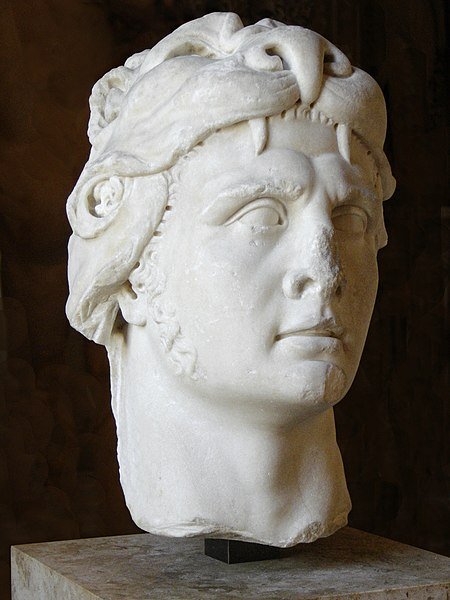
Portrait of the king of Pontus Mithridates VI as Heracles. Marble, Roman imperial period (1st century)
Cultural Flourishing Under Tigranes
An admirer of Greek culture, Tigranes promoted Hellenistic influences in Armenia. He invited Greek philosophers and rhetoricians to his court, and his capital, Tigranocerta, reflected a blend of Greek and Iranian architectural styles. The city became a vibrant cultural hub, populated by forcibly relocated inhabitants from conquered cities. Tigranes’ policies fostered cultural exchange and economic growth, further cementing Armenia’s status as a regional power.
Conflict with Rome
Tigranes’ expansionist policies eventually brought him into direct conflict with Rome. The relationship soured when Mithridates VI sought refuge in Armenia after being defeated by Roman forces. The Roman general Lucullus demanded Mithridates’ surrender, but Tigranes refused, leading to a military confrontation.
In 69 BC, Lucullus launched a campaign against Armenia, decisively defeating Tigranes at the Battle of Tigranocerta. Despite assembling a large army, Tigranes was unable to match the discipline and tactics of the Roman legions. The following year, he suffered another defeat near Artaxata, his old capital. These setbacks marked the decline of Tigranes’ empire.
Submission to Pompey and Later Reign
In 66 BC, Tigranes faced another Roman invasion led by Pompey. Compounded by internal strife, including a rebellion led by his son, Tigranes the Younger, he chose to surrender. Pompey allowed him to retain the core of Armenia as a client kingdom, stripping him of his conquests. This arrangement transformed Armenia into a buffer state under Roman influence.
Tigranes continued to rule as a Roman client-king until his death in 55 BC at the age of 85. Despite the loss of his empire, he maintained stability in Armenia during his later years.
Military Achievements and Tactics
Tigranes earned the title “King of Kings” through his conquests, which extended Armenian control over vast territories, including parts of Mesopotamia, Syria, and Cilicia. He adopted strategies influenced by Achaemenid and Parthian traditions, relying heavily on cavalry and fortified cities. His empire at its peak was a multi-ethnic domain with diverse populations contributing to its military and economic strength.
However, Tigranes’ reliance on numerical superiority and the forced relocation of populations weakened his ability to sustain loyalty among his subjects. These factors, combined with his overextension, left his empire vulnerable to external threats and internal dissent.
Cultural and Economic Policies
Tigranes’ reign was notable for its emphasis on cultural development. Tigranocerta, his newly established capital, became a symbol of Armenian greatness. The city featured theaters, temples, and markets that rivaled those of Hellenistic cities in Greece and the Near East. By fostering trade and cultural integration, Tigranes sought to unify his diverse empire.
Economically, his policies aimed to centralize resources and create a self-sufficient state. The relocation of populations to Tigranocerta not only bolstered the city’s workforce but also demonstrated his intent to control economic activities.
Relations with Neighboring Powers
Tigranes’ relations with neighboring states were complex and strategic. His alliance with Mithridates VI was instrumental in countering Roman expansion, but it also drew Armenia into conflicts that ultimately weakened the kingdom. Meanwhile, his early vassalage to Parthia provided him with the stability needed to consolidate his rule, though he later sought to assert independence by recovering territories ceded to the Parthians.
Tigranes’ interactions with smaller kingdoms and tribes in the region often involved military campaigns and diplomatic marriages, further extending his influence.
Decline of the Empire
The decline of Tigranes’ empire can be attributed to several factors:
- Overextension: His rapid expansion created logistical challenges and overstretched his resources.
- Roman Intervention: Confrontations with Rome exposed the limitations of his military power.
- Internal Rebellions: Discontent among displaced populations and ambitious nobles undermined his authority.
- Succession Disputes: His son’s rebellion weakened the kingdom’s unity during critical moments.
Despite these challenges, Tigranes’ legacy endured as a symbol of Armenian strength and ambition.
Legacy and Historical Assessment
Tigranes the Great remains one of Armenia’s most celebrated historical figures. His reign represents a peak in Armenian power and cultural achievement. Ancient historians like Plutarch and Cicero acknowledged his influence, while modern scholars view him as a complex figure who combined ambition with pragmatism.
Tigranes’ empire, often referred to as “Sea to Sea Armenia,” inspired nationalist aspirations in subsequent centuries. His contributions to Armenian identity and statecraft continue to be honored through monuments, currency, and cultural references.
Frequently Asked Questions
What was significant about Tigranes’ empire?
At its height, his empire stretched from the Mediterranean to the Caspian Sea, including parts of Mesopotamia and Asia Minor. He claimed the title “King of Kings” and established a Hellenistic capital, Tigranocerta.
What were Tigranes’ key achievements?
He created a centralized empire, relocated populations to Tigranocerta, and blended Hellenistic and Iranian cultural elements. His reign marked Armenia’s peak as a major power.
Why did Tigranes conflict with Rome?
Tigranes harbored his ally Mithridates VI, leading to Roman invasions. He suffered defeats at Tigranocerta (69 BC) and Artaxata (68 BC) but retained a portion of his kingdom as a Roman client.
What was Tigranes’ relationship with Parthia?
He initially served as a Parthian vassal but later regained independence, even defeating Parthian forces and reclaiming territories ceded during his hostage years.