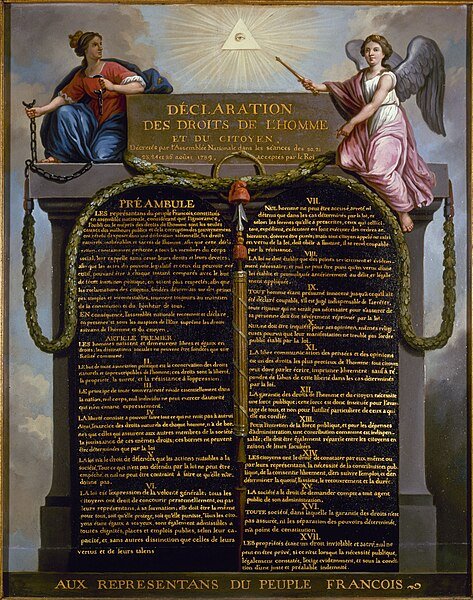
The Declaration of the Rights of Man and of the Citizen, portrayed by Jean-Jacques-François Le Barbier.
The Declaration of the Rights of Man and of the Citizen was adopted by France’s National Constituent Assembly during the French Revolution in August 1789. This landmark document articulated the principles of human and civil rights and reflected the revolutionary ideals of liberty, equality, and fraternity. Inspired by Enlightenment thought and the U.S. Declaration of Independence, the Declaration aimed to establish universal rights for individuals, emphasizing equality before the law and freedom from oppression.
Historical Context
The Declaration emerged amidst the turmoil of the French Revolution, a period marked by challenges to monarchy and aristocratic privilege. Drafting the Declaration began with Marquis de Lafayette, who sought input from his American ally, Thomas Jefferson. However, the final draft was heavily shaped by Abbé Sieyès and other prominent figures of the National Assembly. The document was conceived as a preamble to the forthcoming French Constitution and was adopted on August 26, 1789.
The Revolution’s primary aim was to dismantle feudal systems and create a society grounded in meritocracy, fairness, and shared sovereignty. The Declaration reflected these goals by abolishing hereditary privileges and codifying principles of individual freedom and collective rights.
Philosophical Foundations
The Enlightenment provided the intellectual framework for the Declaration. Philosophers such as Jean-Jacques Rousseau, Montesquieu, and John Locke influenced its key principles:
- Natural Rights: Drawing from Locke’s philosophy, the Declaration asserted that individuals possess inherent and inalienable rights, such as liberty, property, and security.
- The Social Contract: Rousseau’s theory of governance inspired the emphasis on popular sovereignty, whereby legitimate authority derives from the will of the people.
- Separation of Powers: Montesquieu’s ideas underpinned the call for checks and balances in governance, ensuring fairness and preventing tyranny.
Core Principles
The Declaration’s central tenets revolved around universal equality, liberty, and justice:
- Equality Before the Law: All citizens, regardless of birth or status, were declared equal in the eyes of the law. This principle aimed to abolish the privileges of the nobility and clergy.
- Individual Liberty: Freedom of speech, religion, and expression were upheld as fundamental rights, provided they did not harm others.
- Popular Sovereignty: Authority was to emanate from the nation rather than a monarch, reflecting a shift from divine-right rule to democratic governance.
- Rights to Property: Private property was deemed sacred and inviolable, with restrictions permissible only in cases of public necessity and with fair compensation.
- Resistance to Oppression: Citizens were granted the right to resist and oppose tyranny.
The Declaration’s Articles
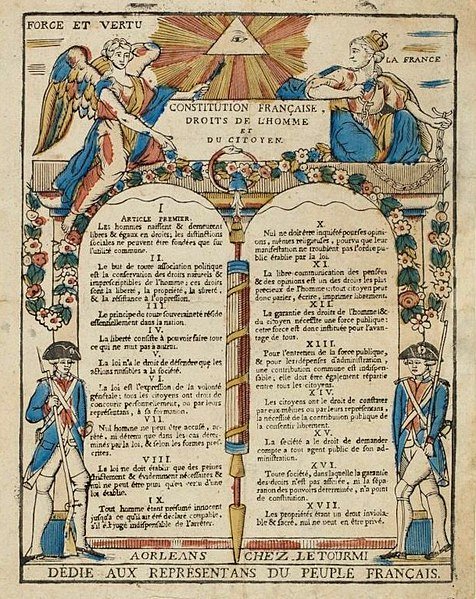
The Declaration comprises 17 articles that outline its principles:
- Article I: Proclaims that all men are born free and remain equal in rights, with social distinctions permissible only if they serve the common good.
- Article II: Defines natural rights as liberty, property, security, and resistance to oppression.
- Article VI: Establishes the principle of legal equality and asserts that all citizens can access public office based on merit.
- Article XI: Protects freedom of expression, enabling individuals to communicate thoughts and opinions without fear of reprisal.
- Article XVI: Declares that any society lacking guarantees of rights or separation of powers lacks a proper constitution.
The provisions of the declaration sought to create a framework for justice and fairness while laying the groundwork for democratic institutions.
Implementation and Challenges
While revolutionary in scope, the Declaration was not without limitations. Political rights were initially granted only to active citizens, defined as male property owners above the age of 25. Women, enslaved people, and the poor were excluded, reflecting the socio-political constraints of the time.
This exclusion provoked significant criticism, particularly from women like Olympe de Gouges, who authored the Declaration of the Rights of Woman and of the Female Citizen in 1791, demanding gender equality. Similarly, the Declaration’s principles inspired enslaved populations in French colonies, particularly during the Haitian Revolution, though slavery persisted in French territories until 1848.
Legacy and Influence
The Declaration of 1789 profoundly impacted France’s constitutional evolution and global human rights development.
The Declaration became a preamble to successive French constitutions, including those of the Fourth Republic (1946) and Fifth Republic (1958), and remains a cornerstone of French constitutional law.
The Declaration inspired other nations and movements advocating for human rights. Its emphasis on equality and liberty resonated in the abolitionist movement, feminist struggles, and the broader fight for universal suffrage.
While the U.S. Declaration of Independence (1776) influenced the French document, the latter’s focus extended beyond independence to address broader societal equality and democratic governance.
Limitations and Controversies
Although the Declaration embodied universal ideals, its practical application revealed inconsistencies:
- Gender Exclusion: Women were explicitly excluded from political rights, despite their significant contributions to revolutionary movements.
- Class and Property Restrictions: The distinction between active and passive citizens limited participation to wealthy male property owners, leaving large segments of society disenfranchised.
- Colonial Implications: The Declaration’s failure to abolish slavery at its inception highlighted contradictions between its principles and colonial realities.
Connection to Revolutionary Ideals
The Declaration was central to the Revolution’s broader agenda of dismantling feudalism and constructing a more equitable society. It sought to redefine the relationship between the individual and the state, emphasizing that governments exist to protect citizens’ rights. By challenging the hierarchical structures of the ancien régime, the Declaration symbolized the transition toward modern democratic governance.
Frequently Asked Questions
What inspired the Declaration?
It was heavily influenced by Enlightenment ideals, including Rousseau’s social contract, Montesquieu’s separation of powers, and natural rights doctrines, as well as the American Declaration of Independence.
Who were its key contributors?
The principal drafts were prepared by Marquis de Lafayette with input from Thomas Jefferson, while Abbé Sieyès played a significant role in the final draft.
What are its central principles?
The Declaration emphasizes natural rights like liberty, property, security, and resistance to oppression, equality before the law, freedom of speech and press, and the abolishment of feudal privileges.
What role did the Declaration play in French constitutional law?
It served as the preamble to the French Constitution of 1791 and remains integral to France’s modern constitutional framework, influencing the Fourth and Fifth Republics.
How did it address citizenship?
The Declaration initially distinguished between “active citizens” (male property owners with political rights) and “passive citizens” (those excluded, such as women and the poor), sparking debates about inclusivity.
What was its impact on global movements?
The Declaration inspired democratic movements worldwide, influencing the Haitian Revolution, abolitionist efforts, and later declarations of human rights.
How did it address women and slavery?
The Declaration excluded women from its rights, prompting works like Olympe de Gouges’ Declaration of the Rights of Woman. It also failed to abolish slavery, though its principles inspired anti-slavery movements.





