
Edvard Grieg (1843–1907)
Edvard Hagerup Grieg (1843–1907) stands as one of the most prominent composers of the Romantic era. A Norwegian composer and pianist, he became renowned for blending the elements of Norwegian folk music with classical traditions, bringing national pride and recognition to his homeland. Much like Jean Sibelius in Finland and Bedřich Smetana in Bohemia, Grieg’s works captured the essence of his country’s cultural identity and elevated Norwegian music onto the global stage.
Early Life and Family Background
Grieg was born in Bergen, Norway, on June 15, 1843, during the period of the Sweden–Norway union. His family was steeped in culture and business. His father, Alexander Grieg, was a merchant and British Vice-Consul, while his mother, Gesine Judithe Hagerup, was a skilled music teacher. It was Gesine who introduced Edvard to the piano at the age of six, fostering his early musical talents.
The Grieg family traced its origins to Scotland, specifically the Clan Gregor. Edvard’s great-grandfather, Alexander Greig, had emigrated to Norway around 1770 after the Battle of Culloden. This heritage connected Grieg to a legacy of resilience and creativity, which would later permeate his music.
Education and Formative Years
In 1858, at the age of 15, Grieg’s talent caught the attention of violinist Ole Bull, a family friend. Bull encouraged Grieg’s parents to send him to the Leipzig Conservatory in Germany. Grieg enrolled, focusing on piano studies under Ignaz Moscheles and delving into theory and composition. While he appreciated the exposure to music and concerts, Grieg found the conservatory’s rigid structure stifling. He later remarked that he left the institution with his individuality largely unexplored.
During his time in Leipzig, Grieg faced significant health challenges. Pleurisy and tuberculosis permanently damaged one of his lungs and weakened his overall health, leading to lifelong respiratory issues. Despite these struggles, he completed his education in 1862 and began his career as a performer and composer.
Career Beginnings and Key Influences
Grieg made his debut as a concert pianist in Sweden in 1861. After completing his studies, he returned to Norway and gave his first hometown concert in Bergen. Seeking broader horizons, Grieg moved to Copenhagen in 1863, where he connected with Danish composers such as Niels Gade and J.P.E. Hartmann. It was here that Grieg met Rikard Nordraak, composer of the Norwegian national anthem, whose passion for Norwegian folk music profoundly influenced Grieg’s artistic direction.
Nordraak’s untimely death in 1866 deeply affected Grieg, inspiring him to compose a funeral march in his memory. Around this time, Grieg married his first cousin, Nina Hagerup, a soprano who became his muse and frequent collaborator. The couple experienced both joy and sorrow, as their only child, Alexandra, died in infancy in 1869.
Breakthrough Works
Grieg’s Piano Concerto in A Minor, composed in 1868, marked a turning point in his career. Written during a vacation in Denmark, the concerto premiered in Copenhagen in 1869 to great acclaim. Its lyrical melodies and rhythmic vitality, infused with Norwegian folk influences, quickly made it one of the most beloved works in the Romantic repertoire. Franz Liszt, who admired Grieg’s talent, played the concerto during their meeting in Rome in 1870, offering constructive feedback.
Another significant collaboration was with playwright Henrik Ibsen. Grieg composed incidental music for Ibsen’s play Peer Gynt in 1875. The resulting suites, including “Morning Mood” and “In the Hall of the Mountain King,” became iconic, encapsulating both the natural beauty and mythical character of Norway.

Mid-Career Achievements and Influence
Grieg’s works gained international recognition during the 1870s and 1880s. His collaborations with poets like Bjørnstjerne Bjørnson resulted in vocal compositions that celebrated Norwegian folklore and identity. Despite occasional disagreements—such as abandoning plans for an opera based on King Olav Trygvason—Grieg maintained a productive relationship with Bjørnson.
Grieg’s affinity for orchestral and chamber music was evident in works like his Holberg Suite and violin sonatas. His lyrical and introspective piano pieces, including the Lyric Pieces collections, showcased his ability to convey deep emotion through simple yet evocative melodies.
International Recognition and Honors
Throughout his career, Grieg formed connections with influential figures in the musical world. He met Pyotr Ilyich Tchaikovsky in 1888 and was deeply impressed by the Russian composer’s artistry. Grieg also performed for Queen Victoria at Windsor Castle in 1897, solidifying his reputation as a cultural ambassador for Norway.
Grieg received honorary doctorates from the University of Cambridge in 1894 and the University of Oxford in 1906. These accolades reflected his standing as a composer of international renown.
Later Years and Legacy
In his later years, Grieg’s health declined, but his passion for music remained undiminished. The Norwegian government awarded him a pension, allowing him to focus on his compositions. Grieg also embraced emerging recording technologies, creating piano rolls and gramophone recordings that preserved his performances for future generations.
In 1906, Grieg met Australian pianist Percy Grainger, whose interpretations of Grieg’s works impressed him. Grieg described Grainger as a genius who understood the essence of his music.
Grieg passed away on September 4, 1907, in Bergen due to heart failure. His funeral attracted tens of thousands of mourners, a testament to his impact on Norwegian culture. His ashes, along with those of his wife, were interred in a mountain crypt near his home, Troldhaugen.
Musical Style and Contributions
Grieg’s music is characterized by its lyrical quality, nationalistic elements, and incorporation of folk traditions. He masterfully blended the simplicity of Norwegian folk tunes with the sophistication of Romantic harmony and form. His piano works, such as Wedding Day at Troldhaugen and Butterfly, exemplify his gift for capturing fleeting emotions in music.
Edvard Grieg’s work remains a cornerstone of classical music, celebrated for its originality, emotional depth, and timeless appeal.
Grieg’s chamber music, including his violin sonatas and cello sonata, further demonstrated his ability to balance technical demands with expressive depth. His incidental music for Peer Gynt remains some of the most recognizable classical music, often performed as standalone orchestral suites.
Selected Works
Grieg’s oeuvre includes a wide range of compositions:
- Piano Concerto in A Minor, Op. 16
- Peer Gynt Suites Nos. 1 and 2, Op. 46 and Op. 55
- Holberg Suite, Op. 40
- Lyric Pieces (66 short piano works in ten books)
- Violin Sonatas Nos. 1-3
- Cello Sonata in A Minor, Op. 36
- Norwegian Dances, Op. 35
- Ballade in G Minor, Op. 24
These works reflect Grieg’s ability to capture the spirit of Norway while appealing to universal emotions.
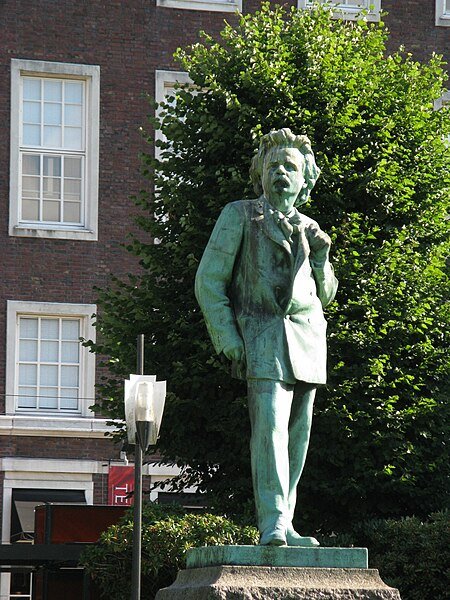
A statue of Grieg, created by Norwegian sculptor Ingebrigt Vik, located in Bergen.
Legacy and Cultural Impact
Edvard Grieg’s influence extended beyond his lifetime. His music inspired composers like Rachmaninoff and Debussy, and his integration of folk elements paved the way for later nationalist movements in music. The Edvard Grieg Museum at Troldhaugen, his former home, stands as a testament to his enduring legacy.
In addition to his musical contributions, Grieg’s advocacy for human rights and progressive ideals, as demonstrated by his protest against the Dreyfus Affair, highlights his commitment to ethical principles.
Statues of Grieg can be found in cities like Bergen and Seattle, and landmarks such as Grieg Hall and the Grieg Academy honor his memory. Even a crater on Mercury bears his name, signifying his far-reaching impact.

Frequently Asked Questions
What are Grieg’s most famous compositions?
His most notable works include the Piano Concerto in A minor, the Peer Gynt Suites (e.g., “In the Hall of the Mountain King” and “Morning Mood”), and the Holberg Suite.
What role did Norwegian folk music play in Grieg’s compositions?
Grieg integrated Norwegian folk melodies and rhythms into his music, which helped bring international recognition to Norwegian culture.
What was Grieg’s relationship with Henrik Ibsen?
Grieg composed incidental music for Ibsen’s play Peer Gynt, which includes some of his most iconic pieces, though he initially had mixed feelings about certain sections of the music.
What was Grieg’s early musical education?
Grieg studied at the Leipzig Conservatory, where he focused on piano. Though he disliked the rigid discipline, he gained valuable experience from concerts and recitals.
How did Grieg’s health affect his life and career?
Grieg suffered from lung and spinal issues, leading to recurring respiratory infections. Despite his health struggles, he remained an active composer and performer.
What international recognition did Grieg receive?
Grieg was awarded honorary doctorates from Cambridge and Oxford, and he performed for Queen Victoria at Windsor Castle.





