
Gillot Saint-Evre’s 1837 depiction of the signing of the Peace Treaty of Vervins.
The Peace of Vervins, signed on May 2, 1598, was a landmark treaty that brought an end to hostilities between France and Spain. Brokered with the assistance of papal legates under Clement VIII, the treaty signaled a new chapter in European politics and marked the waning influence of Habsburg Spain. Signed in the small town of Vervins in northern France, this treaty symbolized not only a diplomatic resolution but also a larger realignment of power in Europe.
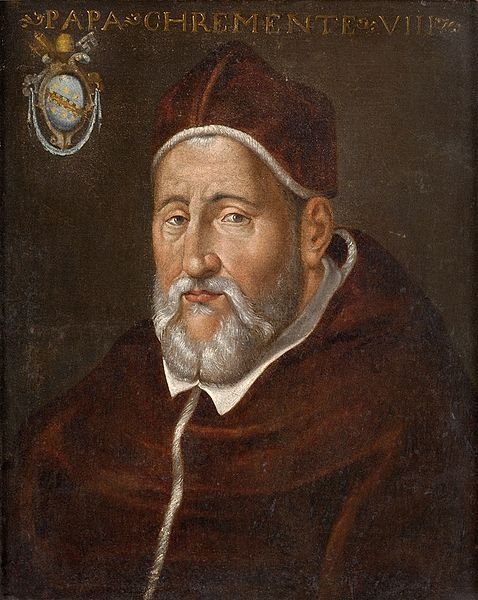
Clement VIII
Background: The Road to Peace
The context of the Peace of Vervins lies within the French Wars of Religion (1562–1598), a series of violent conflicts primarily between Catholics and Huguenots (French Protestants). During this time, Spain, under Philip II, provided significant support to the Catholic League, seeking to uphold Catholic dominance in France. However, this intervention deepened the conflict, escalating the war into a broader European struggle.
In 1589, Henry of Navarre, a Protestant, became Henry IV of France. His claim to the throne was contested by the Catholic League, which sought to block his rule. To stabilize his kingdom and assert his authority, Henry converted to Catholicism in 1593, famously stating, “Paris is worth a Mass.” Despite this, Spain continued to back his opponents.
Henry formally declared war on Spain in 1595, leading to a series of military confrontations. His decisive victory at the Siege of Amiens in 1597 marked a turning point, showcasing his military acumen and weakening Spain’s position in France.
On April 13, 1598, shortly before the treaty, Henry IV issued the Edict of Nantes, granting religious tolerance to Protestants and ending the domestic conflict of the Wars of Religion. By addressing internal divisions, Henry positioned France as a more unified and stable kingdom, ready to negotiate peace with Spain.
The Treaty of Vervins: Key Provisions and Negotiations
The treaty negotiations took place in Châteauneuf de Vervins, a château owned by Guillemette de Coucy, co-seigneur of Vervins. Situated in the war-torn Thiérache region near the Spanish Netherlands, the town bore scars of the recent fighting. The involvement of Clement VIII’s papal legates, particularly Alessandro de’ Medici, was instrumental. Medici, later Pope Leo XI, played a pivotal role as the “architect of the treaty,” ensuring that the terms aligned with Catholic interests while fostering peace.
Core Terms of the Treaty
The Peace of Vervins involved significant concessions and commitments by both parties:
Recognition of Henry IV as King of France
Spain formally acknowledged Henry IV’s legitimacy, ending its support for the Catholic League. This recognition solidified Henry’s authority and effectively dismantled the remnants of opposition within France.
Territorial Adjustments
Key territories, including the strategic port city of Calais and the coastal fortress of Risban, were returned to France. These had been captured by Spanish forces in 1596 and were vital for controlling access to the English Channel.
Spanish Withdrawal
Philip II agreed to withdraw all Spanish forces from French soil, marking the end of direct Spanish intervention in French affairs.
Broader Implications
The treaty was not only a bilateral agreement but also a reflection of shifting dynamics in European power. Spain’s recognition of Henry IV signaled a pragmatic departure from its ultra-Catholic stance, prioritizing diplomatic stability over prolonged conflict.
Aftermath and Legacy
The Peace of Vervins brought relative stability to France and Spain, but it also highlighted the differing trajectories of the two kingdoms. Henry IV used the treaty as a foundation to rebuild France, focusing on economic recovery and political centralization. In contrast, Spain’s withdrawal and the loss of key territories underscored its declining influence.
Philip II died on September 13, 1598, shortly after the treaty was signed. His successor, Philip III, honored the terms of the agreement, ensuring continued peace between the two kingdoms. This marked a shift in Spanish policy, as Philip III’s reign was characterized by a less aggressive approach to European conflicts.
By recognizing Henry IV as the legitimate king of France and restoring key territories, the Peace of Vervins facilitated the stabilization of France and marked the decline of Spain’s dominance.
In the years following the Peace of Vervins, Henry IV continued to consolidate power. One notable outcome was his victory over Carlo Emanuele I, Duke of Savoy, who had initially refrained from participating in the treaty. The subsequent Treaty of Lyon in 1601 further strengthened France’s territorial integrity, marking another diplomatic success for Henry IV.
Historians view the Peace of Vervins as a pivotal moment in the decline of Habsburg Spain. Philip II’s policy of championing ultra-Catholicism, while initially effective, became increasingly unsustainable. The treaty symbolized the limits of Spain’s imperial ambitions and foreshadowed its gradual loss of hegemony in Europe.
Conversely, the treaty marked the beginning of France’s ascent as a dominant power. Under Henry IV and subsequent rulers, France entered the Grand Siècle (Great Century), a period of cultural, economic, and political flourishing. The Peace of Vervins laid the groundwork for this resurgence by providing a stable foundation for domestic and international policies.
Cultural and Regional Impact
The treaty left a lasting imprint on the Thiérache region, which had endured significant damage during the conflict. The fortified churches of the area, built in the 16th century, stand as enduring reminders of the tumultuous period. These structures, designed to withstand sieges, reflect the region’s strategic importance and the hardships faced by its inhabitants.
The significance of the Peace of Vervins extends beyond its immediate context, serving as a precursor to the broader shifts in power and diplomacy that would define 17th-century Europe.
The Peace of Vervins, coupled with the Edict of Nantes, fostered a new era of religious coexistence in France. While tensions between Catholics and Protestants persisted, the treaty demonstrated the possibility of resolving conflicts through diplomacy rather than warfare.
Historical Significance
The Peace of Vervins represents more than a cessation of hostilities; it is a case study in the interplay of religion, politics, and diplomacy during the late 16th century. It underscores the following themes:
The treaty highlighted the complex relationship between religious ideology and political pragmatism. While Spain initially supported the Catholic League out of religious conviction, the Peace of Vervins demonstrated a shift toward prioritizing state interests.
Through the Peace of Vervins, Europe inched closer to an era where pragmatism and statecraft began to outweigh the destructive forces of religious fervor.
The treaty contributed to the gradual decline of religion-driven conflicts in Europe. It marked the beginning of a transition toward the Westphalian system, which emphasized the sovereignty of states over religious unity.
The treaty reflected the changing balance of power in Europe. While Spain remained a formidable empire, its influence began to wane, making room for France to emerge as a key player on the continental stage.
The involvement of Clement VIII’s legates illustrated the Vatican’s continued influence in European diplomacy. However, it also showcased the diminishing ability of the papacy to enforce religious unity across Christendom.
Frequently Asked Questions
What was the context of the Peace of Vervins?
Henry IV declared war on Spain in 1595 and secured victory at the Siege of Amiens in 1597. Shortly before the treaty, he issued the Edict of Nantes, ending the French Wars of Religion and associated conflicts.
Where was the treaty signed, and why was it significant?
The treaty was signed in Vervins, a town in Picardy near the Spanish Netherlands. The Thiérache region, heavily damaged by recent fighting, symbolized the need for peace.
Who mediated the treaty?
The treaty was mediated by Alessandro de’ Medici, papal legate of Clement VIII, recognized as its key architect.
What were the key terms of the treaty?
Philip II recognized Henry IV as the legitimate King of France, withdrew Spanish forces, and returned Calais and the fortress of Risban to France. This deprived the Catholic League of crucial support.
What happened after the treaty?
Philip II died later in 1598, but his successor Philip III honored the treaty. Carlo Emanuele of Savoy, initially resistant, was defeated in 1599 and signed the Treaty of Lyon with Henry IV in 1601.
Why is the Peace of Vervins historically significant?
It marked the decline of Habsburg Spain and Philip II’s ultra-Catholic ambitions, paving the way for France’s rise as a dominant European power during the Grand Siècle.
How did the treaty influence European politics?
The treaty signaled a shift in power dynamics, ending Spain’s dominance and strengthening France’s position in the European balance of power





