
The taegeuk symbol, representing the cosmos
Shamanism, one of the oldest spiritual practices in human history, played a foundational role in ancient Korea’s culture, religion, and social structure. Known as “Muism” or sometimes “Korean Shamanism”, it emerged long before the advent of organized religions like Buddhism and Confucianism and remained influential throughout the Korean Peninsula. Shamanism in Korea was not merely a spiritual system but a way of life deeply connected to nature, community, and daily existence.
The Korean term for a shaman is “Mudang” (female) or “Baksu” (male), though female shamans dominated the practice historically and continue to do so in modern times. Central to Korean shamanism is the belief in a spiritual world inhabited by gods, ancestors, and spirits, which influence the lives of individuals and communities. Shamans acted as intermediaries, facilitating communication between the spiritual and human realms.
Origins and Early History
The roots of Korean shamanism date back to prehistoric times, with archaeological evidence suggesting animistic and shamanic practices among early Korean tribes. The Bronze Age (circa 1500–300 BCE) saw the development of rituals centered around nature worship, fertility, and ancestor veneration. These practices were likely influenced by broader shamanic traditions across Central Asia and Siberia, as early Koreans shared cultural and migratory ties with these regions.
Three Kingdoms Period (57 BCE–668 CE)
During the Three Kingdoms Period (Goguryeo, Baekje, and Silla), shamanism coexisted with emerging state religions like Buddhism and Confucianism. Despite the introduction of Buddhism as a state-sponsored religion, shamanic practices retained their importance, especially among the common people. Each kingdom had its distinct pantheon of deities and spirits, with shamans playing vital roles in court rituals, military affairs, and agricultural ceremonies.
- Goguryeo: Shamanic rites were often tied to the worship of celestial gods, mountain spirits, and guardian deities. Historical records describe the performance of elaborate rituals to ensure military victories or good harvests.
- Baekje: Shamanism in Baekje emphasized ancestor worship and nature-based rituals. The integration of shamanic traditions with Buddhism was particularly evident in Baekje, where Buddhist temples often hosted ceremonies influenced by shamanic elements.
- Silla: In Silla, shamans were closely associated with the ruling elite and played key roles in state rituals. The Hwarang, an elite warrior group, is thought to have drawn inspiration from shamanic ideals of spirituality, bravery, and connection to nature.
Unified Silla and Goryeo Periods (668–1392)
With the unification of the Korean Peninsula under the Unified Silla (668–935) and later the Goryeo Dynasty (918–1392), shamanism underwent significant transformations. While Buddhism became dominant, shamanic traditions continued to thrive, especially among rural communities. During the Goryeo period, the Sansin (Mountain Spirit) cult and Dragon King worship gained prominence, reflecting a blend of shamanic, Buddhist, and Taoist influences.
State-sponsored rituals often included shamanic practices, particularly in times of crisis, such as droughts, famines, or military invasions. The continued reliance on shamans for divination, healing, and spiritual guidance highlighted their indispensable role in Korean society.
Joseon Dynasty (1392–1897)
The rise of the Joseon Dynasty brought about a Confucian state ideology that sought to suppress shamanism as part of its effort to establish social order and rational governance. Confucian scholars criticized shamanism as superstition, leading to periodic crackdowns on shamans and their practices.
Despite official disapproval, shamanism persisted, especially among the lower classes. Female shamans, in particular, became central figures in maintaining the tradition. The gut (ritual) ceremonies, which involved music, dance, and offerings, remained a vital part of community life, addressing issues such as sickness, misfortune, and spiritual imbalance.
Core Beliefs and Practices
The Spiritual World
Korean shamanism is based on the belief in a dynamic spiritual world that interacts with the human realm. This world includes:
- Deities and Spirits: Nature spirits (e.g., mountain, river, and tree spirits), household gods, and village guardians play key roles in everyday life. The most prominent nature deity is the Sansin, or Mountain Spirit.
- Ancestral Spirits: Ancestors are revered as protectors and guides. Regular rituals are performed to honor and appease them.
- Ghosts and Malevolent Spirits: These entities are believed to cause misfortune or illness if not properly addressed.
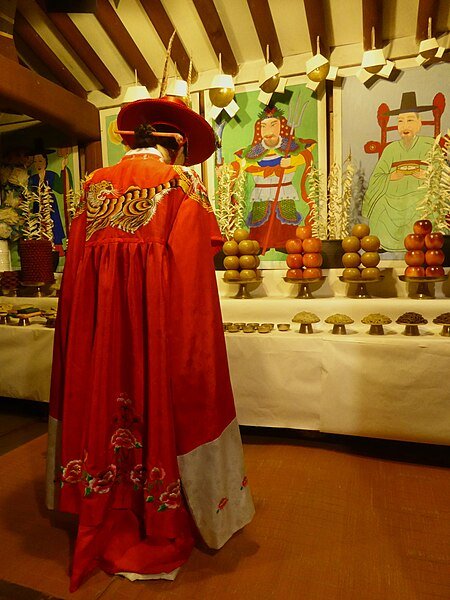
A mudang worshiping at a shrine, located at the Lotte World Folk Museum in Seoul.
Role of the Shaman
Shamans serve as spiritual intermediaries, healers, and guides. Their primary functions include:
- Divination (Kutgi): Shamans use rituals to gain insights into the future, diagnose spiritual causes of illness, or provide guidance on important decisions.
- Healing (Byeong-sin): Spiritual illnesses, believed to be caused by displeased spirits or broken connections to the spiritual world, are treated through ceremonies.
- Exorcism (Geun-sin): Shamans expel harmful spirits from people or places.
- Rituals (Gut): The gut is the most significant aspect of shamanic practice. These ceremonies involve offerings, music, dance, and invocations to appease spirits, seek blessings, or restore harmony.
Types of Rituals
- Naerim-gut: An initiation ritual for new shamans.
- Jesa: Ancestral worship ceremonies.
- Dodang-gut: Village-wide rituals for communal well-being.
- Gosa: Rituals performed for prosperity and success in endeavors like starting a business or moving into a new home.
Cultural Significance
Korean shamanism reflects a profound respect for nature and its forces. Mountains, rivers, trees, and rocks are considered sacred, embodying the spirits of the land. This worldview fostered a harmonious relationship between ancient Koreans and their environment, influencing agricultural practices and seasonal festivals.
Shamans practiced wherever needed and had no dedicated temples, although some mountain shrines existed for deities like Sanshin, the Mountain God.
Shamanism served as a repository for Korea’s oral traditions, folk songs, and dances. The rituals often incorporated traditional music (sinawi) and storytelling, preserving cultural heritage across generations.
Shamanic rituals functioned as communal events that strengthened social bonds. By addressing collective concerns, such as harvests or epidemics, shamans played a unifying role in village life.
Challenges and Adaptations
Under Confucian rule and later during Japanese colonial rule (1910–1945), shamanism faced significant repression. Modernization and the spread of Christianity in the 20th century further marginalized shamanic practices, labeling them as backward or superstitious.
Despite these challenges, Korean shamanism has experienced a resurgence in recent decades. The designation of certain rituals as Intangible Cultural Heritage by the Korean government and UNESCO has helped preserve and promote the tradition. Contemporary shamans often adapt their practices to address modern concerns, blending traditional rituals with new cultural contexts.
Legacy of Shamanism in Korea
The influence of shamanism on Korean culture remains evident in various aspects:
Shamanic themes and symbols appear in traditional Korean art, literature, and modern media.
Shamanic healing practices have contributed to the development of traditional Korean medicine, emphasizing the balance of mind, body, and spirit.
Seasonal festivals like Dano and Chuseok retain elements of shamanic tradition, reflecting a deep connection to ancestral and nature worship.
Shamanism continues to offer spiritual guidance to individuals seeking solace, healing, or connection to their heritage.
Frequently asked questions
How does shamanism differ from formal religions?
Shamanism is not a formal religion; it lacks a hierarchical priesthood, sacred texts, and dogma. Shamans derived their authority from the belief of their followers rather than institutional frameworks.
What role did shamanism play in Korean culture?
Shamanism remained significant to the peasant population and influenced Korean art, architecture, literature, and music, even during periods when Buddhism was the state religion.
What beliefs and practices characterize Korean shamanism?
Korean shamanism, known as misin or “superstition,” posits the existence of a spirit world inhabited by good and bad entities. It incorporates animism, attributing spirits to natural features, and geomancy, emphasizing the spiritual importance of locations. Shamans reached altered states of consciousness through chanting, dancing, and drumming to communicate with spirits.
What was the role of shamans in rituals?
Shamans were believed to interact with spirits, enter the spirit world, or allow spirits to temporarily possess their bodies during kut rituals. They were also credited with healing powers and promoting fertility and longevity.
Who were the practitioners of shamanism, and how did they become shamans?
Female shamans, or mudang, were more common than their male counterparts, paksu or pansu. Becoming a shaman required no formal training; many began their practice after a spiritual experience, often during illness. Daughters of mudang frequently followed in their mothers’ footsteps.
What was the role of shamans in addressing ancestral spirits?
Shamans were often employed to communicate with chosang, or ancestral spirits, blamed for misfortunes. They sought to placate these spirits and resolve issues affecting the living.
What evidence suggests shamans held influence in ancient Korean society?
Shamans may have served as community leaders, with early Silla kings referred to as chachaung, meaning “shaman.” Royal crowns from the 5th-6th century CE featured shamanistic tree-like designs, similar to Siberian tribal motifs.
How did shamanism coexist with other religions?
As Confucianism and Buddhism grew during the Goryeo dynasty, shamanism’s influence on state affairs declined. By the Joseon dynasty, Neo-Confucian principles led to restrictions on shamanic practices, including mandatory registration and supervision. Despite this, shamanism blended with ancestor worship, Taoism, Buddhism, and Confucianism, maintaining influence among rural populations.
What themes and subjects appear in shamanistic art?
Shamanistic art often depicted kut rituals, featuring bold imagery on silk, paper, or cotton. Common subjects included Sanshin, the Mountain God, and Yongwang, the Dragon King. Mixed-style paintings often incorporated Buddhist figures alongside shamanistic spirits.
What other forms of art reflect shamanistic influence?
Other art forms include pujok—temporary drawings of animals to ward off spirits—and bronze rattles used in rituals. Shamanistic motifs also influenced Buddhist architecture, such as pagodas and large Buddha statues wearing tall, hat-like headgear. These elements highlight the lasting cultural significance of shamanism in Korea.





