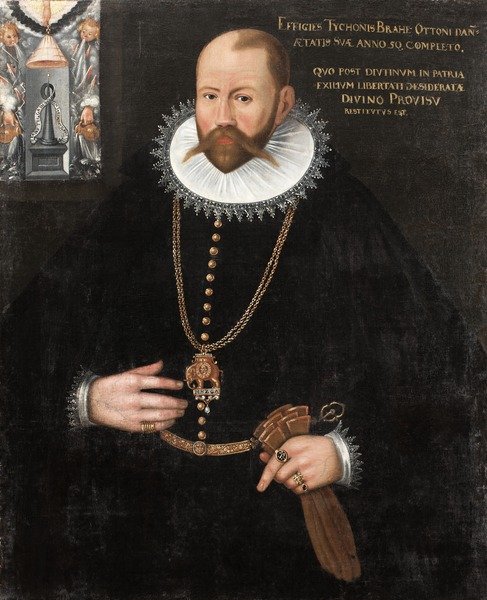
Tycho Brahe
Tycho Brahe (1546–1601) was a Danish astronomer, astrologer, and alchemist of the Renaissance era, known for his groundbreaking astronomical observations. Considered the greatest pre-telescopic astronomer, he bridged the gap between medieval observational astronomy and the early modern scientific revolution. His meticulous work in measuring celestial positions led to significant advancements in understanding planetary motion, directly influencing the work of Johannes Kepler.
Early Life and Education
Tycho Brahe was born on December 14, 1546, into a noble Danish family. He was the heir to the Brahe and Bille families, both of which had a history of serving in the Danish monarchy’s Privy Council. As a child, he was taken in by his wealthy uncle, Jørgen Brahe, who provided him with an extensive education. At the age of 12, he began studying at the University of Copenhagen, where he was initially expected to pursue law, but he became fascinated with astronomy after witnessing a solar eclipse in 1560.
Early Astronomical Interests
In 1563, Tycho made one of his first important observations, noting discrepancies in the predictions of planetary conjunctions according to both the Ptolemaic and Copernican models. This realization led him to dedicate himself to refining astronomical observations. He traveled to several European universities, furthering his studies in astronomy, mathematics, and medicine.
The Duel and the Prosthetic Nose
In 1566, a quarrel with a fellow nobleman, Manderup Parsberg, led to a sword duel in which Tycho lost part of his nose. He wore a prosthetic nose made of brass for everyday use, though he reportedly had a silver and gold nose for special occasions. This incident became one of the more colorful anecdotes in his biography.
Observational Achievements
The Supernova of 1572
In 1572, Tycho observed a bright new star in the constellation Cassiopeia, now known as SN 1572. His publication De nova stella (1573) argued against the Aristotelian belief in an unchanging celestial sphere. His precise measurements proved that the new star lay beyond the Moon, challenging long-held astronomical assumptions.
Establishing Uraniborg and Stjerneborg
Recognizing the need for better instruments, Tycho was granted the island of Hven by King Frederick II of Denmark, where he built Uraniborg, the first research institution of its kind. The observatory housed advanced instruments and an alchemical laboratory. Later, he built a second, more stable underground observatory, Stjerneborg, to enhance measurement accuracy.
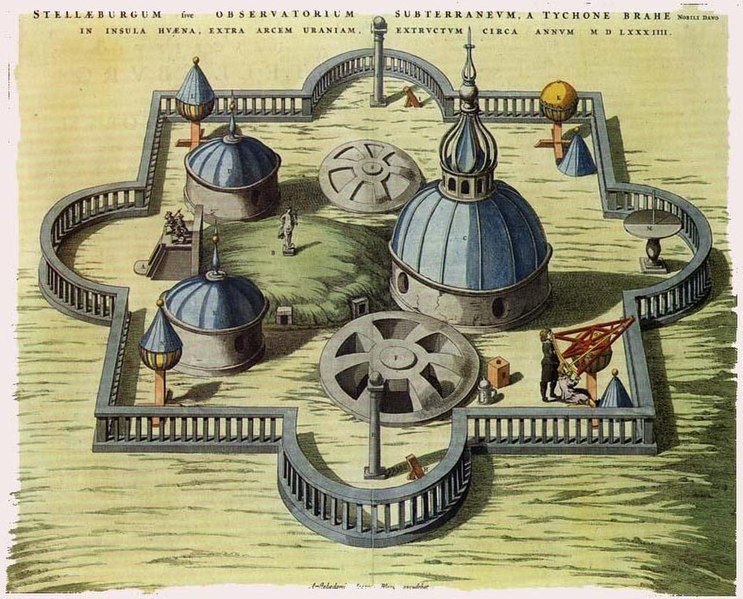
An engraving depicting the above-ground structures of Tycho Brahe’s underground observatory, Stjerneborg.
The Tychonic System
Tycho developed his own cosmological model, the Tychonic system, as a compromise between the Ptolemaic and Copernican models. He proposed that the Sun orbited Earth, while the other planets orbited the Sun. Although incorrect, his model held sway among astronomers for several decades due to its alignment with prevailing physical theories.
Observations of Comets
In 1577, Tycho observed a comet, demonstrating through precise measurements that it moved through space beyond the Moon, contradicting the Aristotelian idea of celestial spheres. This finding further destabilized the geocentric worldview.
Exile and Work in Prague
Following the death of King Frederick II in 1588, Tycho lost royal favor under the new ruler, Christian IV. In 1597, he left Denmark and eventually settled in Prague under the patronage of Emperor Rudolf II. He built a new observatory at Benátky nad Jizerou, where he continued his astronomical work. During this time, he collaborated with Johannes Kepler, who later used Tycho’s extensive observational data to formulate his three laws of planetary motion.
Contributions to Astronomy
Tycho revolutionized observational astronomy by designing more precise instruments, such as large quadrants and sextants. His observations of planetary positions reached an accuracy of within one arcminute, far surpassing earlier measurements.
Tycho’s observations laid the foundation for The Rudolphine Tables, later completed by Kepler, which provided highly accurate planetary positions. These tables proved instrumental in the eventual acceptance of Kepler’s laws and the heliocentric model.
Tycho Brahe’s work exemplifies the shift from traditional Aristotelian cosmology to a more empirical, science-driven approach, marking him as one of the most influential astronomers of all time.
While Tycho never fully accepted heliocentrism, his data enabled Kepler to develop his laws of planetary motion, which in turn laid the groundwork for Newton’s theory of gravitation.
Personal Life and Legacy
Tycho had a long-term relationship with Kirsten Jørgensdatter, a commoner. Though they were not officially married due to noble restrictions, they had several children together. She accompanied him in exile, demonstrating their deep bond.
Tycho died on October 24, 1601, after suffering from a bladder or kidney ailment. Some 20th-century investigations suggested mercury poisoning, fueling conspiracy theories, but recent forensic examinations have ruled this out. His famous last words, “Let me not seem to have lived in vain,” reflect his enduring commitment to his scientific work.
Despite the rejection of his cosmological model, Tycho remains a central figure in astronomy. His name is honored through the Tycho crater on the Moon, the Tycho Brahe Planetarium in Copenhagen, and various celestial objects named after him. His meticulous observations continue to be recognized as crucial to the scientific revolution.

Timeline of Tycho Brahe’s Life and Achievements
1546 – Born on December 14 at Knutstorp Castle in Denmark. Raised by his uncle, Jørgen Brahe.
1559 – Enrolled at the University of Copenhagen at age 12, originally studying law but became fascinated by astronomy.
1563 – Observed a conjunction of Jupiter and Saturn, realizing existing planetary tables were inaccurate.
1566 – Engaged in a duel over a mathematical dispute and lost part of his nose, wearing a metal prosthetic for the rest of his life.
1572 – Discovered a supernova in the constellation Cassiopeia, challenging the Aristotelian belief in an unchanging celestial realm.
1573 – Published De nova stella, proving the new star was beyond the Moon and changing astronomical thought.
1576 – Granted the island of Hven by King Frederick II, where he built Uraniborg, an advanced observatory.
1577 – Observed a comet and determined it moved beyond the Moon, contradicting the idea of celestial spheres.
1588 – Published Astronomiae Instauratae Progymnasmata, detailing his planetary observations.
1597 – Forced to leave Denmark due to conflicts with King Christian IV, eventually settling in Prague.
1600 – Hired Johannes Kepler as his assistant, who later used Brahe’s data to formulate planetary motion laws.
1601 – Died on October 24 in Prague after a severe bladder illness. His precise astronomical data shaped future discoveries.
Frequently Asked Questions
How did Tycho Brahe challenge Aristotelian cosmology?
He disproved the belief in an unchanging celestial realm by observing a supernova in 1572 and proving that comets traveled through space beyond the Moon, contradicting the idea of solid celestial spheres.
What was the Tychonic system?
The Tychonic system was a hybrid model where the Sun and Moon orbited Earth, while other planets orbited the Sun, serving as a compromise between the geocentric and heliocentric models.
Why did Tycho Brahe leave Denmark?
After King Frederick II’s death, he lost royal favor under Christian IV and was forced into exile, eventually moving to Prague under the patronage of Emperor Rudolf II.
How did Tycho Brahe’s observations influence Johannes Kepler?
Kepler used Tycho’s precise data on planetary motion to develop his three laws of planetary motion, which provided strong support for the heliocentric model.
What was Uraniborg, and why was it significant?
Uraniborg was Tycho’s observatory on the island of Hven, where he conducted systematic astronomical observations and advanced the development of scientific instruments.
How did Tycho Brahe die, and what theories exist about his death?
He died in 1601 from a bladder or kidney ailment, though early investigations suggested mercury poisoning. Modern forensic studies have ruled out foul play.
What is Tycho Brahe’s legacy in modern science?
His emphasis on empirical observation laid the foundation for modern astronomy, and his accurate celestial data significantly contributed to the Scientific Revolution.





