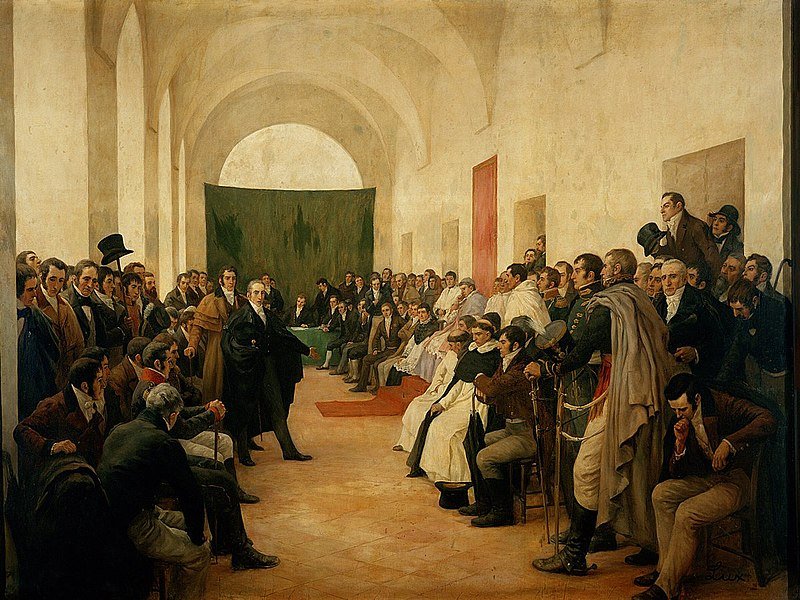
Pedro Subercaseaux’s painting depicts the open cabildo held on May 22, 1810.
The Cabildo Abierto del 22 de Mayo de 1810 is a renowned painting created by Chilean artist Pedro Subercaseaux. This artwork visually captures the Open Cabildo that occurred in Buenos Aires on May 22, 1810, a significant event that contributed to the May Revolution. Subercaseaux’s interpretation aims to portray the intensity and historical importance of this political assembly.
Creation of the Painting
The painting was commissioned in 1908 by Ángel Justiniano Carranza, a historian who sought to commemorate the centennial of the May Revolution of 1810. Subercaseaux, known for his historical artwork, agreed to undertake the task, ensuring that the painting would properly convey the importance of the event. He stated in a letter that the artwork, if executed to satisfaction, would be valued at fifteen thousand pesos in national currency.
Subercaseaux adhered to the principles of European historicism, a style that aimed to authentically depict historical events with accuracy and grandeur. To achieve this, he focused on selecting a moment that best represented the atmosphere of the Open Cabildo. The artist conducted detailed studies of the Buenos Aires Cabildo, analyzing contemporary photographs of its interior. However, since the building had undergone remodeling, its appearance was not entirely faithful to its original colonial form.
Key Figures in the Painting
The scene highlights Juan José Paso, a key political figure, as he takes the floor to address the assembly. His presence is emphasized by his stance and positioning within the composition, making him stand out among the attendees.
Another central figure is Mariano Moreno, who is portrayed with a serious and concerned expression. This detail reflects his deep involvement in the revolutionary cause and his awareness of the political stakes at hand. Subercaseaux’s depiction of these historical figures adds emotional depth to the painting, emphasizing the tension and urgency of the moment.
Lighting and Perspective
The artist utilized lighting techniques to enhance the drama of the scene. By casting light on the central figures and contrasting them with the darker background, Subercaseaux effectively guides the viewer’s focus toward the most crucial elements of the assembly. His use of perspective gives depth to the composition, allowing viewers to feel immersed in the historical event.
Historical Significance of the Event Depicted
The Open Cabildo of May 22, 1810, which the painting represents, was a pivotal moment in Argentina’s history. It was convened to discuss the legitimacy of the Viceroyalty of the Río de la Plata, as Spain was under Napoleonic control, leading to uncertainty about the governance of its American colonies. The debates held during this assembly laid the groundwork for the May Revolution, which ultimately led to Argentina’s independence.
Current Location and Legacy
The Cabildo Abierto del 22 de Mayo de 1810 is currently housed in the National Historical Museum of Argentina. It remains an essential piece of historical art, not only for its artistic value but also for its role in educating future generations about the events that shaped Argentina’s independence movement.
Subercaseaux’s painting serves as a visual testimony of a crucial political turning point, capturing the fervor and gravity of the Open Cabildo.
Frequently Asked Questions about the Cabildo Abierto del 22 de Mayo de 1810
Who commissioned the painting and why?
Ángel Justiniano Carranza commissioned it in 1908 to commemorate the centennial of the May Revolution.
Who created the artwork, and what style did he use?
Chilean artist Pedro Subercaseaux painted it using European historicist techniques to accurately portray the event’s atmosphere.
Which key historical figures are highlighted in the painting?
Juan José Paso is shown addressing the assembly, while Mariano Moreno appears with a serious and concerned expression, reflecting his revolutionary commitment.
What artistic techniques did Subercaseaux use?
He applied dramatic lighting and perspective to focus on key figures and create depth, enhancing the historical intensity of the scene.
Why was the Open Cabildo of May 22, 1810, significant?
It debated the legitimacy of Spanish rule in the region, setting the stage for the May Revolution and Argentina’s eventual independence.
Where is the painting currently displayed?
It is housed in the National Historical Museum of Argentina.





