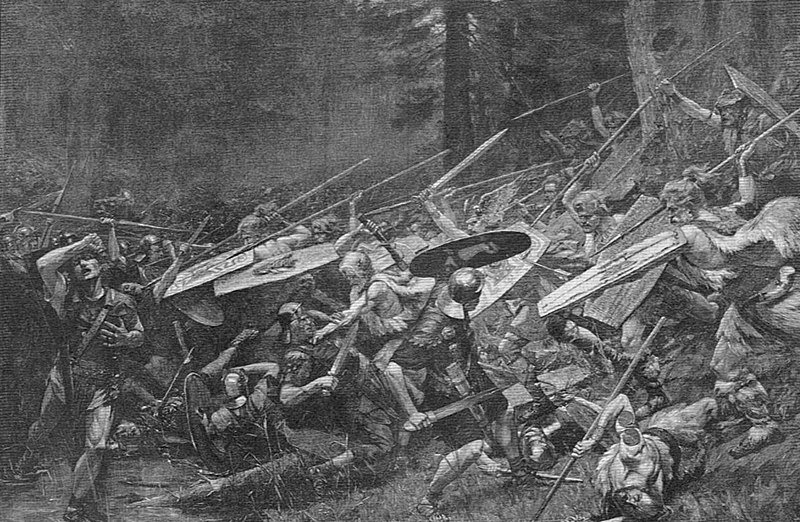
“Furor Teutonicus” – Depiction of the Battle of the Teutoburg Forest by Serbian realist painter Paja Jovanović, 1889.
The Battle of the Teutoburg Forest, fought in September 9 CE, was a pivotal engagement between an alliance of Germanic tribes led by Arminius, a chieftain of the Cherusci, and three Roman legions commanded by Publius Quinctilius Varus. The battle resulted in a catastrophic defeat for Rome, halting its expansion beyond the Rhine River and marking one of the most devastating military losses in Roman history.
Background and Causes of the Battle
By the late 1st century BCE, Rome had steadily expanded its influence beyond the Rhine River, attempting to Romanize the Germanic tribes. Under Emperor Augustus, military campaigns aimed to consolidate Roman control over Germania, turning it into a new province. The Romans established forts, roads, and administrative centers, and Varus, the governor of the region, sought to implement Roman taxation and laws.
The Germanic tribes, however, were fiercely independent and opposed Roman rule. Unlike the Celts, who had assimilated into the Roman system, Germanic tribes maintained a decentralized warrior-based society. Resistance grew, particularly among the Cherusci, a powerful tribe led by Arminius.
Roman dictator and adopted father of Emperor Augustus Julius Caesar first crossed the Rhine River in 55 BCE, initiating Rome’s long military engagement in Germania.
Arminius was a Roman-trained warrior from a noble Germanic family. Having served as an officer in the Roman auxiliaries, he was familiar with Roman military strategies, formations, and tactics. Using his position as a trusted Roman ally, Arminius secretly united several Germanic tribes, including the Cherusci, Chatti, and Bructeri, forming a coalition against Rome.
Arminius tricked Varus into believing that a rebellion had broken out in a remote area of Germania. Varus, confident in his forces and unaware of the deception, marched deep into the Teutoburg Forest, where his legions would be ambushed.
The Battle: The Roman Disaster in the Forest
The March into the Forest
Varus led three legions (Legio XVII, Legio XVIII, and Legio XIX), along with cavalry and auxiliary troops, numbering around 15,000–20,000 soldiers. Some estimates, however, place the number at between 9,500 and 15,000 soldiers.
It’s been stated that the Romans were unprepared for battle, as they were marching in a long, stretched-out column—ideal for travel but vulnerable to ambushes.
The Teutoburg Forest was dense, rugged, and swampy, limiting Roman maneuverability. Arminius and his warriors controlled the terrain, setting up a series of well-coordinated ambush points.
The Ambush Begins
The attack started when the Romans entered a narrow valley, where Germanic warriors launched javelins, spears, and arrows from the surrounding hills. The Romans struggled to form their signature defensive formations, such as the testudo (tortoise formation), due to the thick vegetation.
As panic spread, the Germanic warriors rushed in for close combat, using long spears, axes, and swords. The Romans, burdened by heavy armor and lack of visibility, found themselves unable to counterattack effectively.
A Three-Day Slaughter
For three days, Arminius’s forces harassed and slaughtered the Romans. The weather worsened, as rain turned the ground into mud, making movement even more difficult.
- First Night: Roman casualties were severe, and morale collapsed. Many soldiers deserted, while others attempted to build makeshift defenses.
- Second Day: The Germans launched hit-and-run attacks, exploiting gaps in the Roman lines. The legions were cut off from one another.
- Final Stand: The remnants of the legions attempted to break free, but Arminius’s forces surrounded them, cutting them down. Varus, realizing the battle was lost, committed suicide to avoid capture.
The Battle of Teutoburg Forest demonstrated the importance of strategy, terrain, and deception in warfare, and its consequences lasted for centuries.
Aftermath and Consequences
Roman Casualties and the Psychological Impact
The battle resulted in one of the worst defeats in Roman history:
- All three legions were annihilated; their eagles (sacred military standards) were lost.
- Between 15,000 and 20,000 soldiers were killed or enslaved.
- Only a handful of survivors managed to escape.
Upon hearing the news, Emperor Augustus was devastated. According to historical accounts, he repeatedly shouted:
Varus, give me back my legions!
End of Roman Expansion into Germania
The Battle of Teutoburg permanently halted Roman expansion beyond the Rhine. Rome abandoned plans to colonize Germania and instead focused on defensive strategies:
- Fortifications, like the Limes Germanicus, were built along the Rhine River.
- Future emperor Tiberius and Roman general Germanicus Julius Caesar, launched punitive campaigns, but Germania was never fully conquered.
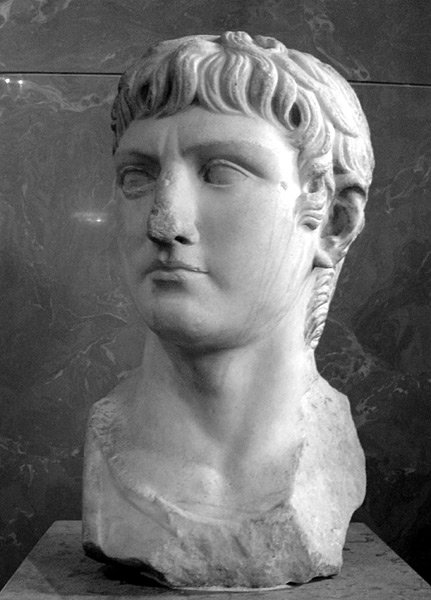
Germanicus
The Rise of Arminius
Arminius became a symbol of German resistance against foreign rule. However, his victory did not lead to long-term Germanic unity. In later years, internal tribal conflicts weakened his influence, and he was assassinated by rival Germanic leaders in 21 CE.
Early Theories on the Battle’s Location
For centuries, historians debated the battle’s precise location. The rediscovery of Tacitus’ Germania and Annales in the 16th century fueled numerous theories. Scholars relied on ancient geographical descriptions, linguistic analysis of place names, and archaeological surveys. Harald Petrikovits classified these theories into four categories:
- Northern Theory – The battle occurred on the northern edges of the Wiehen and Weser Hills.
- Lippe Theory – The battlefield lay between the Teutoburg Forest and the Weser River.
- Münsterland Theory – The site was south of the Teutoburg Forest near Beckum.
- Southern Theory – The battle happened in the hill country southeast of the Westphalian Lowland.
Discovery of the Kalkriese Site
The battle’s location remained uncertain for nearly 2,000 years. In the 19th century, some scholars associated it with Osning, a wooded ridge later renamed Teutoburg Forest. However, the most significant breakthrough occurred in 1987 when British amateur archaeologist Major Tony Clunn discovered Roman coins from Augustus’ reign and lead sling projectiles at Kalkriese Hill in Lower Saxony. These findings led to systematic excavations by Wolfgang Schlüter and, later, Susanne Wilbers-Rost.
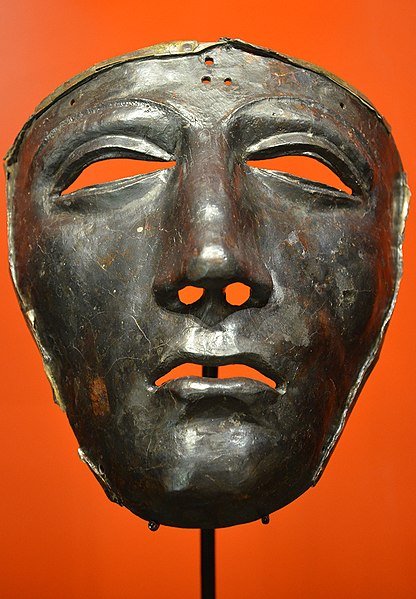
The ceremonial Roman face mask discovered at Kalkriese.
For centuries, the exact location of the Battle of Teutoburg Forest was unknown.
Archaeological Findings
Excavations at Kalkriese uncovered battlefield debris along a narrow corridor approximately 24 kilometers long and 1.6 kilometers wide. The remains of a zig-zagging defensive wall indicated that the Germanic forces had prepared an ambush site. Roman weapons, armor fragments, and human remains corroborated Tacitus’ account of the battle’s aftermath. The discovery of coins marked with “VAR,” issued by Varus, provided further evidence of Roman presence at the site.
The Hermann Monument was placed on Grotenburg Hill (location: district of Lippe (North Rhine-Westphalia), in Germany) because it was initially believed to be near the actual battle site. However, modern research suggests the battle likely occurred at Kalkriese, approximately 62 miles (100 km) away.
Museum and Park Kalkriese
Today, Kalkriese hosts the Museum und Park Kalkriese, offering visitors an interactive experience of the battle. The site includes reconstructed fortifications, trails, and an observation tower, providing a panoramic view of the battlefield.
The museum displays significant artifacts, including Roman sandals, spearheads, and a ceremonial silver-plated face mask. These exhibits help illustrate the battle’s historical significance and its impact on Roman-Germanic relations.
In the 1980s, archaeological evidence at Kalkriese (Germany) revealed: Roman weapons, armor, and coins; remnants of Germanic ambush structures; and a mass grave of Roman soldiers. These discoveries confirmed the site of the Battle of Teutoburg Forest (9 AD).
Cultural and Political Symbolism
In the 19th century, the Battle of Teutoburg Forest became a symbol of German unity and resistance against foreign rule. Nationalists viewed Arminius as a hero who defended Germanic freedom, reinforcing efforts toward unification.
Completed in 1875, the Hermann Monument commemorates Arminius, portraying him as a defender of German identity. It became a patriotic landmark.
Today, historians interpret the battle as a struggle between Roman imperial expansion and tribal resistance, rather than a nationalist triumph.
The Hermannsdenkmal was built to honor Arminius, the Cherusci leader who defeated the Romans in the Battle of Teutoburg Forest in 9 AD. It became a powerful symbol of German nationalism, particularly during the 19th century.
Questions and answers about the
Who led the Roman forces at the Battle of Teutoburg Forest?
The Roman forces were led by Publius Quinctilius Varus, the governor of Germania Inferior.
How many troops did the Romans have in the battle?
The Romans had approximately 9,500–15,000 soldiers, including three legions, cavalry, and auxiliary troops.
What was the estimated size of the Germanic force?
The exact number of Germanic warriors remains unknown, but they were likely outnumbered by the Romans, possibly in a 2:1 ratio.
What was the outcome of the Battle of Teutoburg Forest?
The Germanic tribes completely destroyed the Roman army, seizing their legionary standards and forcing the Romans to abandon expansion into Germania.
How did the battle affect Roman expansion?
The battle permanently halted Roman expansion beyond the Rhine River, leading to a defensive strategy instead of further conquests in Germania.
Who was Arminius, and why did he betray Rome?
Arminius was a Cherusci noble who had been raised in Rome, given Roman citizenship, and served as an auxiliary officer. He secretly united Germanic tribes against the Romans and orchestrated the ambush.
How did Varus fall into Arminius’s trap?
Arminius falsely informed Varus of a rebellion beyond the Rhine, convincing him to march his legions into the Teutoburg Forest, where they were ambushed.
The Roman defeat at Teutoburg Forest halted the empire’s expansion beyond the Rhine and had long-lasting consequences for the empire’s frontier policies.
Where did the ambush take place?
The battle occurred in the Teutoburg Forest, with archaeological evidence pointing to Kalkriese as the most likely site.
How did the geography affect the Roman army?
The dense forest, narrow paths, and muddy terrain prevented the Romans from forming their traditional battle formations, making them vulnerable to attacks.
What tactics did the Germanic tribes use at the Battle of Teutoburg Forest?
The Germanic warriors built defensive ramparts, launched javelins from concealed positions, and harassed the Roman army over three days, preventing them from regrouping.
What happened to Varus?
Realizing the battle was lost, Varus committed suicide rather than be captured.
What were the Roman eagles, and what happened to them?
The Roman eagles were the sacred standards of the legions, and losing them was a major disgrace. The Germanic tribes captured all three legions’ eagles.
How did Emperor Augustus react to the defeat?
Augustus was devastated, reportedly exclaiming, “Quintilius Varus, give me back my legions!” and observing the anniversary of the defeat with mourning.
Did the Romans attempt to recover Germania?
Yes. In 14–16 CE, Roman general Germanicus led retaliation campaigns, recovering two of the lost eagle standards and burying the dead, but the Romans never re-established control.
How was the battle rediscovered?
In the 1980s, archaeologist Tony Clunn discovered Roman weapons, armor, and coins at Kalkriese, confirming it as the battle site.
What role did the battle play in German nationalism?
By the 19th century, the battle became a symbol of German unity, inspiring the construction of the Hermann Monument (1875).
The monument stands on Grotenburg Hill in the Teutoburg Forest, near Detmold, Germany. It is surrounded by the remains of an ancient circular rampart.
Originally thought to be near the battle’s location, modern research suggests the battle occurred at Kalkriese, about 62 miles (100 km) northwest.
Located southwest of Detmold in the district of Lippe (North Rhine-Westphalia), in Germany, the Hermannsdenkmal commemorates Arminius’ victory over the Romans in 9 AD. In the 19th century, it became a nationalist symbol of German unity and resistance against foreign rule.
How was Arminius viewed in modern history?
Arminius became a national hero in Germany, later exploited by Nazi propaganda as a symbol of Germanic superiority.
Why is the Battle of Teutoburg Forest significant?
It was one of Rome’s worst defeats, preventing the conquest of Germania and shaping the historical divide between Roman and Germanic Europe.





