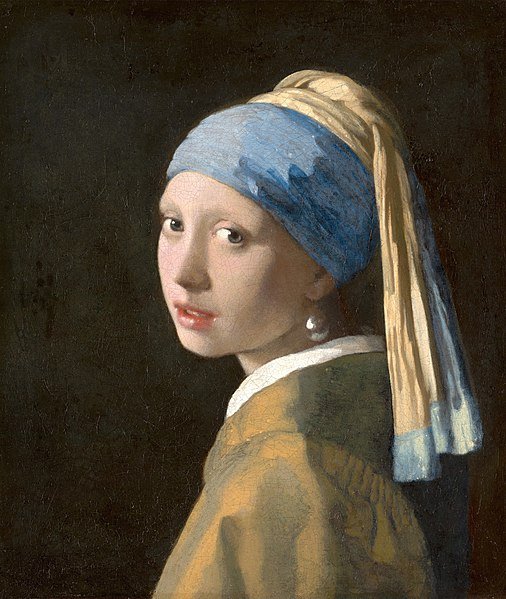
Girl with a Pearl Earring remains one of the most beloved and studied works of art in the world. Image: Girl with a Pearl Earring (1665) by Dutch Golden Age painter Johannes Vermeer.
One of the most celebrated paintings of the Dutch Golden Age, Girl with a Pearl Earring by Johannes Vermeer, has captivated audiences for centuries. Painted around 1665, this oil-on-canvas artwork is renowned for its intimate portrayal of a young woman, her enigmatic gaze, and the luminous pearl earring that gives the painting its name.
Although it was referred to by different titles over the years, its current name became widely recognized in the late 20th century. Currently housed in the Mauritshuis museum in The Hague, the painting has been the subject of extensive scholarly analysis, literary adaptations, and cinematic interpretations.
The Tronie: A Study in Expression
Rather than a formal portrait, Girl with a Pearl Earring is classified as a tronie, a genre of painting in 17th-century Dutch art that depicted an expressive or characterful head rather than a specific individual. Tronies often showcased exaggerated facial expressions, exotic costumes, and dramatic lighting to highlight artistic techniques rather than to document a real person. In this case, Vermeer presents an anonymous young woman wearing a striking blue and yellow turban and a large pearl earring. Her attire and pose contribute to the painting’s timeless allure and mystery.
The Identity of the Girl
The identity of the model remains unknown, giving rise to speculation. Some scholars propose that she may have been a real model, possibly one of Vermeer’s family members, while others argue that she represents an idealized figure inspired by biblical or mythological subjects.
A popular but unproven theory suggests that the girl was Vermeer’s eldest daughter, Maria, though this claim has been contested due to historical inconsistencies.
Ultimately, the girl’s anonymity enhances the painting’s mystique, allowing viewers to project their own interpretations onto her expression and pose.
Composition and Technique
Vermeer was a master of light and shadow, and this painting exemplifies his meticulous technique. The composition is simple yet striking: the girl’s face emerges from a dark, almost black background, enhancing the luminosity of her skin. This contrast creates an effect of depth and realism, drawing the viewer’s eye directly to her features. Her parted lips and direct gaze suggest a fleeting, intimate moment, almost as if she has just turned toward the viewer.
Some art historians have described Vermeer’s painting “Girl with a Pearl Earring” as the “Mona Lisa of the North” for its mystery and light.
The artist’s handling of color is equally remarkable. Vermeer used high-quality pigments, including natural ultramarine—a deep blue pigment derived from lapis lazuli, which was extremely expensive in the 17th century.
The turban’s brilliant blue hue demonstrates Vermeer’s commitment to achieving vibrant, life-like tones. The girl’s skin is rendered with delicate transitions between light and shadow, creating a smooth, lifelike quality that is characteristic of Vermeer’s work.
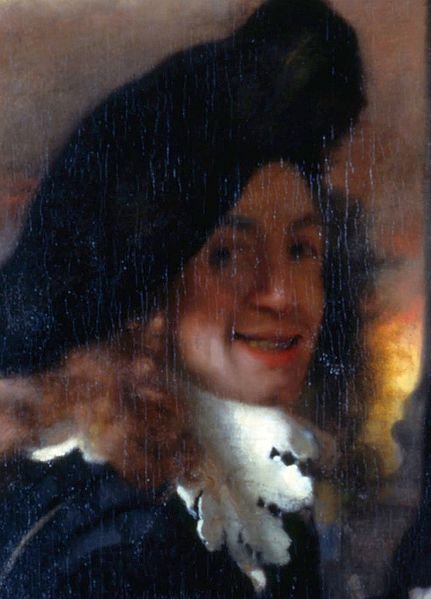
A section of The Procuress (1656), thought to feature Dutch Golden Age painter Johannes Vermeer’s self-portrait.
The Earring: Pearl or Illusion?
The earring is the most striking feature of the painting and the reason behind its modern title. However, some experts question whether it is actually a pearl. In 2014, astrophysicist Vincent Icke proposed that the earring’s reflection and shape suggest it may be made of polished tin rather than an actual pearl. Regardless of its material, the earring serves as a focal point, catching light and adding to the overall radiance of the painting.
Restoration and Discoveries
A major restoration in 1994 revealed important details about the painting. It was discovered that the dark background, originally thought to be black, was actually a deep green glaze that has since faded due to the breakdown of organic pigments. The restoration also enhanced the clarity of the girl’s expression and the delicate color transitions in her face and clothing.
Further research was conducted in 2018 as part of The Girl in the Spotlight project, led by conservator Abbie Vandivere. This non-invasive study utilized advanced imaging techniques such as X-rays and ultraviolet light to examine the layers of paint. The findings revealed subtle details, including previously unnoticed eyelashes and a green curtain in the background.
The above in a way confirmed that Vermeer painted the girl as a real person in a three-dimensional space rather than as an abstracted or idealized figure.
Ownership and Display
The painting’s provenance reflects its journey through history. In 1881, art collector Arnoldus Andries des Tombe purchased the artwork at an auction in The Hague for just two guilders and thirty cents, an astonishingly low price. At the time, the painting was in poor condition, with parts of the paint layer flaking. Upon Des Tombe’s death, he bequeathed the painting to the Mauritshuis museum in 1902, ensuring its preservation and public display.
Since then, Girl with a Pearl Earring has been exhibited worldwide, gaining immense popularity. However, in 2014, the Mauritshuis decided that the painting would remain permanently in the museum due to its significance and fragility. By this time, its iconic status had been solidified, with a CNN survey naming it one of the most recognizable paintings in the world.
Johannes Vermeer’s painting “Girl with a Pearl Earring” (1665) has been housed in the Mauritshuis museum in The Hague since 1902 and is no longer loaned for exhibitions.
The Evolution of Its Title
Over the centuries, the painting has been known by different names. Originally, it may have been one of the two tronies described in Vermeer’s inventory as “painted in the Turkish fashion.” Later, it was referred to as Portrait in Antique Costume. By the 19th century, it was commonly known as Girl with a Turban. The title Girl with a Pearl Earring became widely accepted only in the 20th century, aligning with the earring’s prominence in the composition.
Cultural Impact and Literary Influence
The painting has inspired numerous artistic and literary works. Tracy Chevalier’s 1999 novel Girl with a Pearl Earring fictionalizes the story behind the painting, imagining a narrative in which a young servant girl, Griet, becomes Vermeer’s assistant and muse. The novel was later adapted into a 2003 film starring Scarlett Johansson and a 2008 play.
Poets have also drawn inspiration from the painting. W. S. Di Piero reimagined the girl in a modern setting, while Marilyn Chandler McEntyre explored her self-possessed demeanor. In visual art, contemporary artists such as Banksy and Awol Erizku have created reinterpretations that comment on social issues, further cementing the painting’s relevance in popular culture.

Contemporary Adaptations and Controversies
The painting continues to be reinterpreted in various forms. In 1985, Peruvian artist Herman Braun-Vega incorporated the girl into a work symbolizing cultural syncretism.
In 2009, Ethiopian American artist Awol Erizku reimagined her as a young Black woman wearing bamboo earrings, highlighting representation in art. Banksy’s 2014 mural Girl with a Pierced Eardrum replaced the earring with an alarm box, adding a street art twist to Vermeer’s classic image.
In 2022, the painting became the focus of a climate protest when activists from the Just Stop Oil campaign threw tomato soup on it and attempted to glue their heads to the protective glass. Fortunately, the artwork was undamaged, but the incident sparked debate about the role of activism in cultural spaces.
Frequently Asked Questions
Who is the girl in the painting?
The subject’s identity remains unknown. Some speculate she was a real model, possibly Vermeer’s daughter, but others believe she is an idealized or symbolic figure.
Why is the earring significant?
The painting’s modern title emphasizes the striking earring, but some experts argue it resembles polished tin rather than a pearl due to its reflective qualities and size.
Where is the Girl with a Pearl Earring painting located?
Since 1902, it has been part of the Mauritshuis collection in The Hague, Netherlands, and is no longer loaned for exhibitions.
Vermeer’s masterful use of light, color, and composition makes the painting an enduring masterpiece, while its mysterious subject continues to captivate audiences
What painting techniques did Vermeer use?
Vermeer used a complex layering of pigments, including ultramarine, ochres, and lead white. The dark background, originally a deep green glaze, has faded over time.
How was the painting rediscovered?
Arnoldus Andries des Tombe bought it at an auction in 1881 for just two guilders. It was in poor condition but later restored and donated to the Mauritshuis.
How has the painting influenced culture?
It inspired Tracy Chevalier’s 1999 novel and a 2003 film adaptation. Artists like Banksy and Awol Erizku have reinterpreted it in contemporary contexts.





