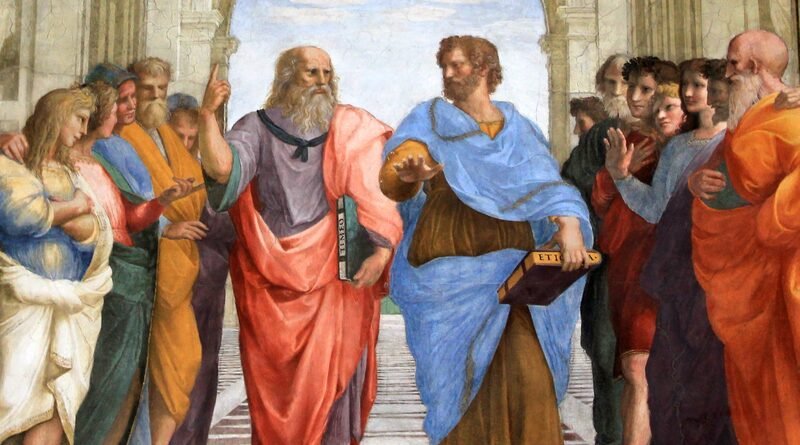
A depiction of Plato and Aristotle walking and debating, from Raphael’s “The School of Athens” (1509–1511).
The Peripatetic School, known in Ancient Greek as “Περίπατος” (Peripatos), was a philosophical and scientific institution founded by Aristotle in 335 BCE in the Lyceum, Athens. Renowned for its association with Aristotle’s habit of walking while teaching, the school became a hub for intellectual exploration. Over time, it experienced periods of decline and revival, notably under the Roman Empire.
Origins of the Peripatetic School
The term peripatetic is derived from the Greek word peripatētikós, meaning “of walking” or “given to walking about.” This name likely originated from the peripatoi or walkways of the Lyceum where members met. Although a legend claims it references Aristotle’s habit of walking while lecturing, this may have been a later interpretation by Hermippus of Smyrna.
Aristotle’s Lyceum played a pivotal role in the history of philosophy and science. Its emphasis on empirical research and systematic inquiry set the stage for later intellectual developments.
The Lyceum served as a gathering place for Aristotle and his colleagues, as Aristotle, not being a citizen of Athens, could not own property. Philosophers like Socrates had previously used the Lyceum grounds, but Aristotle institutionalized its use around 335 BCE after leaving Plato’s Academy and traveling for several years. Unlike formal schools, the early Peripatetic gatherings were likely informal, with no rigid curriculum or membership fees. Members collaborated on philosophical and scientific research under Aristotle’s guidance.
Structure and Goals
The Peripatetic School aimed to explore philosophical and scientific theories rather than adhering to a strict doctrine. Members were divided into junior and senior roles, with senior members leading research and lecturing. Aristotle’s teachings, often delivered through lectures, formed the foundation of many of his surviving works.
Prominent members during Aristotle’s tenure included:
- Theophrastus: Aristotle’s successor and a key figure in the school’s development.
- Phanias of Eresus
- Eudemus of Rhodes
- Aristoxenus
- Dicaearchus
Unlike other philosophical schools, the Peripatetics emphasized collaborative inquiry, combining theoretical and practical approaches to knowledge.
Leadership and Decline
After Aristotle’s death in 322 BCE, Theophrastus succeeded him, followed by Strato of Lampsacus, who emphasized naturalistic interpretations of Aristotle’s philosophy and was noted for his atheistic views. Other leaders included:
- Lyco of Troas: Known more for his oratory than philosophy.
- Aristo of Ceos: Focused on biographical studies.
- Critolaus: Active philosophically but lacked originality.
- Diodorus of Tyre and Erymneus: Lesser-known figures.
By the 3rd century BCE, the Peripatetic School began to wane. Competing schools, such as Stoicism and Epicureanism, offered more systematic and dogmatic philosophies, appealing to those seeking certainty. Additionally, skepticism from the Middle Academy attracted those resistant to dogmatism.
One tradition attributes the decline to the hiding of Aristotle’s and Theophrastus’s works by Neleus of Scepsis, though this account is debated. Regardless, Aristotle’s writings were not widely disseminated until rediscovered in the 1st century BCE.
Revival Under the Roman Empire
The Roman sack of Athens in 86 BCE disrupted the philosophical schools, including the Lyceum, which ceased as a functioning institution. Ironically, this event revitalized Peripateticism. The Roman general Sulla brought Aristotle’s and Theophrastus’s manuscripts to Rome, where Andronicus of Rhodes compiled and edited them into the Corpus Aristotelicum, the basis of Aristotle’s surviving works.
During the Roman period, the focus of the Peripatetic School shifted from expanding Aristotle’s philosophy to preserving and interpreting it. Andronicus, often considered the 11th scholarch, led this effort alongside his pupil Boethus of Sidon. The most prominent Peripatetic thinker of this era was Alexander of Aphrodisias, known for his detailed commentaries on Aristotle’s works.
Influence of the Peripatetic School
In the 3rd century CE, the rise of Neoplatonism and Christianity overshadowed Peripateticism as an independent philosophy. However, Neoplatonists integrated Aristotle’s ideas into their systems, producing commentaries on his works.
Aristotle’s works were preserved and studied in the Islamic world, where they significantly influenced Islamic philosophy. Prominent Peripatetic philosophers in this tradition included:
- Al-Kindi (Alkindus)
- Al-Farabi (Alpharabius)
- Avicenna (Ibn Sina)
- Averroes (Ibn Rushd)
These thinkers adapted Aristotelian ideas to Islamic theology and science, ensuring their survival and transmission.
By the 12th century, Aristotle’s works re-entered Europe through Latin translations. His philosophy shaped Scholasticism, with thinkers like Thomas Aquinas synthesizing Aristotelianism with Christian theology. The commentaries of Averroes and Avicenna further enriched this tradition.
Top Scholars of the Islamic Golden Age and their Major Achievements
Key Figures and Contributions
- Theophrastus (322–288 BCE): Expanded Aristotle’s botanical studies and philosophical teachings.
- Strato of Lampsacus (288–c. 269 BCE): Advocated a naturalistic, atheistic interpretation of Aristotle’s philosophy.
- Alexander of Aphrodisias (c. 200 CE): Authored influential commentaries, securing Aristotle’s legacy in later philosophical traditions.
- Islamic Philosophers: Preserved and advanced Aristotelian thought, linking it to broader intellectual traditions.