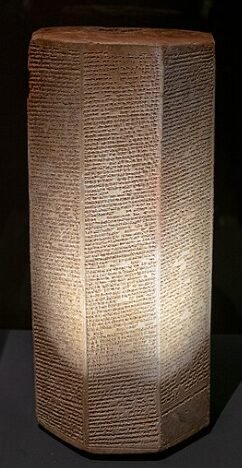
Prism of King Sennacherib
Early Life and Rise to Power
Sennacherib was raised in the Assyrian royal court and gained critical experience as crown prince while residing in Nineveh. His early years were spent administering the empire, maintaining relationships with governors and generals, and overseeing projects under his father’s rule. However, he never accompanied Sargon II on military campaigns, a decision that may have influenced his own military strategies as king.
Upon his father’s unexpected death, Sennacherib moved the capital from Dur-Sharrukin to Nineveh, distancing himself from Sargon’s legacy. This marked the beginning of extensive building projects that transformed Nineveh into a grand capital.
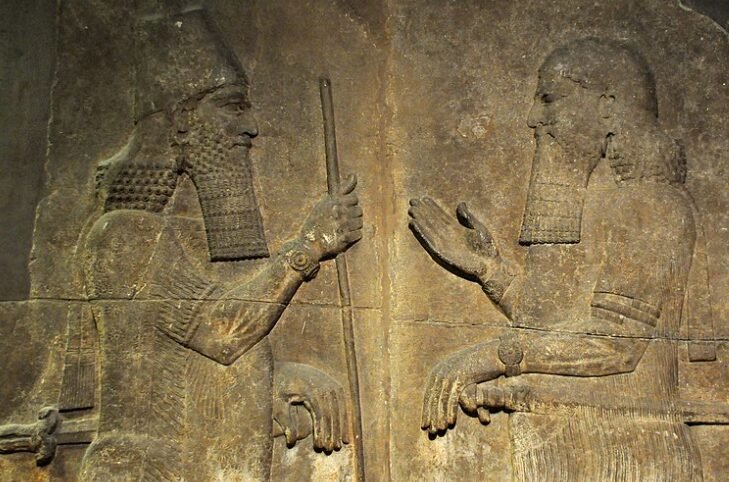
Sargon II (left) with a high-ranking official, likely crown prince Sennacherib.
Military Campaigns
Sennacherib’s reign was characterized by his ability to respond to widespread rebellions and maintain control over the vast empire. His military campaigns targeted key regions, including Babylonia, the Levant, and Elam, each presenting unique challenges and outcomes.
Babylonian Campaigns
Babylonia posed a constant challenge to Sennacherib’s authority. Shortly after his accession, Marduk-apla-iddina II, a Chaldean leader, seized Babylon with Elamite support. Sennacherib’s initial response was delayed, but by 703 BC, he launched a successful campaign to reclaim the city. Recognizing Babylon’s importance, he installed Bel-ibni, a Babylonian educated at the Assyrian court, as a vassal king. However, unrest persisted, exacerbated by support from Elam and internal divisions among Babylonians, Chaldeans, and Arameans.
In 689 BC, after years of rebellion and the execution of his son Ashur-nadin-shumi by the Elamites, Sennacherib destroyed Babylon. This act was unprecedented, as previous Assyrian kings revered Babylon’s cultural and religious significance. The city’s destruction alienated many within the empire, including elites who held Babylon in high esteem.
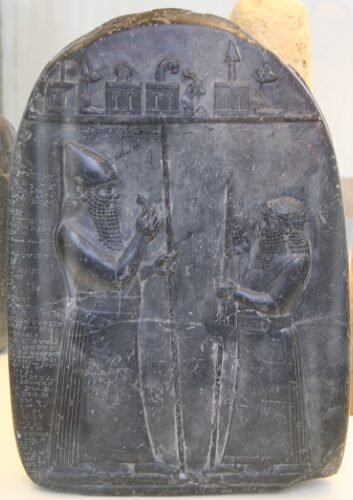
King Sennacherib struggled to control Babylonia, clashing with Marduk-apla-iddina II, a Chaldean leader who retook Babylon and allied with Elam.
Old Babylonian Empire: History, Extent, & Accomplishments
Levantine Campaigns
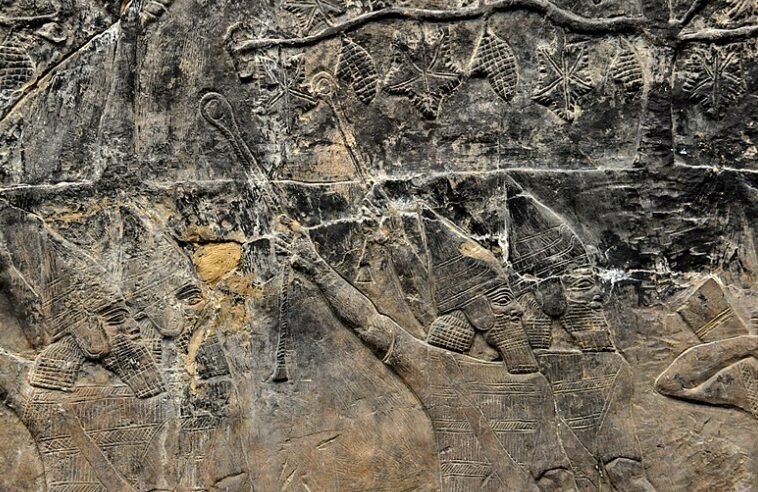
Sennacherib attacked Elam to defeat Marduk-apla-iddina II but suffered personal loss when his son Ashur-nadin-shumi, Babylon’s vassal king, was executed. Image: Relief from Sennacherib’s reign depicting Assyrian slingers hurling stones at an enemy city
In 701 BC, Sennacherib directed his forces to the Levant, responding to rebellions by vassal states, including Judah under King Hezekiah. His campaign is one of the most documented events in ancient Near Eastern history.
The Assyrian army captured the fortified city of Lachish, a victory prominently depicted in reliefs at Nineveh. Jerusalem was blockaded, and Hezekiah ultimately submitted, paying tribute and releasing prisoners.
The Biblical account claims divine intervention prevented Sennacherib from capturing Jerusalem, but historical evidence suggests a negotiated settlement. The campaign consolidated Assyrian control over the Levant and reaffirmed the empire’s dominance in the region.
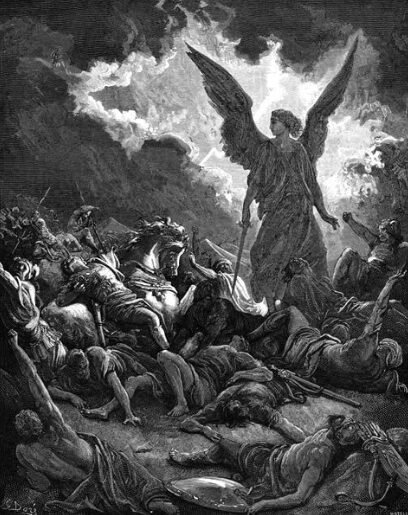
19th-century wood engraving by French artist Gustave Doré depicting the Biblical narrative of an angel destroying King Sennacherib’s army outside Jerusalem
Assyrian Army: History and Major Facts
Elamite and Eastern Campaigns
Sennacherib’s campaigns in the east were primarily aimed at eliminating Elamite support for Babylonian rebellions. His arch-enemy, Marduk-apla-iddina II, fled to Elam, prompting Sennacherib to invade the region. While he achieved military success, including the destruction of Elamite strongholds, the Elamites captured and executed Ashur-nadin-shumi, who had been installed as Babylon’s vassal king.
Sennacherib launched a subsequent campaign against Elam in 694 BC, using innovative naval strategies to transport his army across the Persian Gulf. Although he weakened Elamite influence, internal rebellions and alliances continued to challenge Assyrian authority in the region.
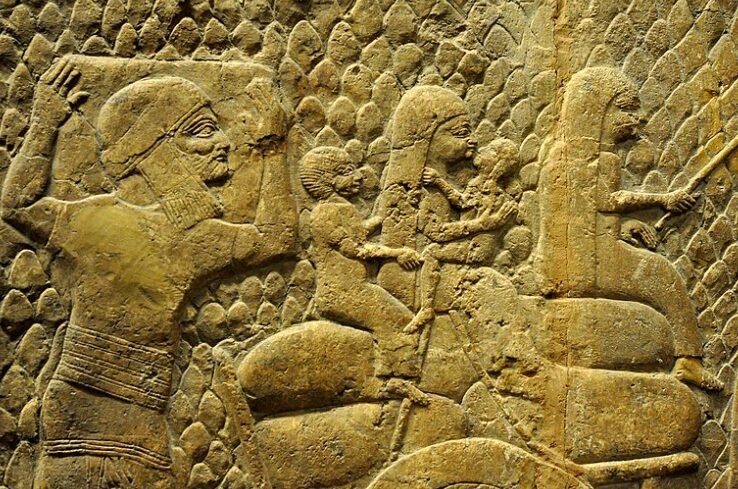
Despite reclaiming the south in 700 BC, rebellions in the Levant led to the 701 BC war against King Hezekiah of Judah. Sennacherib also destroyed Babylon in 689 BC following repeated unrest and the death of his son Aššur-nādin-šumi. Image: Judean people being deported into exile after the fall of Lachish to the Assyrians
Architectural Achievements
Sennacherib’s most enduring legacy lies in his architectural projects, particularly the transformation of Nineveh. He expanded the city’s infrastructure, constructing massive walls, aqueducts, and the “Palace Without Rival.” This palace, renowned for its innovative design and grandeur, served as a symbol of Assyrian power.
Sennacherib also developed an advanced water management system to supply Nineveh, including aqueducts and canals. His gardens, featuring exotic plants, have been speculated to inspire the Hanging Gardens of Babylon. These projects solidified Nineveh’s status as a cultural and political center of the empire.

In Nineveh, Sennacherib initiated vast construction projects, including the “Palace without Rival.” After disinheriting Arda-Mulissu in favor of Esarhaddon, Sennacherib was assassinated in 681 BC, paving the way for Esarhaddon’s ascension. Image: 1876 reconstruction of Sennacherib’s “Palace without Rival” in Nineveh by American bishop John Philip Newman
Administrative Reforms and Governance
Sennacherib approached governance with pragmatism, delegating military campaigns to trusted generals while focusing on domestic affairs. His inscriptions emphasize justice and divine favor, portraying him as a protector of the weak. However, his destruction of Babylon strained relationships with both the priesthood and the populace. To justify his actions, he promoted religious propaganda, claiming the gods supported his decisions.
His administrative reforms streamlined the empire’s governance, ensuring efficient communication and control across vast territories. Sennacherib’s emphasis on infrastructure and urban development reflected his vision for a stable and prosperous empire.
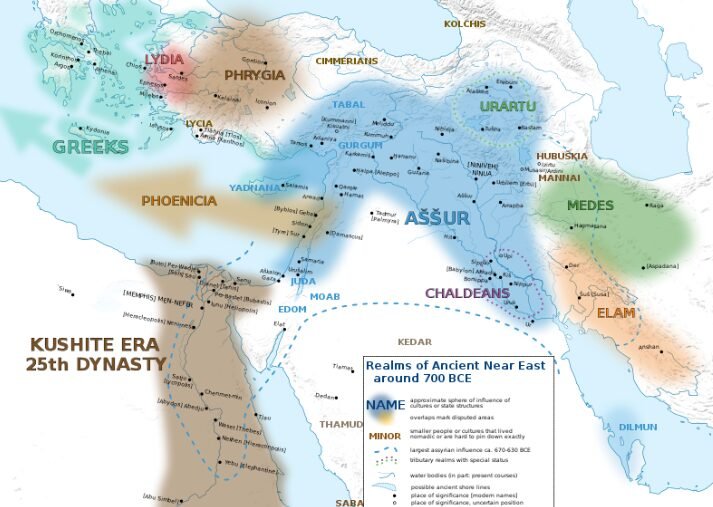
A map of the Near East in 900 BC illustrates Assyria’s core (Aššur) and Babylonia’s territories, highlighting their positions before the Neo-Assyrian Empire’s dominance.
Family and Succession
Sennacherib’s family dynamics significantly impacted the later years of his reign. After the death of his eldest son and heir, Ashur-nadin-shumi, Sennacherib designated Arda-Mulissu as his successor. However, in 684 BC, he replaced him with a younger son, Esarhaddon, likely influenced by Esarhaddon’s mother, Naqi’a. This decision created a rift within the royal family.

Relief depicting King Sennacherib’s son and successor Esarhaddon (right) and Esarhaddon’s mother (and Sennacherib’s wife) Naqi’a (left)
In 681 BC, Arda-Mulissu and his brother Nabu-shar-usur assassinated Sennacherib, hoping to seize power. Despite their efforts, they failed to secure the throne. Esarhaddon quickly mobilized support, defeated the conspirators, and became king, marking the end of Sennacherib’s transformative reign.
Assyrian Reliefs: Purpose, Major Themes, & Artistic Style
Legacy

Sennacherib, king of the Neo-Assyrian Empire (705–681 BC), is renowned for his military campaigns and architectural achievements. Image: 19th-century reconstruction of Nineveh by the British archaeologist Austen Henry Layard
Sennacherib’s reign left a mixed legacy. His military campaigns demonstrated Assyria’s might, while his architectural projects showcased innovation and grandeur. However, his destruction of Babylon and the circumstances of his death highlighted the volatility and complexity of his rule.
Modern historians recognize Sennacherib as a skilled and innovative ruler whose decisions balanced strategic acumen with emotional volatility. His contributions to Assyrian history, particularly in governance and infrastructure, remain pivotal, shaping the empire’s trajectory and its enduring legacy in world history.