The Battle of Adrianople, fought on 9 August 378 AD, was one of the most catastrophic defeats in Roman history and a defining moment in the decline of the Roman Empire. Taking place near the city of Adrianople (modern Edirne, in Turkey), this clash saw the Eastern Roman Emperor Valens confront Gothic forces, primarily composed of Thervings and Greuthungs under the command of Fritigern. This battle is often considered a key event that precipitated the fall of the Western Roman Empire, even though it occurred in the Eastern half.
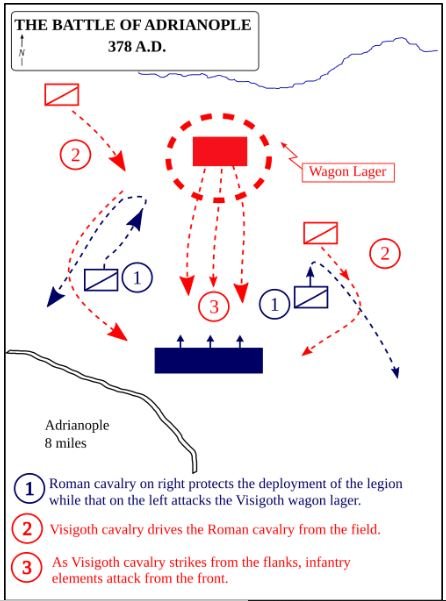
Battle layout as interpreted by the U.S. Military Academy’s History Department.
The Road to War: How the Goths Entered the Empire
The origins of the battle lie in the year 376, when large groups of Gothic peoples fled from the Huns and sought asylum across the Danube River within Roman territory. Led by Alavivus and Fritigern, they approached the Eastern Roman Emperor Valens for permission to settle in the empire as foederati—federated allies. Valens, hoping to gain new soldiers and taxpayers, agreed. Unfortunately, the settlement process was catastrophically mismanaged.
Local Roman commanders, Lupicinus and Maximus, exploited the Gothic refugees by overcharging them for food and provisions, even reportedly trading dog meat for children. Starvation and mistreatment soon led to open revolt. What began as a desperate refugee crisis escalated into a full-blown war, as the Goths, now disillusioned and armed, roamed the Balkans looting Roman cities and towns.

A Failing Response: Rome’s Struggle to Contain the Threat
For the next two years, Roman attempts to contain the Gothic threat yielded no decisive victories. Valens sought help from the Western Emperor Gratian, who responded by sending the general Frigeridus and his commander of guards, Richomeres, with reinforcements. Yet the balance remained uncertain. Meanwhile, Gratian’s forces became preoccupied with defending Gaul from the Alamanni, delaying their ability to reinforce Valens directly.
By 378, Valens grew impatient. Despite the absence of Gratian’s full support, Valens left Antioch and arrived in Constantinople to personally take command. He was eager for a victory that would rival Gratian’s recent successes. To support his efforts, Valens appointed Sebastianus to lead Roman troops already in Thrace. With 2,000 handpicked soldiers, Sebastianus launched ambushes on small Gothic bands, scoring some minor victories and boosting Roman confidence.
Misjudgment and the March to Battle
With a growing desire to claim glory and perhaps insecure about sharing victory with Gratian, Valens decided to confront the Goths before reinforcements from the West arrived. On 6 August, scouts informed Valens that around 10,000 Gothic warriors were encamped 25 kilometers north of Adrianople. Valens then fortified his own position near the city.
Meanwhile, Fritigern, sensing an impending clash, attempted diplomacy. He offered peace terms and proposed an alliance in exchange for territory. Valens, encouraged by faulty intelligence suggesting he held a numerical advantage, dismissed the offer. Unknown to him, a large contingent of Gothic cavalry led by Alatheus and Saphrax was temporarily absent, foraging in the countryside. This critical oversight would later prove disastrous.

A gold solidus depicting Valens adorned with a pearl-studded diadem and a rose-colored brooch.
The Roman Forces and Their Structure
Valens’ army was composed of several units from the Eastern Roman military structure, potentially including remnants of the Army of Thrace and detachments from the 1st and 2nd Armies in the Emperor’s Presence. While exact numbers are debated, modern historians estimate the Roman force to have been around 15,000 strong—roughly 10,000 infantry and 5,000 cavalry.
The legions included elite units like the Lanciarii and Mattiarii. Veteran soldiers filled the ranks, and mounted archers, as well as elite imperial guards called the Scholae, were present. The Batavians were held in reserve, although they played little role in the fighting. Officers like Sebastianus, Victor the cavalry commander, and Equitius were all key figures, though many would fall in the battle. Several high-ranking tribunes and aides, including Potentius and Valerianus, were also lost, underscoring the scale of the Roman leadership’s decimation.
Gothic Forces and Tactical Strengths
The Gothic army, although composed mainly of infantry, was well-organized under Fritigern. It included both Thervings and Greuthungs, as well as some Alanic allies. While early narratives often overemphasized the role of Gothic cavalry, recent scholarship shows that most of the Gothic forces were infantry. Nevertheless, the cavalry—especially those led by Alatheus and Saphrax—played a decisive role at a critical moment in the battle.
The Gothic force is estimated to have matched or slightly exceeded the Roman army in size, with figures ranging between 12,000 and 15,000. Importantly, they employed a fortified wagon circle—known as a laager—to protect their families and supplies, and their elevated position on a hill provided a tactical advantage.
The Battle Unfolds: 9 August 378
On the morning of the battle, Valens left Adrianople and marched eight miles to confront the Gothic position. The Roman soldiers arrived weary and dehydrated, only to find the Goths entrenched in a wagon fort on a hill. The Goths, aware of the approaching army, had intentionally burned fields to disrupt the Romans and create smoky confusion.
Fritigern initiated peace negotiations, likely a ruse to buy time for his returning cavalry. The Roman troops grew restless during the delay, and some began the attack without orders. The result was chaos. Bacurius the Iberian’s mounted archers struck first but were repelled. Soon after, the Roman left wing reached the Gothic wagon circle, but at that exact moment, Gothic cavalry returned and launched a devastating flank attack.
The Collapse of the Roman Army
The Roman formation, already disorganized from premature attacks and the heat of the day, now faced a full encirclement. With no space to maneuver and trapped at the base of the hill, Roman infantry were overwhelmed. The heavily armored legions found themselves exhausted and surrounded. As Gothic cavalry pounded their flanks and rear, panic spread.
Emperor Valens, abandoned by many of his guards, tried to retreat. His exact fate remains a mystery. One account claims he died on the battlefield; another suggests he was burned alive in a cottage after being wounded and hidden there by a peasant. His body was never recovered. The loss of Valens marked a disastrous symbolic and strategic blow for the Eastern Empire.
The Battle of Adrianople It exposed the cracks in Rome’s administrative, military, and diplomatic systems and ushered in an age where barbarian groups played an increasingly central role in shaping the future of Europe.
Aftermath: The Cost of Defeat
The Roman losses at Adrianople were staggering. Two-thirds of Valens’ army was killed. High-ranking officers, generals, and staff perished alongside thousands of infantry. The survivors fled to Adrianople, which the Goths attempted but failed to capture immediately after the battle. Ammianus Marcellinus, the Roman historian and primary source for the battle, vividly described the scene and aftermath as catastrophic.
This defeat broke the backbone of the Eastern Roman field army in the Balkans. It left the Danubian frontier vulnerable and sparked a recruitment crisis. Armories and garrisons were looted, and the empire was unable to immediately replace its losses. It also showed that Rome could no longer assume military superiority over the migrating peoples along its borders.
Though the Eastern Empire would survive and eventually rebound, the Western Empire was on a slow, inevitable path toward fragmentation. Adrianople was one of the clearest signs that the ancient world was ending and a medieval one was beginning.
The Strategic and Psychological Impact
Though the Eastern Roman Empire did eventually recover under Theodosius I, the battle highlighted the changing dynamics of power in the empire. The Goths were no longer seen as mere raiders but as a formidable and permanent presence within Roman territory. The settlement agreements Theodosius made with them would lay the groundwork for future Gothic autonomy—and at times hostility—within imperial borders.
In psychological terms, Adrianople was a wake-up call. It shattered the illusion of invincibility and exposed the fragility of Roman imperial defenses. The Romans would never again fully control the Balkans in the same way. The age of imperial dominance was giving way to a new era—one of shifting alliances, semi-independent barbarian kingdoms, and a slow transformation of Roman identity itself.
Debating the Military Legacy
Some historians, like Charles Oman in the 19th century, saw Adrianople as the dawn of cavalry dominance and the decline of classical heavy infantry. However, modern historians like T. S. Burns argue otherwise, noting that infantry still dominated Roman and barbarian armies for centuries to come. The battle’s outcome, they suggest, was due more to tactical missteps, overconfidence, and logistical failings than a fundamental change in military doctrine.
Nonetheless, the tactical coordination between Gothic infantry and cavalry during the battle was noteworthy. Fritigern’s ability to delay, deceive, and ultimately overwhelm a numerically comparable Roman force speaks to the growing sophistication of the so-called “barbarian” armies.
FREQUENTLY ASKED QUESTIONS
Why did the Goths enter Roman territory?
The Goths sought refuge from the Huns and were allowed to settle in the Eastern Roman Empire as foederati, but mistreatment by Roman officials led them to revolt.
What caused the battle to happen when it did?
Valens, eager for personal glory and misjudging the size of the Gothic force, chose to engage without waiting for reinforcements from Western Emperor Gratian.
What was the composition of the Roman army?
Valens’ army included legions from Thrace and the imperial field armies, with about 15,000 troops comprising heavy infantry, archers, and cavalry units.
How did the Goths achieve victory?
Using deceptive peace talks to delay the Romans, the Goths waited for their cavalry to return, then encircled and overwhelmed the Roman forces, who were exhausted and disorganized.
What happened to Emperor Valens?
Valens likely died in battle, possibly burned alive in a cottage after being wounded; his body was never found, symbolizing the scale of the defeat.
What were the immediate consequences of the battle?
The Roman field army in the Balkans was shattered, many officers were killed, and the empire suffered a severe military and psychological blow.
How did the battle affect the Roman Empire long-term?
It exposed Rome’s vulnerability, legitimized barbarian power within imperial borders, and is seen as a turning point that contributed to the eventual fall of the Western Roman Empire.





