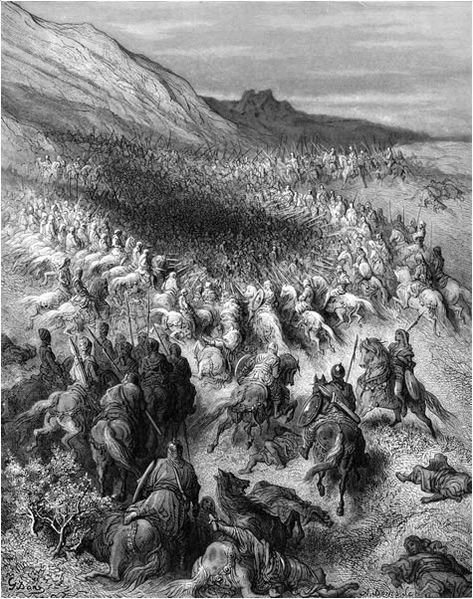
The Battle of Hattin, depicted by French printmaker Gustave Doré.
The Battle of Hattin, fought on July 4, 1187, marked a pivotal moment in the history of the Crusades. Occurring near the extinct volcanic formation known as the “Horns of Hattin” in present-day Israel, it saw the Ayyubid forces under Sultan Saladin decisively defeat the Crusader armies of the Kingdom of Jerusalem. This catastrophic loss for the Crusaders led to the fall of Jerusalem and other key territories, effectively shifting the balance of power in the Holy Land. The repercussions of this defeat would prompt the launch of the Third Crusade, two years later.
The Geographic and Strategic Setting
The battlefield of Hattin was strategically significant. Located near Tiberias, the site was characterized by its double hill formation, the “Horns of Hattin,” which overlooked an arid plateau. This area was a crucial pass between the Jordan River, the Sea of Galilee, and the Mediterranean coast, making it a vital corridor for military and trade movements. The Crusader army, positioned initially near La Saphorie, faced the challenge of navigating this inhospitable terrain while lacking access to essential water sources—a factor that would play a decisive role in the outcome.
Background: Political and Military Divisions
The Crusader states were plagued by internal divisions at the time of the battle. Guy of Lusignan became King of Jerusalem in 1186 through his marriage to Sibylla, but his rule was contested by the “nobles’ faction,” led by Raymond III of Tripoli, who had previously served as regent for the young Baldwin V. This factionalism weakened the Crusader leadership and decision-making, as political rivalry often overshadowed strategic priorities.
Meanwhile, Saladin, who had united the Muslim territories under his leadership, was consolidating his power. After becoming vizier of Egypt in 1169, Saladin expanded his control to Damascus (1174) and Aleppo (1183). By 1187, he commanded a unified Muslim front dedicated to reclaiming Jerusalem. Saladin’s ability to mobilize a cohesive force under the banner of jihad contrasted sharply with the fractured Crusader leadership.
The Prelude to Battle: Truce Violations and Provocations
The fragile truce between Saladin and the Crusaders unraveled when Raynald of Châtillon, a key supporter of Guy, violated the agreement by attacking a Muslim caravan. This act of aggression prompted Saladin to swear vengeance against Raynald and launch a full-scale campaign against the Crusader states. In May 1187, Saladin’s forces decisively defeated the Knights Templar at the Battle of Cresson, significantly weakening the military capacity of the Kingdom of Jerusalem.
In July 1187, Saladin laid siege to Tiberias, where Eschiva of Bures, Raymond III’s wife, was trapped. Although Raymond advised avoiding confrontation with Saladin, his warnings were dismissed by the ambitious Gerard de Ridefort, Grand Master of the Templars. Guy, influenced by Gerard, decided to confront Saladin, despite the strategic disadvantages.
The Crusader Army: A Fatal March
The Crusader army, numbering approximately 18,000–20,000 troops, included knights from Jerusalem, Tripoli, and Antioch, as well as mercenaries and crossbowmen financed by Henry II of England. Their most valuable asset, the True Cross, carried by the Bishop of Acre, symbolized their religious zeal but could not compensate for the army’s strategic missteps.
On July 3, the Crusader army set out from La Saphorie toward Tiberias, only to be lured into Saladin’s trap. Saladin had intentionally attacked Tiberias to draw the Crusaders away from their fortified positions. The march across arid terrain, under constant harassment by Saladin’s cavalry archers, left the Crusaders exhausted and desperately thirsty. Their decision to camp near the Horns of Hattin, far from any water sources, sealed their fate.
The Battle: The Collapse of the Crusader Forces
The battle commenced on the morning of July 4, 1187, as Saladin’s forces surrounded the Crusader army. Using smoke from burning dry grass to disorient the enemy, Saladin’s archers unleashed volleys that devastated the Crusader ranks. Deprived of water and weakened by exhaustion, the Crusaders were unable to maintain cohesion.
Several desperate charges were launched in an attempt to break through to the water at Lake Tiberias. Raymond III of Tripoli managed to escape with a small contingent, but the majority of the Crusader infantry and cavalry were either killed or captured. The symbolic fall of the tent carrying Guy of Lusignan’s banner signaled the complete defeat of the Crusader forces.
The Aftermath: Surrender and Execution
Following the battle, Guy of Lusignan, Raynald of Châtillon, and other high-ranking Crusader nobles were captured. Saladin treated Guy with dignity, offering him water—a sign of mercy in Muslim culture—but refused to extend the same courtesy to Raynald. Accusing Raynald of violating the truce, Saladin personally executed him, fulfilling his vow of vengeance.
Saladin ordered the execution of the captured Templar and Hospitaller knights, viewing them as a direct threat to his campaign. The remainder of the captured soldiers were sold into slavery, while some high-ranking nobles were later ransomed.
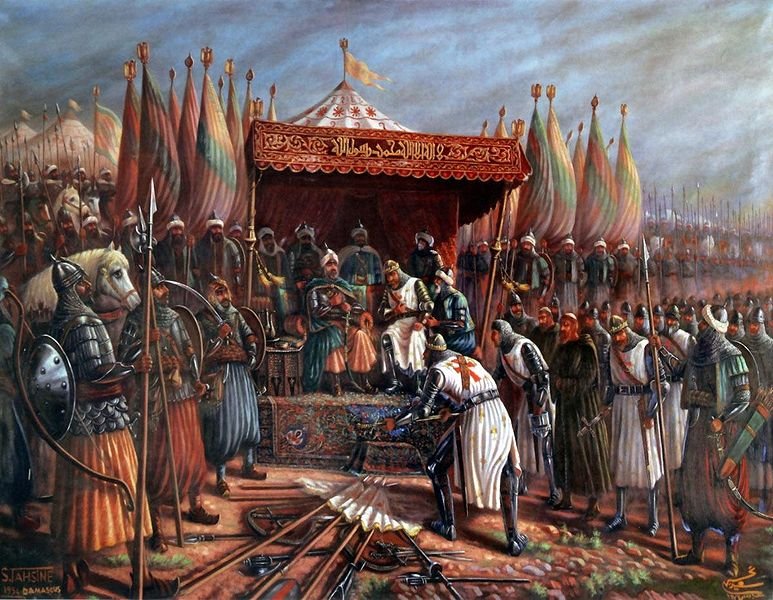
A contemporary portrayal of Saladin receiving the surrender of Guy of Lusignan.
The Consequences: The Fall of Jerusalem
The defeat at Hattin left the Crusader states virtually defenseless. With their military strength decimated, Saladin quickly capitalized on his victory. Within months, he captured key cities, including Acre, Nablus, Jaffa, and Ascalon. By October 1187, Saladin laid siege to Jerusalem, which surrendered after negotiations led by Balian of Ibelin. The loss of Jerusalem sent shockwaves through Europe and led to the mobilization of the Third Crusade.
Significance in Crusading History
The Battle of Hattin marked a turning point in the history of the Crusades. It demonstrated the strategic superiority of Saladin’s leadership and the consequences of disunity among the Crusader states. The loss of Jerusalem was not only a military blow but also a symbolic defeat for Christendom, galvanizing efforts to launch a new crusade.
The battle also highlighted the vulnerability of the Crusader states’ reliance on external support and their inability to sustain prolonged campaigns. Despite their initial successes, the Crusader states lacked the cohesion and resources to withstand Saladin’s determined campaign to unify the Muslim world and reclaim the Holy Land.

Legacy: Lessons from Hattin
The Battle of Hattin is remembered as a cautionary tale of overconfidence and strategic miscalculation. Guy of Lusignan’s decision to abandon a strong defensive position at La Saphorie in favor of a risky march toward Tiberias exemplifies the consequences of poor leadership. The failure to heed the warnings of more experienced commanders like Raymond III of Tripoli underscored the dangers of internal divisions.
For Saladin, Hattin cemented his reputation as one of history’s greatest military leaders. His ability to unite disparate factions under a common cause and execute a well-planned strategy demonstrated the effectiveness of his leadership. The capture of the True Cross, a symbol of Crusader zeal, further solidified his victory.
Frequently Asked Questions
Why did the Crusaders lose the battle?
The Crusaders were lured into an arid area by Saladin, where they were cut off from water sources, exhausted by thirst, and demoralized. Strategic missteps, internal divisions, and overconfidence contributed to their downfall.
Who led the opposing forces?
The Crusader army was commanded by Guy of Lusignan, King of Jerusalem, while Saladin, the Ayyubid Sultan, led the Muslim forces.
What role did the True Cross play in the battle?
The True Cross, a revered Christian relic, was carried into battle by the Crusaders. Its capture by Saladin after the battle was a symbolic and morale-shattering blow to the Crusaders.
What happened to the Crusader leaders?
King Guy of Lusignan was captured but spared by Saladin. Raynald of Châtillon was executed for violating a truce, while most Templar and Hospitaller knights were also executed.
How did the battle impact the Crusader Kingdom of Jerusalem?
The defeat left the Crusader states defenseless. Saladin quickly captured key cities, including Jerusalem, marking the end of Christian dominance in the Holy Land.
What was the significance of the battle in the Crusades?
The Battle of Hattin shifted the balance of power in the Holy Land to the Muslims, prompting the Third Crusade to attempt to reclaim lost territories.





