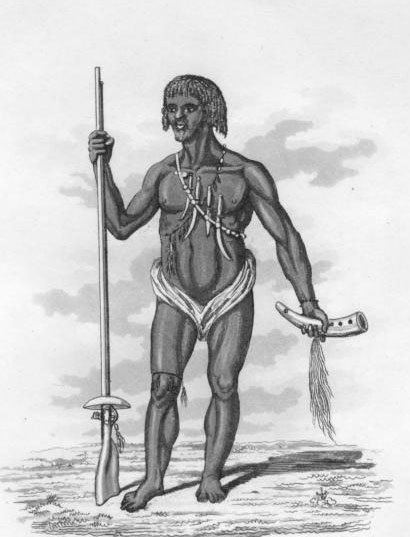
A warrior from Ashanti
The Battle of Nsamankow was a conflict between the British and the Ashanti Empire in 1824 during the First Anglo-Ashanti War, where the British, led by Charles MacCarthy, suffered a devastating defeat.
Background
The Battle of Nsamankow, fought in 1824, was a significant engagement between the United Kingdom and the Ashanti Empire as part of the First Anglo-Ashanti War.
The conflict arose due to escalating tensions between the Ashanti and the Fante, a coastal ethnic group allied with the British.
The British, seeking to assert greater control over the Gold Coast and protect their trading interests, declared war against the Ashanti kingdom in late 1823.
At the time, the British forces in the region were under the command of Charles MacCarthy, the governor of the British Gold Coast territories. Recognizing the threat posed by the powerful Ashanti military, MacCarthy sought to counter the Ashanti forces with a combined army of British troops, colonial militias, and local Fante allies. His primary strategy was to divide his forces into four groups and converge on the enemy to deliver an overwhelming blow.
MacCarthy’s personal force was relatively small, consisting of approximately 80 men from the Royal African Colonial Corps (RACC), 170 militia members from Cape Coast, and 240 Fante warriors. He was also accompanied by aides-de-camp from the 2nd West India Regiment, a military surgeon, and his colonial secretary, J. T. Williams. The three other detachments, led by different commanders, included a mix of British regulars and thousands of native levies.
Despite the ambitious plan, communication and coordination among these groups were inadequate, leaving MacCarthy’s force isolated and vulnerable to attack.
The Battle Begins
On January 20, 1824, MacCarthy’s contingent camped by a tributary of the Pra River, unaware that they were about to face a far superior enemy force. The next afternoon, at approximately 2 PM, his troops encountered an Ashanti army estimated to be around 10,000 strong. Believing that some of the Ashanti chiefs might be willing to defect, MacCarthy ordered his band to play “God Save the King” in an attempt to sway enemy loyalties. However, the Ashanti responded by closing in, beating war drums, and showing no signs of defection. The battle was inevitable.
In an unusual display, MacCarthy ordered his band to play God Save the King. The Ashanti responded with their own war drums and horns, leading to a tense musical exchange. However, the situation quickly escalated into open combat.
As the Ashanti warriors attempted to cross the river using makeshift bridges made from felled trees, the British forces opened fire. Despite their initial defensive advantage, the British soon found themselves in a precarious situation. The supply bearers, responsible for transporting essential gunpowder and ammunition, fled after hearing the sounds of gunfire, fearing for their lives. This left MacCarthy’s men with critically low supplies.
Despite warnings of the Ashanti’s proximity, MacCarthy remained confident, eager to test their response to British firepower. On January 21, at around 2 PM, the Ashanti army, numbering approximately 10,000, approached.
Upon receiving a partial resupply, the British opened the first case, expecting much-needed ammunition. To their dismay, the remaining cases contained only macaroni—an oversight that proved disastrous. As the British soldiers ran out of ammunition, the Ashanti forces seized the opportunity to press forward. With their superior numbers and well-coordinated attack, they overwhelmed the defenders in brutal hand-to-hand combat.
The Death of Charles MacCarthy
As the battle turned against the British, many of the Fante militia abandoned the fight, leaving MacCarthy and his remaining troops severely outnumbered. In the ensuing chaos, MacCarthy, along with his colonial secretary J. T. Williams and Ensign Wetherell, attempted to retreat. However, MacCarthy was wounded by enemy gunfire. Rather than be captured, he reportedly took his own life.
His death marked a symbolic victory for the Ashanti, who later used his gold-rimmed skull as a drinking cup, a practice common in Ashanti culture as a way of honoring significant battlefield triumphs. Ensign Wetherell was killed while attempting to defend MacCarthy’s body, while Williams was taken prisoner.
Williams’ Captivity and British Casualties
J. T. Williams’ survival was an unexpected outcome. He later recounted that he was recognized by an Ashanti chief to whom he had previously done a favor. This act of goodwill spared his life, though he remained a prisoner for several months. During his captivity, Williams was held in a dwelling where he was forced to live alongside the severed heads of MacCarthy and Wetherell, which the Ashanti had kept as war trophies.
The British suffered devastating losses in the battle. Out of MacCarthy’s original force, only a handful survived the encounter. The number of British and allied casualties was significant, with many soldiers either killed in combat or captured. This defeat not only highlighted the military prowess of the Ashanti but also revealed the weaknesses in British strategy and logistical planning.
Aftermath and Strategic Implications
In the weeks following the battle, a larger British force, composed of both European troops and local allies, attempted to confront the victorious Ashanti army. However, this force failed to make significant gains, ultimately retreating to the coast. In total, British casualties included 176 dead and 677 wounded. The loss at Nsamankow was a severe blow to British prestige in the region and forced a reevaluation of their approach to warfare in West Africa.
Despite their initial success, the Ashanti were unable to capitalize fully on their victory. The British, determined to maintain their presence on the Gold Coast, reorganized their forces and launched new campaigns against the Ashanti in the following years. This led to further conflicts between the two powers, culminating in multiple Anglo-Ashanti wars throughout the 19th century.
After the battle, the Ashanti maintained their resistance for several decades before ultimately succumbing to British imperial power in the late 19th century.
Impact on British Policy and the Gold Coast
The Battle of Nsamankow underscored the difficulties faced by European forces in conducting military operations in West Africa. The British had underestimated the tactical strength, organizational abilities, and resilience of the Ashanti army. The loss also exposed logistical weaknesses, particularly the dependency on unreliable supply chains and the limitations of coordinating multi-front engagements in unfamiliar terrain.
Despite their defeat, the British continued their efforts to dominate the Gold Coast, leading to further conflicts and eventual colonial rule.
In response to this defeat, the British increased their military presence in the Gold Coast, improving fortifications and adjusting their strategic approach.
Over the next decades, they adopted more aggressive policies, leading to further clashes with the Ashanti kingdom.
Ultimately, these conflicts played a role in shaping the colonial history of Ghana, with the British eventually establishing firm control over the region.
Literary References and Cultural Legacy
The Battle of Nsamankow has been referenced in historical literature, particularly in Flashman and the Golden Sword, a novel by Robert Brightwell. The book draws upon firsthand accounts of the battle, including those of Captain Ricketts, one of the few British survivors. Such literary works have helped preserve the memory of the battle.
Frequently Asked Questions
Why did the Battle of Nsamankow take place?
The battle occurred due to growing tensions between the British and the Ashanti over control of trade and territorial influence on the Gold Coast, particularly after British support for the Fante against Ashanti expansion.
What was Charles MacCarthy’s strategy?
MacCarthy aimed to converge multiple British-led forces to overwhelm the Ashanti, but poor coordination left his contingent isolated and vulnerable.
How did the Ashanti achieve victory?
The Ashanti outnumbered the British, exploited their supply shortages, and overwhelmed them in hand-to-hand combat after the British ran out of ammunition.
What happened to Charles MacCarthy?
MacCarthy was wounded and, rather than be captured, took his own life. His skull was later used as a ceremonial drinking cup by the Ashanti.
What was the fate of J. T. Williams?
Williams was captured but spared due to a favor he had previously done for an Ashanti chief. He was imprisoned alongside the severed heads of MacCarthy and Ensign Wetherell.
How did the battle impact British colonial policy?
The defeat exposed British military weaknesses, leading to increased fortifications and a more aggressive approach in later conflicts with the Ashanti.
What was the long-term significance of the battle?
The battle highlighted Ashanti military strength and British vulnerabilities, setting the stage for continued Anglo-Ashanti conflicts that ultimately led to British dominance in the region.





