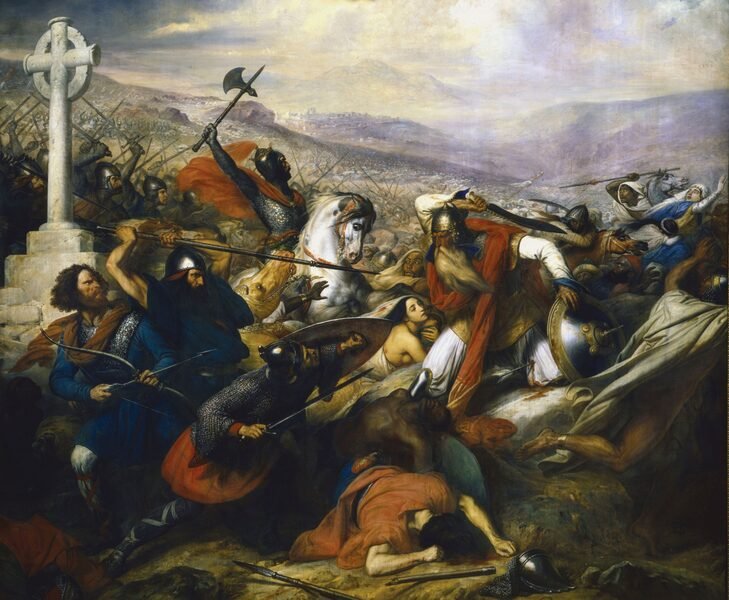
Charles de Steuben’s painting romantically portrays Charles Martel’s victory over Abd al-Rahman at Tours.
The Battle of Tours, also known as the Battle of Poitiers or the Battle of the Highway of the Martyrs, took place on October 10, 732. This pivotal encounter during the Umayyad invasion of Gaul ended with a decisive victory for the Frankish and Aquitanian forces led by Charles Martel, defeating the invading Umayyad forces under Abd al-Rahman al-Ghafiqi, the governor of al-Andalus. A number of historians have recognized its significance in halting the spread of Islam in Western Europe, shaping the continent’s destiny.
Historical Context and Background
By the early 8th century, the Umayyad Caliphate had become a dominant military power, expanding rapidly across the Iberian Peninsula after the invasion of the Visigothic Kingdom in 711. These conquests set the stage for military campaigns into Gaul, reaching Aquitaine and Burgundy by the 720s. The caliphate’s goal was not only expansion but also securing dominance over the region.
The Frankish realm, under the command of Charles Martel, was emerging as a key power in Western Europe. Despite internal struggles and external threats, including from Saxons and Frisians, Martel’s leadership positioned the Franks as a formidable military force. His alliance with Odo the Great, Duke of Aquitaine, became a critical element in countering the Umayyad advances.
Prelude to the Battle
Before the confrontation at Tours, the Umayyad forces had conducted several successful raids, including capturing Bordeaux and devastating the region around the Garonne River. Their ultimate goal may have included the Abbey of Saint Martin of Tours, a site of great spiritual and material wealth.
The Umayyads, after conquering the Iberian Peninsula, launched raids into Gaul, aiming to expand their domain. Their forces had earlier victories, including sacking Bordeaux and defeating Aquitanian troops under Duke Odo the Great.
In response, Charles Martel meticulously prepared his forces. Unlike his opponents, the Frankish troops consisted primarily of disciplined and battle-hardened infantry. Martel avoided the Roman roads to surprise the advancing Umayyads, positioning his army strategically near Tours.
Key Events of the Battle of Tours
For seven days, both armies engaged in minor skirmishes. The Franks took a defensive position on elevated terrain, using forests and hills to obstruct the Umayyad cavalry’s mobility. Charles’ strategy relied on patience, discipline, and leveraging the terrain.
On the seventh day, Abd al-Rahman launched repeated cavalry charges against the Frankish phalanx. Despite breaking into the Frankish lines at times, the Umayyads could not dismantle the Frankish formation. The battle’s turning point came when Abd al-Rahman was killed, causing confusion among his troops. Sensing vulnerability, the Franks pressed their advantage.
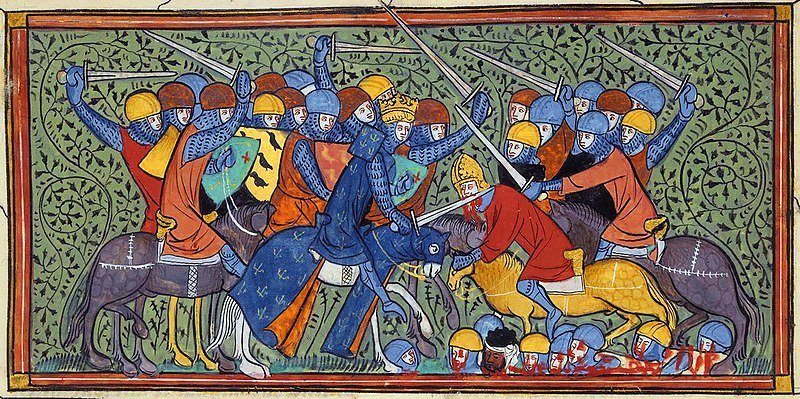
Charles Martel, portrayed at the Battle of Tours in the “Grandes Chroniques de France”.
Aftermath and Consequences
Following Abd al-Rahman’s death, the Umayyad forces retreated overnight. The Frankish army, wary of potential traps, did not pursue immediately. The retreat marked the end of significant Umayyad incursions into Gaul.
The victory at Tours solidified Charles Martel’s reputation as a military leader. It laid the foundation for the Carolingian Empire, which dominated Western Europe for the next century. By asserting Frankish dominance, the battle ensured the continuation of Christian rule in the region.
Historical Significance
The Battle of Tours is often viewed as a critical moment in halting the northward expansion of Islam. Although some historians argue that the battle’s significance has been overstated, many agree that it prevented further Umayyad advances into Western Europe, preserving the continent’s Christian character.
By halting the advance of a powerful adversary, Charles Martel not only safeguarded his realm but also laid the groundwork for the Carolingian Renaissance and the future of Western Europe.
The battle demonstrated the effectiveness of disciplined infantry formations against cavalry charges. The Franks’ use of terrain and defensive strategies highlighted the importance of preparation and adaptability in medieval warfare.
By defeating a powerful external threat, Charles Martel reinforced the unity of the Frankish realm. His success also paved the way for his descendants, including Charlemagne, to expand and consolidate power across Europe.
Controversies and Debates
The exact location of the battle, the number of combatants, and casualty figures remain unclear due to conflicting accounts. Some sources, like the Mozarabic Chronicle of 754, suggest a larger Frankish army, while others estimate the Umayyad forces as vastly superior in size.
Modern historians are divided on the battle’s significance. Critics argue that the Umayyad invasion was more of a large-scale raid than a genuine attempt to conquer Gaul. They suggest that internal factors within the Umayyad Caliphate, including the Berber Revolt, played a greater role in limiting their expansion.
The battle has been romanticized in Western narratives, often portrayed as a decisive struggle between Christianity and Islam. While this perspective highlights its symbolic importance, it risks oversimplifying the complex motivations and outcomes of the conflict.
Broader Implications
The battle marked the beginning of a gradual decline in Umayyad influence in Europe. The caliphate’s focus shifted back to internal challenges and maintaining control over its vast territories. In contrast, the Franks emerged as a dominant force, shaping the political landscape of medieval Europe.
By securing the Frankish realm, the battle ensured the survival of Christian institutions and cultural traditions. Monasteries, as centers of learning, played a crucial role in preserving knowledge during the Middle Ages.
Frequently Asked Questions
Why is the Battle of Tours significant?
Many historians, including Edward Gibbon, consider it a pivotal event in halting the spread of Islam into Western Europe, ensuring the dominance of Christianity in the region and laying the foundations of the Carolingian Empire.
Where did the battle take place?
The battle was fought near the cities of Tours and Poitiers in northern Aquitaine, modern-day France, though the exact location remains uncertain.
Who were the leaders of the opposing forces?
The Frankish forces were led by Charles Martel, while the Umayyad forces were commanded by Abd al-Rahman al-Ghafiqi, who was killed in the battle.
What were the outcomes of the battle?
The Frankish forces emerged victorious. The Umayyads retreated, and the battle secured Frankish dominance in Western Europe. It also weakened the momentum of the Umayyad expansion beyond the Iberian Peninsula.
How many troops participated, and what were the casualties?
Estimates vary widely, but modern historians suggest both armies had around 20,000–30,000 soldiers. The Frankish casualties were minimal, while Umayyad losses were significantly higher, though figures are debated.
What tactics did Charles Martel use?
Martel employed a defensive phalanx-like formation on high ground, utilizing the terrain and forest to neutralize the Umayyad cavalry’s effectiveness.
What is the modern historical debate on the battle’s significance?
Some historians argue the battle decisively shaped European history, while others downplay its importance, suggesting the Umayyad forces were primarily conducting raids rather than planning full-scale conquest.
What happened after the battle?
The Umayyad forces retreated across the Pyrenees. Charles Martel continued campaigns to consolidate Frankish power and repel further incursions, while the Umayyads faced internal unrest and eventually retreated from Septimania in 759.





