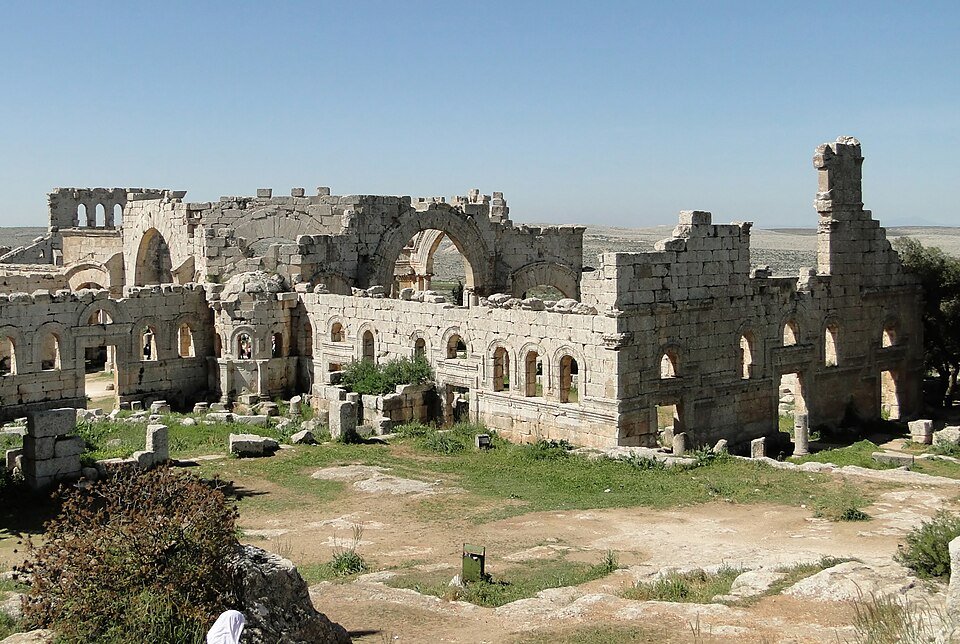
Overview of Church of Saint Simeon Stylites complex
The Church of Saint Simeon Stylites, located approximately 30 kilometers (18.64 miles) northwestern of Aleppo, Syria, is a notable and ancient church complex that holds a deep connection to the history of early Christian asceticism and pilgrimage. Founded in the 5th century, this church was constructed on the site where Saint Simeon Stylites, one of the most famous early Christian hermits, lived atop a pillar for decades. It is an important archaeological and religious site, often referred to as either Qalaat Semaan (the “Fortress of Simeon”) or Deir Semaan (the “Monastery of Simeon”). Over the centuries, the church has endured numerous wars, including the Arab-Byzantine War and the Syrian Civil War, all of which have left their mark on its structures.
The Life of Saint Simeon Stylites
Saint Simeon was born around 390 AD in the Amanus mountains village of northern Syria. From a young age, Simeon was drawn to asceticism, entering a monastery at the age of 16. However, his extreme devotion to self-denial led to his exclusion from the monastic community as he was deemed unsuitable for cenobitic life, which involved living in communal monastic settings. In search of solitude, Simeon retreated into the wilderness, emulating the example of Saint Anthony of Egypt, another prominent hermit.
Simeon’s ascetic practices, such as extreme fasting and physical endurance, began to attract a following of pilgrims and admirers, eager to learn from his example. In an attempt to further isolate himself from the distractions of these visitors, he chose to live on a platform atop a 3-meter high pillar, a decision that would make him famous. Over time, the height of the pillar was raised to an extraordinary 18 meters. Simeon preached to the crowds twice a day from this lofty perch, and a ladder was placed to enable messengers to bring him food and messages. His renown spread, and even the Eastern Roman emperors—Theodosius, Leo, and Theodosius II—sought his counsel.
Simeon lived atop the pillar for over 30 years before dying in 459 AD at the age of 69. His death triggered a fierce dispute over the possession of his remains, which were ultimately sent to Antioch. His tomb became a major pilgrimage destination for Christian devotees, further cementing his legacy.
Construction of the Church Complex
After Simeon’s death, the site where he had lived became a focal point for Christian worship and pilgrimage. Within a few decades, a large monastic church was constructed on the site, completed in 473 AD. The design of the church was ambitious and reflected the growing importance of the pilgrimage site. The church was built around a central octagonal crossing and consisted of four basilicas, with the central dome crowning the structure. At the heart of the church was Simeon’s column, the very site of his ascetic lifestyle.
The Church of Saint Simeon Stylites is more than just a religious site—it is a testament to the enduring power of faith and asceticism in the early Christian world.
The church complex was a grand architectural endeavor, extending over 5,000 square meters. The design featured numerous additions and refinements, including a series of chapels and auxiliary structures, such as hostels for pilgrims and other monastic buildings. The church’s role as both a religious and architectural landmark became evident as it drew large numbers of visitors each year.
9 Greatest Catholic Saints of All Time and Their Accomplishments
Architecture and Layout of the Church
The Church of Saint Simeon Stylites was designed as a large, cruciform structure composed of four basilicas, each aligned with one of the cardinal directions. This layout was symbolic of the Christian cross and was meant to enhance the spiritual experience of those who came to the site. The basilicas were arranged around a central courtyard, which was octagonal in shape. The central column of Saint Simeon stood at the very heart of the complex, reducing over time to a small boulder due to relic-seeking pilgrims who chipped off parts of the column.
One of the most notable architectural elements of the church is its four-basilica design. The east basilica, in particular, was the largest and most significant, hosting major ceremonies and liturgies. The U-shaped monastery, located to the south of the eastern basilica, provided additional space for monastic life and prayer. The monastery itself had been established earlier in the 5th century as a place for ascetics and monks, with the name Telanissos, before Saint Simeon took residence atop the pillar nearby.
The baptistery, a key feature of the pilgrimage complex, was situated opposite the southern basilica. The baptistery was a finely constructed structure, designed in two phases. Initially, the octagonal drum was built, and later a basilica was added. The baptistery played an essential role in the liturgical functions of the complex, serving as a site for baptisms. Its design was admired for its architectural sophistication, particularly the semi-circular apsidiole that housed a tunnel leading to an underground chamber.
The Significance of the Church Complex
The Church of Saint Simeon Stylites was not just a place of worship; it also symbolized the growing influence of Christian asceticism and monasticism in the Byzantine world. The construction of the church on the site of Saint Simeon’s pillar marked the transformation of a solitary and austere lifestyle into a grand, institutionalized religious complex. The church became a focal point for pilgrims, many of whom sought to pay homage to Saint Simeon’s memory and seek spiritual guidance. Its central location in the countryside allowed pilgrims to journey from afar, contributing to the spread of Christianity throughout the region.
The Church and the Arab-Byzantine War
Following the Arab conquest of Syria in the 7th century, the church and its surrounding complex underwent significant changes. The church complex was fortifying, and the role of the site as a sacred destination became increasingly complicated due to political and military struggles. During the Arab-Byzantine Wars, the church was attacked and later captured by Sa’d al-Dawla, the Emir of Aleppo. He repurposed the complex as a fortress, and the site’s religious significance was somewhat overshadowed by its new military function. Despite this, pilgrims continued to visit the site, and the church remained a prominent symbol of the Christian faith in Syria.
Damage During the Syrian Civil War
The Church of Saint Simeon Stylites, like many other historical sites in Syria, suffered immense damage during the Syrian Civil War. The church complex was subjected to illegal excavations, stone removal, and even airstrikes, particularly after the site became embroiled in the broader conflict involving various factions vying for control. In 2015, the church was briefly captured by Kurdish forces, only to be recaptured by opposing factions. The site suffered significant damage when, in May 2016, Russian airstrikes targeted the area, further harming the already crumbling remains of the pillar of Saint Simeon and other parts of the church complex.
The destruction of the church, along with many other ancient structures, highlights the tragic toll that the civil war has taken on Syria’s cultural heritage. As of 2020, the area near the church complex was under the control of Turkish forces, further complicating the situation. Despite these challenges, the Church of Saint Simeon remains an important symbol of the rich religious and architectural history of Syria.
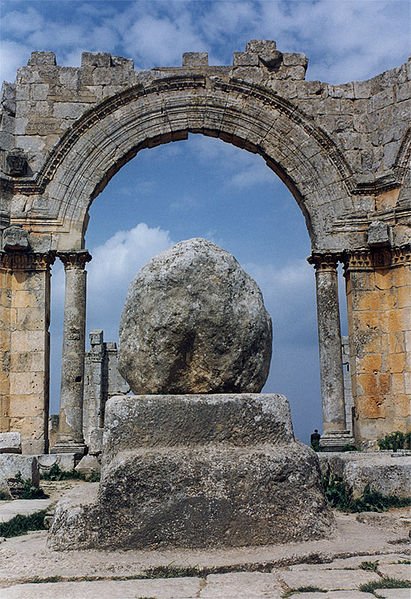
The ruins of Saint Simeon Stylites’ pillar in 2000, prior to the 2016 Russian airstrikes.
UNESCO World Heritage Status
In recognition of its historical and cultural significance, the Church of Saint Simeon Stylites, along with its surrounding village, was designated a UNESCO World Heritage Site in June 2011. As part of the “Ancient Villages of Northern Syria,” the site is now protected under international agreements aimed at preserving Syria’s invaluable heritage. However, ongoing conflicts and the challenges of maintaining the site in a region ravaged by war continue to threaten its future.
Frequently Asked Questions
Who was Saint Simeon Stylites?
Saint Simeon was a 5th-century Christian ascetic who lived on a pillar for over 30 years, attracting pilgrims with his extreme acts of self-denial and religious teachings.
What is the significance of the Church of Saint Simeon Stylites?
The church marks the site of Saint Simeon’s ascetic life, becoming a major pilgrimage destination. It also symbolizes the spread of early Christian monasticism and asceticism in the region.
How was the Church of Saint Simeon Stylites designed?
The church was designed as a cruciform structure with four basilicas surrounding a central octagonal crossing. The complex housed various chapels, a monastery, and a baptistery for pilgrims.
What role did the Church of Saint Simeon Stylites play in Christian pilgrimage?
The church became a key pilgrimage site where followers could pay homage to Saint Simeon and seek spiritual guidance, with the central pillar where he lived remaining a focal point.
What happened to the church during the Arab-Byzantine Wars?
During the Arab conquest of Syria, the church was repurposed as a fortress by the Emir of Aleppo, although it continued to attract Christian pilgrims.
How has the church complex been affected by modern conflicts?
The church complex suffered significant damage during the Syrian Civil War, including airstrikes and illegal excavations, which harmed the historical site and its surrounding structures.
What is the current status of the Church of Saint Simeon Stylites?
As of 2011, the church and surrounding village were designated a UNESCO World Heritage Site, although the site remains under threat due to ongoing regional conflicts.





