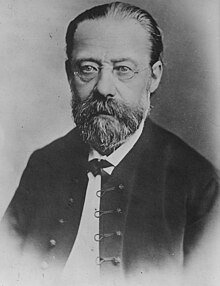
Bedřich Smetana (2 March 1824 – 12 May 1884)
Bedřich Smetana was a Czech composer celebrated as the father of Czech music, pioneering a musical style linked to Czech cultural and political revival.
Early Life and Background
Bedřich Smetana was born on March 2, 1824, in Litomyšl, a town in the Bohemian region of the Austrian Empire, which is now part of the Czech Republic. Born into a family with strong musical inclinations, his father, František Smetana, was a brewer who played violin in a local quartet. Smetana was the third child and the first son of his parents, Barbora Linková and František, who had children from previous marriages.
From a young age, Smetana demonstrated exceptional musical talent. At six years old, he gave his first public performance, showcasing an innate aptitude for piano. Encouraged by his early success, his father initially supported his musical interests, though he later hoped Bedřich would pursue a more stable career. This tension between family expectations and personal ambition would shape Smetana’s early life.
Musical Education and Early Challenges
Smetana’s formal education began in Prague at the Academic Grammar School, where he studied under Josef Jungmann, a notable figure in the Czech National Revival. However, Smetana struggled with academics and often skipped classes to immerse himself in Prague’s musical scene. Inspired by Franz Liszt’s performances, he aspired to achieve technical mastery on the piano while developing his compositional skills.
In 1843, after convincing his father of his dedication to music, Smetana began studying with Josef Proksch, a prominent music teacher. Proksch introduced him to advanced compositional techniques and exposed him to the works of Liszt, Berlioz, and other luminaries of the Romantic era. During this period, Smetana composed several piano pieces and began experimenting with orchestral works.
Revolutionary Spirit and National Identity
The political turbulence of 1848 deeply influenced Smetana. As revolutionary sentiments spread across Europe, he joined Prague’s pro-democracy movement, contributing to the nationalist cause by composing patriotic marches and songs. These compositions reflected his growing desire to connect his music with Czech identity.
Despite his efforts, Smetana struggled to gain recognition in Prague’s conservative musical circles. Disillusioned, he sought opportunities elsewhere and moved to Gothenburg, Sweden, in 1856. There, he established himself as a teacher, conductor, and composer, laying the groundwork for his future success.
Return to Prague and Operatic Success
In the early 1860s, a more liberal political climate in Bohemia encouraged Smetana’s return to Prague. Determined to advance Czech culture through music, he became involved in the city’s burgeoning operatic scene. His first opera, The Brandenburgers in Bohemia, premiered in 1866 and was well received, solidifying his reputation as a composer of Czech opera. That same year, The Bartered Bride premiered, achieving widespread acclaim. This comic opera, infused with Czech folk dances and melodies, became a cornerstone of the Czech operatic tradition.
Smetana’s first opera, The Brandenburgers in Bohemia, premiered in 1866 and was well received, solidifying his reputation as a composer of Czech opera.
Smetana’s appointment as the principal conductor of the Provisional Theatre in 1866 further positioned him as a leader in the development of Czech music. However, his embrace of the progressive ideas of composers like Liszt and Wagner sparked controversy. Critics accused him of abandoning traditional Czech styles, creating significant opposition within Prague’s musical community.
Deafness and Creative Resurgence
In 1874, Smetana’s health took a dramatic turn when he became completely deaf. Despite this debilitating condition, he entered one of the most prolific phases of his career. Freed from the pressures of conducting, Smetana devoted himself entirely to composition. During this time, he created his masterpiece, Má vlast (“My Fatherland”), a cycle of six symphonic poems celebrating Czech history, mythology, and landscapes. The most famous of these, Vltava (“The Moldau”), vividly depicts the journey of the Vltava River through Bohemia.
Later Operas and National Recognition
Smetana continued to compose operas, including Libuše, a grand ceremonial work intended for the opening of Prague’s National Theatre. Though it premiered in 1881, Libuše symbolized the culmination of Smetana’s vision for a distinctly Czech operatic tradition. Other late operas, such as The Kiss and The Secret, further showcased his lyrical and dramatic prowess.
By the 1880s, Smetana was widely regarded as the father of Czech music. His works were celebrated as embodiments of Czech national identity, and he received numerous honors for his contributions.
Decline and Death
Smetana’s final years were marked by physical and mental decline. In 1883, he began experiencing symptoms of dementia, likely caused by syphilis, a condition he had contracted earlier in life. By 1884, his health had deteriorated to the point where he was institutionalized in a Prague asylum. He died on May 12, 1884, leaving behind a legacy as the pioneer of Czech music.
Legacy and Influence
Smetana’s impact on Czech music cannot be overstated. He is credited with establishing a national style that reflected the aspirations and cultural identity of his people. Works like Má vlast and The Bartered Bride remain central to Czech musical heritage and are performed internationally.
Bedřich Smetana’s works are often praised for their emotional depth and nationalistic fervor.
Comparisons with Dvořák
international reputation has often been overshadowed by that of his younger contemporary, Antonín Dvořák. While Dvořák achieved greater global recognition, Smetana’s role as the architect of Czech music remains foundational. His innovative use of folk elements, combined with Romantic expressiveness, continues to inspire composers and musicians worldwide.

Frequently Asked Questions
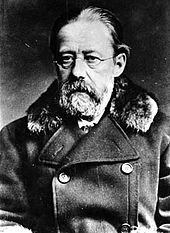
Smetana, around 1883, toward the end of his life.
What are Smetana’s most famous works?
His most renowned works are the opera The Bartered Bride and the symphonic cycle Má vlast (especially “Vltava,” also known as “The Moldau”).
What was Smetana’s role in Czech opera?
Smetana established Czech opera as a distinct genre, with works like The Bartered Bride and Libuše reflecting Czech culture and national identity.
How did deafness affect Smetana’s career?
Smetana became completely deaf in 1874, yet this period marked his most productive years, during which he composed Má vlast and three operas.
What influenced Smetana’s music?
His music was influenced by Czech nationalism, Romanticism, and progressive composers like Liszt and Wagner, though he maintained a distinct personal style.
Why did Smetana leave Prague early in his career?
After struggling to establish himself in Prague, Smetana moved to Sweden in 1856, where he gained recognition as a teacher and conductor.
What challenges did Smetana face in his later years?
Smetana faced health issues, opposition to his “modernist” music, and mental illness, which led to his confinement in an asylum before his death in 1884.





