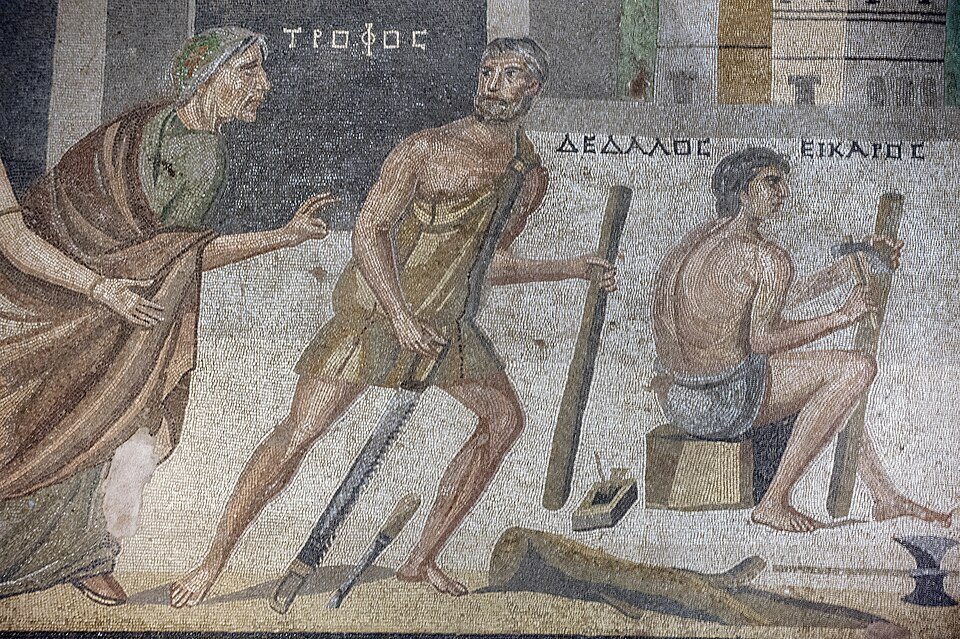
A Roman mosaic from Zeugma, Commagene, now on display at the Zeugma Mosaic Museum in Gaziantep, Turkey, illustrates Daedalus and his son Icarus.
Daedalus, a name synonymous with brilliance and craftsmanship, holds an esteemed position in Greek mythology. Known as a master architect, inventor, and artist, his stories are filled with creativity, ambition, and tragedy. Daedalus’s myths intertwine with other well-known figures, such as King Minos of Crete, the Minotaur, and his ill-fated son, Icarus. His life offers a fascinating glimpse into the realm of Greek myths where genius, pride, and punishment often go hand in hand.
Daedalus in Early Greek Texts
Daedalus’s legacy begins in the ancient Greek writings, with some of the earliest mentions found in the Linear B tablets of Mycenaean Greece, around 1410 BCE. These inscriptions hint at Daedalus being a figure of immense importance, possibly associated with religious sites.
Although Homer does not introduce Daedalus as a primary character, he references him indirectly, citing the famed artist as a part of an already established mythological tradition. Homer, through his epic works, points to Daedalus as an inventor and creator of marvelous feats like the “dancing floor” for Ariadne, highlighting the recognition Daedalus had even during the early centuries of Greek mythology.
The Myth of Daedalus’s Family
Daedalus’s family plays an integral role in the myths surrounding him. Although details vary, he is often depicted as the son of Eupalamus or Metion and, in some versions, the grandson of the Athenian king Erechtheus. His family dynamics are further complicated by the tragic events involving his nephew and son.
His Nephew, Perdix
Daedalus’s nephew, often referred to as Perdix, Talos, or Calos, was a young and talented apprentice under his watch. Perdix is credited with inventing the saw and compasses, tools that demonstrated his ingenuity. However, Daedalus, unable to bear the idea of a rival in his domain, grew envious of his nephew’s accomplishments. In a fit of jealousy, he pushed Perdix from the Acropolis, intending to kill him. Athena intervened, transforming Perdix into a partridge, a bird symbolically tied to Daedalus’s downfall. This act of murder set the stage for Daedalus’s eventual exile to Crete, marking the beginning of his many trials.
The Tragic Fate of Icarus
The most famous aspect of Daedalus’s life is his relationship with his son, Icarus. After being imprisoned by King Minos in the labyrinth he himself had constructed, Daedalus sought a way to escape. Knowing that Minos controlled all sea routes and that escaping by land was impossible, Daedalus crafted wings for himself and his son using bird feathers, beeswax, and thread.
Before they took flight, Daedalus gave Icarus a stern warning: not to fly too high, lest the heat of the sun melt the wax, and not to fly too low, where the sea foam would weigh down the feathers. But Icarus, filled with youthful abandon, ignored his father’s caution. He flew too close to the sun, causing the wax in his wings to melt. As his wings fell apart, Icarus plunged to his death in the sea, which was later named the Icarian Sea in his memory. Daedalus, devastated by the loss of his son, buried Icarus on an island and named it Icaria.
The tragic story of Icarus serves as a powerful lesson in Greek mythology about the dangers of hubris and disobedience. Icarus’s flight symbolizes the pursuit of freedom and ambition, but it also highlights the fatal consequences of ignoring wise counsel.
A Master Craftsman and Inventor
Daedalus’s fame in Greek mythology extends far beyond his tragic familial tales. He was celebrated for his remarkable craftsmanship and innovation. His works were legendary, and his creations often transcended ordinary craftsmanship, blending art, engineering, and ingenuity.
The Labyrinth and the Minotaur
One of Daedalus’s most famous achievements was the creation of the Labyrinth on the island of Crete. This immense and intricate maze was designed to imprison the Minotaur, a monstrous creature born from the union of Pasiphaë, the wife of King Minos, and a bull sent by Poseidon. Daedalus, commissioned by Minos, constructed the Labyrinth so complex that even he struggled to find his way out. The Minotaur was placed in the heart of the maze, and many of Minos’s enemies were sent into the Labyrinth to be sacrificed to the beast.
The story of the Labyrinth is intertwined with that of Theseus, the Athenian hero who ventured into the maze to slay the Minotaur. Theseus was aided by Ariadne, who provided him with a thread to help him find his way out. Daedalus, who had secretly provided Ariadne with the solution to the maze’s structure, thus became indirectly responsible for Theseus’s success.

Greek god Poseidon depicted with his trident.
The Wooden Cow and the Birth of the Minotaur
Another of Daedalus’s infamous creations was a hollow wooden cow, constructed at the request of Queen Pasiphaë. Minos, having angered Poseidon by failing to sacrifice a white bull, was punished by having his wife fall in love with the bull.
To satisfy her desire, Pasiphaë sought Daedalus’s help in creating a lifelike cow made of wood. Pasiphaë climbed inside the hollow structure and mated with the bull, resulting in the birth of the Minotaur, a creature that was part man, part bull. This creature was kept within the Labyrinth Daedalus had built.
Daedalus’s Legacy in Art and Culture
Daedalus’s influence on art and culture cannot be overstated. His name became synonymous with craftsmanship, and he was regarded as a symbol of dexterity and innovation in ancient Greece. The Daedalic style of sculpture, which emerged in the Archaic period, is named after him and is characterized by rigid and formal representations, laying the groundwork for later developments in Greek sculpture.
Furthermore, the festival of Daedala, celebrated in Boeotia, is said to have honored Daedalus and his genius. The festival involved the construction of a wooden altar and the creation of an effigy dressed as a bride, which was then paraded through the streets. The festival’s name, Daedala, may either refer to Daedalus himself or to his style of craftsmanship, depending on the source.
The Riddle of the Seashell
After the death of Icarus and his brief stay in the court of King Cocalus in Sicily, Daedalus was forced to contend with Minos once again. Minos, seeking Daedalus for the death of his son, presented a riddle involving a spiral seashell. He asked for a string to be passed through the shell’s spiral, a task that seemed impossible to accomplish. However, Daedalus, ever the clever inventor, solved the riddle by attaching a thread to an ant, which, attracted to a drop of honey, crawled through the seashell, passing the string through. Daedalus’s solution to the riddle ultimately led to Minos discovering his location.
The Death of Daedalus
Daedalus’s death, like much of his life, is shrouded in mystery and varying versions of the myth. Some accounts place his death in Sicily, where he was struck down by a snake while wandering outside the city of Camicus. Other stories suggest his death occurred in Lycia, where he was bitten by a water snake. In yet another version, Daedalus is said to have died in the Egyptian Nile after a long life of invention and exile. His tomb in the city of Daidala, located in Sicily, became a site of worship, further cementing his legacy.
The Lasting Impact of Daedalus
Daedalus’s influence can still be seen in modern interpretations of mythology. His story continues to inspire works of art, literature, and even scientific and technological achievements. The myth of Daedalus and Icarus, in particular, serves as a timeless reminder of the balance between ambition and humility, the risks of unchecked freedom, and the dangers of flying too close to the sun.
Frequently Asked Questions
What was the Labyrinth, and why was it significant?
The Labyrinth was an intricate maze Daedalus built on Crete to imprison the Minotaur, a creature born from Queen Pasiphaë’s union with a bull. It became a central element in the myth of Theseus and the Minotaur.
What role did Daedalus play in the birth of the Minotaur?
Daedalus crafted a wooden cow for Queen Pasiphaë, allowing her to mate with a bull, which led to the birth of the Minotaur, a half-man, half-bull creature.
What tragic event involved Daedalus’s son Icarus?
Daedalus created wings for himself and Icarus to escape Crete, but Icarus flew too close to the sun, melting the wax holding his wings together. He fell into the sea and drowned.
Why did Daedalus kill his nephew Perdix?
Daedalus became envious of his nephew Perdix’s inventions, such as the saw and compasses, and in a fit of jealousy, he pushed him from the Acropolis. Athena saved Perdix by turning him into a partridge.
What was Daedalus’s involvement with the seashell riddle?
When King Minos sought Daedalus after his son’s death, Daedalus solved a difficult riddle involving a spiral seashell by using an ant to thread a string through it, outsmarting Minos.
How did Daedalus’s craftsmanship influence Greek culture?
Daedalus was regarded as the epitome of skill in Greek craftsmanship. His name was used to describe a specific style of early Greek sculpture (Daedalic), and a festival named Daedala was held in his honor.
Where did Daedalus die, and how is his death described?
Daedalus’s death is shrouded in mystery, with different accounts stating he died in Sicily, Lycia, or Egypt, often attributed to being bitten by a snake. His tomb became a site of worship.





