Diodorus Siculus, a Greek historian from Sicily, offers one of the key historical accounts of the Battle of Chaeronea, which took place in 338 BCE. This battle, fought near the town of Chaeronea in Boeotia, was pivotal in establishing Macedonian dominance over Greece.
The Macedonian forces, led by King Philip II and his son Alexander (later known as Alexander the Great), defeated a coalition of Greek city-states, including Athens and Thebes.
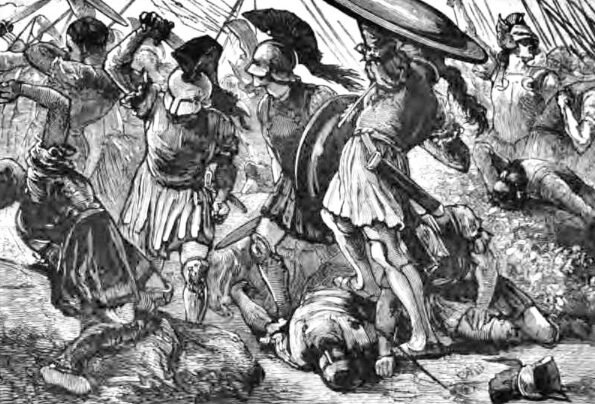
The Battle of Chaeronea unified Greece under Macedonian rule and set the stage for Philip’s plans to invade Persia, which would later be realized by Alexander. This unification of Greece laid the foundation for the spread of Hellenistic culture across the known world. Image: An 1882 depiction of the Battle of Chaeronea, from Cassell’s Illustrated Universal History
Below is a comprehensive overview of the Battle of Chaeronea according to Diodorus Siculus:
Background to the Conflict
The rise of Philip II of Macedon posed a significant challenge to the traditional independence of the Greek city-states. Throughout the 4th century BCE, Greece had been plagued by internal conflicts, notably the Peloponnesian War between Athens and Sparta, which weakened the Greek world. As Philip extended his influence through military conquests and diplomacy, many Greek states, particularly Athens and Thebes, grew increasingly concerned.
Philip’s expansionist policies, including his control over Thessaly and his influence in central Greece, triggered the formation of a Hellenic alliance against him. Athens and Thebes, historical rivals, joined forces against the common Macedonian threat. They formed a coalition of forces from various city-states, seeking to protect their autonomy from Macedonian domination.
Diodorus records that, tensions escalated when Philip sought control over Greece through the Amphictyonic Council, a religious and political league. His intervention in the Third Sacred War, which involved conflicts over the control of Delphi and its sacred treasury, further inflamed the situation. Eventually, Philip’s ambitions for hegemony led to an open confrontation with the Greek coalition.
READ MORE: Why was Alexander the Great exiled by his father?
The Armies and Preparation
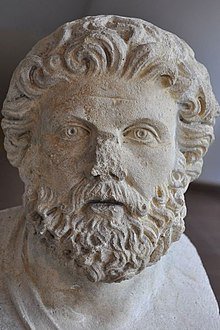
The Battle of Chaeronea marked the end of the classical era of independent Greek city-states and the rise of Macedonian power under Philip II. Image: Statue of Philip II, 350-400 AD. Rheinisches Landesmuseum Trier.
Diodorus describes the preparations for war as both sides amassed their forces. Philip’s army was well-trained, battle-hardened, and bolstered by innovations such as the Macedonian phalanx, a dense infantry formation armed with long spears (sarissas). This formation was highly disciplined and effective in battle.
On the other side, the Greek coalition army was a mix of city-state forces, each bringing their own contingents. Athens provided hoplites, heavily armored infantrymen, while Thebes contributed the elite Sacred Band, a unit of 300 warriors known for their courage and unity in battle. Despite their differences, the Athenians and Thebans, alongside other allies, aimed to confront Philip in the field to preserve their freedom.
The Battle of Chaeronea
Diodorus Siculus recounts that the two armies met at Chaeronea in Boeotia. The exact size of the forces is debated among historians, but Philip’s army likely numbered around 30,000 men, while the Greek coalition fielded a somewhat smaller force. The battle was a crucial test of Philip’s military reforms and his ability to decisively defeat the Greek states.
The Macedonian army, commanded by Philip himself, took the right wing of the battlefield, while his son, Alexander, who was only 18 years old at the time, was given command of the left wing. Alexander’s presence on the battlefield is notable as it marked one of his first major roles in a military engagement.
Diodorus highlights Philip’s tactical genius in the battle. Instead of launching an immediate, full-scale attack, Philip feigned a retreat on the right wing where he commanded. This tactical maneuver drew the Athenians, who believed they were gaining the upper hand, out of their defensive positions and into more vulnerable terrain. The Athenians, who were led by commanders such as Chares and Lysicles, fell into Philip’s trap, and their formation began to weaken as they pursued the Macedonian forces.
Meanwhile, on the left wing, Alexander launched a ferocious assault on the Thebans. Diodorus Siculus emphasizes Alexander’s role in this part of the battle, noting that he fought with exceptional bravery and determination. The elite Sacred Band of Thebes, known for their valor, fought valiantly against Alexander’s forces but were eventually overwhelmed and annihilated. This marked a significant turning point in the battle.
Once the Athenian forces had been drawn out and disordered, Philip ordered his troops to turn and launch a counterattack. The Macedonian phalanx, with its long sarissas, pressed the Athenians, whose lines collapsed under the pressure. The combination of Alexander’s success on the left and Philip’s tactical maneuvering on the right resulted in a devastating defeat for the Greek coalition.
Aftermath of the Battle
Diodorus Siculus portrays the aftermath of Chaeronea as a momentous event in Greek history. The defeat at Chaeronea effectively ended any hope of resistance to Macedonian power. Thebes and Athens, the leading states of the coalition, were forced to accept Philip’s terms of surrender. While Thebes suffered harsh consequences, including the installation of a Macedonian garrison, Athens was treated more leniently due to its naval power and cultural significance. Philip sought to incorporate Athens into his future plans rather than destroy it.
Diodorus remarks that Philip, after his victory, was both magnanimous and strategic. He respected the fallen soldiers and arranged for their proper burial, a gesture that helped to smooth relations with the defeated cities. His victory at Chaeronea gave him the power to form the Corinthian League, a federation of Greek states under Macedonian leadership. This league would become the foundation for Philip’s planned invasion of Persia, a campaign that would later be undertaken by his son Alexander.
Alexander’s Role and Legacy
The Battle of Chaeronea is significant not only for establishing Macedonian dominance over Greece but also for launching the military career of Alexander the Great. Diodorus Siculus highlights how the battle showcased Alexander’s military talent and courage at a young age. His leadership of the Macedonian left wing and his defeat of the Sacred Band were early indicators of his future greatness.
Diodorus emphasizes that while Philip was the architect of the Macedonian victory, Alexander’s actions were critical to the battle’s outcome. His boldness on the battlefield and his ability to inspire his troops earned him recognition within the Macedonian army and the Greek world. This battle marked the beginning of his rise to power, which would culminate in his conquests of the Persian Empire.
Significance in Greek History
According to Diodorus, the Battle of Chaeronea marked the end of the classical era of Greek independence. The city-states, which had long been the dominant political units of the Greek world, were now subject to Macedonian authority. Philip’s victory at Chaeronea allowed him to impose a new political order on Greece, uniting the city-states under his leadership while maintaining a degree of local autonomy.
The battle also had profound cultural and psychological effects on the Greek world. For many Greeks, the defeat symbolized the end of the era of free and independent city-states. Diodorus reflects on how the battle reshaped Greek identity, as the Greeks now looked to Macedon for leadership rather than to their own traditional powers.
Conclusion
Diodorus Siculus’ account of the Battle of Chaeronea highlights its importance as a turning point in Greek history. Philip’s tactical brilliance, Alexander’s emergence as a military leader, and the decisive defeat of the Greek coalition all contributed to the rise of Macedon as the dominant power in the Greek world.
Undoubtedly, the battle paved the way for Philip’s plans to invade Persia and laid the groundwork for the future conquests of Alexander the Great.
Questions and Answers for the Battle of Chaeronea

Chaeronea, Boeotia, Greece
What was the significance of the Battle of Chaeronea?
The Battle of Chaeronea, fought in 338 BCE, marked a decisive turning point in Greek history. It saw the forces of Philip II of Macedon defeat the combined armies of Athens and Thebes, effectively ending the era of independent Greek city-states and bringing Greece under Macedonian rule. The victory set the stage for Philip’s leadership of a united Greece and paved the way for future conquests by his son, Alexander the Great.
What caused the Battle of Chaeronea?
The battle was a result of Philip II’s expansion of power in Greece through military conquest and alliances with other Greek states such as Thessaly, Epirus, Aetolia, and Northern Phocis. His ambitions, however, alarmed Athens and Thebes, leading them to form an alliance to resist Macedonian dominance. The immediate trigger was Philip’s seizure of the town of Elateia in Phocis, which prompted panic in Athens and led to the alliance with Thebes.

Image: Niketerion (victory medallion) bearing the effigy of king Philip II of Macedon, 3rd century AD, probably minted during the reign of Roman Emperor Alexander Severus
How did Athens and Thebes react to Philip’s advance?
Athens and Thebes, traditionally rivals, formed an alliance to defend against Philip. The Athenian statesman Demosthenes urged his fellow citizens to seek Thebes’ support in a united front against Macedon, despite past hostilities. Both cities realized that they had to cooperate to preserve their independence from Macedonian domination.
How large were the forces on each side at the Battle of Chaeronea?
Philip II’s Macedonian army consisted of around 30,000 infantry and 2,000 cavalry. His forces were well-trained and included the famous Macedonian phalanx, a disciplined infantry formation. The Greek coalition army, though formidable, lacked the same level of experience and cohesion. Athens contributed hoplites, while Thebes provided the Sacred Band, an elite unit of 300 soldiers.
What role did Alexander the Great play in the Battle of Chaeronea?
At just 18 years old, Alexander commanded the left wing of the Macedonian army. His leadership was instrumental in breaking through the Theban lines, particularly defeating the Sacred Band of Thebes. His actions in the battle demonstrated his military prowess and helped secure the Macedonian victory, marking the beginning of his legendary military career.

Alexander Mosaic, National Archaeological Museum, Naples.
What tactics did Philip II use to win the battle?
Philip employed a clever strategy by feigning a retreat on his right wing, drawing the Athenian forces out of their defensive positions. This caused disorganization in the Athenian ranks. Meanwhile, Alexander led a bold assault on the Theban forces, breaking through their lines. After Alexander’s success, Philip launched a counterattack on the disordered Athenian forces, leading to a complete rout of the Greek coalition.
What were the casualties of the Battle of Chaeronea?
Over 1,000 Athenians were killed, and 2,000 were taken prisoner. The Theban casualties were similarly heavy, and the Sacred Band of Thebes was completely annihilated during the battle.
What were the consequences of the Battle of Chaeronea for Athens and Thebes?
After their defeat, Athens and Thebes were forced to accept Macedonian dominance. Philip showed restraint in victory, renewing peace with Athens and allowing it to retain much of its local autonomy. However, he placed a Macedonian garrison in Thebes to maintain control. The battle also allowed Philip to form the Corinthian League, a federation of Greek city-states that would support his planned invasion of Persia.
Why is the Battle of Chaeronea considered important for Alexander the Great’s legacy?
The Battle of Chaeronea is significant because it was Alexander’s first major military engagement. His success in breaking through the Theban lines and his leadership at such a young age foreshadowed the military genius he would later display in his conquests. It also solidified his position as Philip’s successor and hinted at the future dominance he would achieve as Alexander the Great.
A brief history of Ancient Athens and how it became the birthplace of Western Civilization





