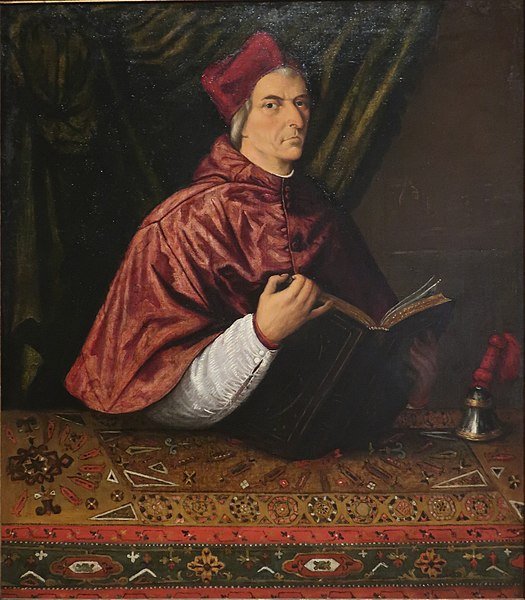
Domenico Grimani
Domenico Grimani was an Italian nobleman, theologian, and cardinal known for his ecclesiastical pluralism and patronage of humanist scholarship.
Early Life and Education
Domenico Grimani was born on February 22, 1461, in Venice, into one of the city’s most influential noble families. His father, Antonio Grimani, later became the Doge of Venice (1521–1523), while his mother, Catarina Loredan, belonged to another distinguished Venetian lineage.
Growing up in an environment of political and intellectual prominence, Grimani displayed a keen interest in humanist studies from an early age. His education was fostered in Venice, where he encountered scholars and tutors who encouraged his passion for learning and philosophy.
As he matured, Grimani’s intellectual pursuits led him to Florence, where he became involved with the Medicean Academy, a prestigious center for Renaissance humanism. There, he formed relationships with eminent thinkers such as Pico della Mirandola and Poliziano. Their philosophical discussions influenced his approach to theology and classical studies.
Continuing his formal education, he attended the University of Padua, one of Europe’s most esteemed institutions, where he earned a doctorate in canon law on October 23, 1487. His academic achievements were quickly recognized, and he was elected a Senator of Venice that same year, marking the beginning of his political and ecclesiastical career.
Ecclesiastical Career and Rise to Cardinalate
Grimani’s rapid rise in the church hierarchy was facilitated by his noble status and intellectual reputation. In 1491, Pope Innocent VIII appointed him as papal secretary, a role that brought him closer to the inner workings of the Vatican. His influence expanded further when he was named a protonotary apostolic, a senior administrative position in the papal bureaucracy.
In 1493, he was elevated to the rank of cardinal by Pope Alexander VI. This appointment, however, was secured through financial negotiations, as his father reportedly paid between 24,000 and 31,000 ducats to secure his son’s position. Such practices were common among noble families seeking to strengthen their influence within the Catholic Church. Despite the monetary aspect of his promotion, Grimani’s intellectual stature and theological knowledge justified his elevation.
Domenico Grimani’s influence extended beyond his lifetime through the institutions and collections he nurtured.
Grimani was ordained a priest in 1498 and continued to accumulate significant ecclesiastical positions. In 1503, he became the Cardinal Priest of San Marco Evangelista al Campidoglio in Rome, further consolidating his status within the church.
He also served as the apostolic administrator of Nicosia and later as the Patriarch of Aquileia, a prestigious post he held from 1497 until 1517, when he ceded the position to his nephew Marino Grimani, who later also became a cardinal.
Additionally, in 1508, he was appointed Cardinal Bishop of Albano, and by 1514, he had assumed administrative control of the Diocese of Urbino. From 1517 to 1520, he also held the position of Bishop of Ceneda.
Theological Contributions and Patronage of Humanism
Grimani’s deep engagement with theology was evident in his writings and translations. He authored several theological treatises, exploring doctrinal and philosophical themes that reflected his humanist education.
His intellectual pursuits also extended to translation, most notably rendering the homilies of John Chrysostom into Latin, making them accessible to a broader audience in the Western Church.
His commitment to humanism was further demonstrated through his patronage of scholars and artists. A known admirer of Desiderius Erasmus, the Dutch humanist dedicated his work Musica to Grimani, acknowledging his support and intellectual camaraderie. This patronage extended beyond theological studies into the visual arts, as he became one of the most distinguished art collectors of his time.
Grimani’s Influence in Art and Manuscript Collecting
As a Renaissance patron, Grimani amassed a remarkable collection of paintings, sculptures, and manuscripts. His collection featured works by some of the most renowned artists of the era, including Leonardo da Vinci, Giorgione, Titian, Hans Memling, Hieronymus Bosch, and Raphael. These masterpieces reflected his refined taste and deep appreciation for artistic excellence.
One of his most significant contributions to art history was the Grimani Breviary, a lavishly illuminated manuscript created between 1515 and 1520 in Ghent and Bruges. Although it is unclear whether he originally commissioned it, the breviary became one of the most treasured possessions in his collection. It features the work of leading Flemish artists, including Simon Bening and Gerard David, and remains a masterpiece of late medieval illumination. Today, the Grimani Breviary is housed in the Biblioteca Marciana in Venice, preserving the cardinal’s legacy as a patron of the arts.
Grimani’s love for classical antiquity also led him to collect ancient sculptures, many of which were discovered on land his family owned on the Quirinal Hill in Rome. These artifacts, originally part of Roman baths and gardens, further enriched his extensive collection.
His manuscripts, particularly those in Hebrew, Greek, and Latin, were later bequeathed to the religious community at S. Antonio di Castello, ensuring their preservation and continued scholarly use.
Later Years and Death
Despite his significant achievements in both ecclesiastical and cultural spheres, Grimani’s later years were marked by declining health. He participated in the papal conclave of 1521, which elected Pope Adrian VI, but by then, his condition had worsened. He passed away on August 27, 1523, in Rome. Initially buried in the church of Santi Giovanni e Paolo, his remains were later transferred to San Francesco della Vigna in Venice, fulfilling his wish to rest in his homeland.
Legacy and Historical Significance
Domenico Grimani remains a noteworthy figure in Renaissance history for his dual roles as a high-ranking churchman and a devoted patron of the arts and humanist scholarship. His extensive collection of paintings, illuminated manuscripts, and classical antiquities solidified his reputation as one of the foremost collectors of his time.
By fostering intellectual exchange and supporting humanist endeavors, Domenico Grimani bridged the worlds of theology, art, and philosophy.
Frequently Asked Questions
What was Domenico Grimani’s family background?
He was the eldest son of Antonio Grimani, Doge of Venice, and Catarina Loredan.
What was his educational background?
He studied humanism in Venice and Florence and earned a doctorate in canon law from the University of Padua in 1487.
How did he rise in the Church hierarchy?
He became papal secretary in 1491, a cardinal in 1493, and later held multiple bishoprics, including Patriarch of Aquileia and Cardinal Bishop of Albano.
What role did he play in Venice and the Papal Court?
He was elected a Venetian senator in 1487 and played a key role in papal administration, serving as apostolic administrator in various dioceses.
What was his contribution to the arts?
He was a notable art collector, owning works by Leonardo da Vinci, Titian, and Hieronymus Bosch, with his collection now in Venice’s Museo d’Antichità.
What was the Grimani Breviary?
It was a masterpiece of Flemish illuminated manuscripts, owned by Grimani and now preserved in the Biblioteca Marciana, Venice.





