John Lloyd Stephens and Frederick Catherwood played crucial roles in bringing the ancient Maya civilization to the attention of the world. Their pioneering expeditions in the 19th century led to the discovery and documentation of numerous Maya ruins, previously unknown to most of the Western world. Their work not only highlighted the grandeur of Maya architecture and art but also laid the foundation for future archaeological studies of the region.
Below is a detailed examination of their journeys, contributions, and the significance of their work in understanding the Maya civilization.
John Lloyd Stephens
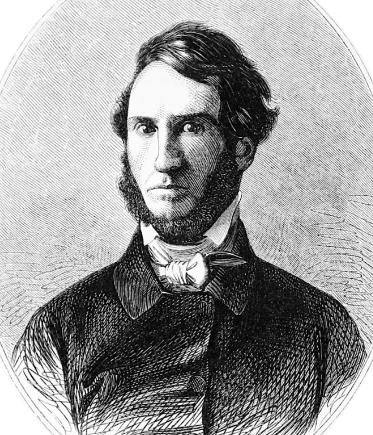
John Lloyd Stephens
John Lloyd Stephens, born in 1805 in New Jersey, was a lawyer by profession. However, his interest in travel and exploration soon eclipsed his legal career. After studying law at Columbia College (now Columbia University) and gaining experience in the legal field, he began to pursue travel writing.
Stephens traveled extensively in Europe, the Middle East, and other regions, documenting his experiences in several popular travelogues. His vivid descriptions and keen observations of culture, history, and architecture earned him a reputation as a skilled writer and adventurer.
In the early 1830s, Stephens took a particular interest in the ancient civilizations of the Americas. His curiosity was piqued by reports of mysterious ruins in Central America, particularly those in the dense jungles of Mexico, Guatemala, and Honduras, which were believed to be remnants of an ancient and sophisticated culture.
In 1839, Stephens was appointed as a U.S. diplomat to Central America. This appointment allowed him to pursue his interest in the region’s history and archaeology. It was during this time that he met Frederick Catherwood, an English artist and architect, who would become his companion and collaborator on two groundbreaking expeditions into the Maya world.
Their first expedition, which took place from 1839 to 1840, focused on exploring the ruins of Copán in present-day Honduras, as well as other sites in Guatemala, Mexico, and Belize. Stephens and Catherwood traveled through rugged terrain, often facing difficult conditions in the jungle. Despite these challenges, they meticulously documented the ruins they encountered, including monumental structures, intricate carvings, and hieroglyphic inscriptions.
The ancient city of Copán was one of Stephens and Catherwood’s most significant discoveries. When they arrived in Copán in 1839, they were astonished by the scale and complexity of the site. Stephens, who was deeply impressed by the artistic and architectural achievements of the Maya, wrote extensively about the city’s pyramids, plazas, and stelae (tall stone monuments covered with carvings and inscriptions).
In his writings, Stephens expressed his amazement that such an advanced civilization had existed in the Americas long before European contact. He also noted the sophistication of Maya art and architecture, contrasting it with the widely held belief at the time that indigenous American cultures were “primitive” or unsophisticated.
Frederick Catherwood
Frederick Catherwood was born in 1799 in England and trained as an architect and artist. He had a deep interest in ancient civilizations and was particularly fascinated by the architecture of Egypt, Greece, and the Middle East.
Prior to meeting Stephens, Catherwood had already traveled extensively and produced detailed illustrations of ancient monuments in places like Egypt and Palestine.
Catherwood’s artistic skills were well-suited to the task of documenting the Maya ruins. His ability to create precise and detailed drawings of complex structures and carvings was invaluable in conveying the grandeur of the Maya civilization to a broader audience.
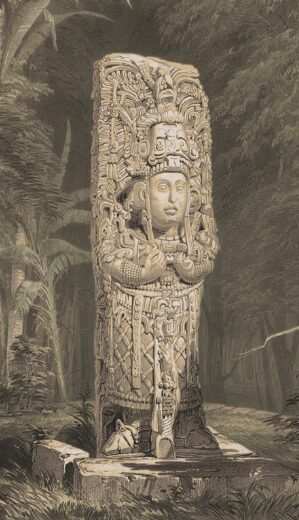
Lithograph of Stela D. Copan (1844)
Catherwood accompanied Stephens on both of their expeditions to Central America. His role was to create accurate visual representations of the ruins they explored. Using a camera lucida, a device that allowed him to project an image onto paper for more precise tracing, Catherwood produced some of the most detailed and accurate illustrations of Maya architecture and art ever made.
Catherwood’s drawings captured the intricacies of Maya sculpture, architecture, and hieroglyphic writing. His illustrations were not only artistically impressive but also scientifically valuable, as they helped future archaeologists and researchers to identify and study specific details of the ruins.
In addition to Copán, Stephens and Catherwood explored several other major Maya sites, including:
- Quiriguá: Known for its massive stelae and zoomorphic carvings, Quiriguá is located in present-day Guatemala. Catherwood’s illustrations of the site’s towering monuments were some of the first to show the scale and grandeur of Maya sculpture.
- Palenque: One of the most famous Maya cities, Palenque is located in the Mexican state of Chiapas. Stephens and Catherwood’s exploration of Palenque revealed intricate stucco reliefs and monumental architecture, including the Temple of the Inscriptions, which later became known as the tomb of the great Maya ruler Pakal.
- Uxmal: Uxmal, located in Mexico’s Yucatán Peninsula, was another major site documented by Stephens and Catherwood. The city’s Pyramid of the Magician and Governor’s Palace are among the finest examples of Maya Puuc architecture, characterized by elaborate stone mosaic patterns. Catherwood’s drawings of these structures captured their architectural precision and artistic detail.
Publication and Impact
In 1841, Stephens published Incidents of Travel in Central America, Chiapas, and Yucatán, a two-volume work that detailed his and Catherwood’s first expedition. The book was a bestseller and was widely praised for its engaging writing and detailed descriptions of the Maya ruins. Stephens’ clear, accessible prose helped to ignite popular interest in the ancient Maya civilization.
Catherwood’s illustrations, which accompanied Stephens’ text, were equally well-received. They provided readers with a visual representation of the ruins, bringing to life the splendor of the ancient cities they had discovered. The combination of Stephens’ narrative and Catherwood’s illustrations made the book both an adventure story and an important contribution to the field of archaeology.
Following the success of their first expedition, Stephens and Catherwood embarked on a second journey in 1841, during which they revisited some of the sites they had previously explored and discovered new ones, including the ruins of Chichén Itzá in the Yucatán Peninsula. This second expedition resulted in the publication of Incidents of Travel in Yucatán in 1843, another two-volume work that continued to capture the imagination of readers and scholars alike.
Once again, Catherwood’s illustrations were a key component of the book’s success. His depictions of Chichén Itzá’s El Castillo (the Temple of Kukulkan) and the Great Ball Court, among other structures, provided some of the earliest visual records of these iconic monuments.
Significance of Stephens and Catherwood’s Work
Prior to Stephens and Catherwood’s expeditions, the ancient civilizations of the Americas were not widely studied or appreciated by European and American scholars. Many people in the 19th century viewed the indigenous cultures of the Americas as inferior to those of Europe, Asia, and the Middle East. The discovery of the Maya ruins challenged these assumptions and demonstrated that the Americas had been home to advanced, highly developed societies long before European contact.
Stephens and Catherwood’s work helped to shift the perception of the Maya civilization. They showed that the Maya were skilled architects, artists, and astronomers who had developed a complex writing system and calendar. Their publications played a crucial role in changing Western attitudes toward indigenous American cultures and opened the door for further archaeological exploration of the region.
Stephens and Catherwood are often credited with laying the groundwork for the field of Mesoamerican archaeology. Their detailed documentation of Maya sites, including measurements, descriptions, and illustrations, provided a valuable resource for future researchers. Many of the ruins they discovered were later excavated and studied in greater detail by archaeologists, who built on the foundation laid by Stephens and Catherwood.
In particular, Catherwood’s illustrations have proven to be an invaluable record of Maya art and architecture. In some cases, the ruins he depicted have deteriorated or been altered by subsequent excavations, making his drawings one of the few remaining visual records of their original state.
Legacy
The legacy of John Lloyd Stephens and Frederick Catherwood is enduring. Their work continues to be studied and admired by historians, archaeologists, and enthusiasts of Maya culture. In addition to their contributions to the study of the Maya civilization, they are remembered for their adventurous spirit, perseverance, and curiosity about the world.
Today, many of the sites they explored, including Copán, Palenque, and Chichén Itzá, are UNESCO World Heritage Sites and popular tourist destinations. The ruins they documented have become symbols of the ancient Maya civilization’s achievements, and their work continues to inspire those who seek to understand the history and culture of Mesoamerica.
Conclusion
John Lloyd Stephens and Frederick Catherwood were pioneers in the exploration and documentation of the ancient Maya civilization. Through their expeditions, they brought to light the architectural and artistic achievements of a culture that had been largely forgotten by the Western world. Their publications, filled with vivid descriptions and detailed illustrations, sparked widespread interest in the Maya and laid the foundation for future archaeological research in the region. Today, their legacy lives on in the field of Mesoamerican studies and in the many Maya ruins that continue to captivate people around the world.
Frequently Asked Questions

Main temple at Tulum, a pre-Columbian Mayan site
Who were John Lloyd Stephens and Frederick Catherwood?
John Lloyd Stephens was an American explorer, writer, and diplomat, while Frederick Catherwood was an English architect and artist. They are renowned for their exploration and documentation of ancient Maya ruins across Central America and Mexico. Their work helped bring global attention to the Maya civilization.
What were some of the key publications by Stephens and Catherwood?
Stephens published two important travel narratives: Incidents of Travel in Central America, Chiapas, and Yucatán (1841) and Incidents of Travel in Yucatán (1843). Catherwood published Views of Ancient Monuments in Central America, Chiapas, and Yucatán (1844), which included detailed illustrations of the Maya ruins they explored.
Why are Stephens and Catherwood significant in the study of the Maya civilization?
They were the first to extensively document Maya ruins with precision, creating detailed descriptions and drawings of previously unknown sites. Their work played a key role in sparking international interest in the Maya civilization and laid the foundation for future archaeological studies.
What inspired Stephens to start traveling and exploring ancient sites?
Stephens was initially a lawyer but, after being diagnosed with a throat illness, he began traveling for his health. His journeys to Europe, the Mediterranean, and Egypt led him to write popular travel books, earning him the title “the American Traveler.” His fascination with ancient civilizations eventually led him to explore the Maya ruins.
How did Frederick Catherwood contribute to their expeditions?
Catherwood, an accomplished artist and architect, created highly accurate drawings of the Maya ruins using a device called the camera lucida. His illustrations were instrumental in documenting the intricate details of the Maya structures and are still used by archaeologists today to study and restore these sites.
What was one of the most significant discoveries made by Stephens and Catherwood?
One of their most significant discoveries was the ancient Maya city of Copán. Stephens described a massive stone monument with intricate reliefs and hieroglyphics, which confirmed to him that the Maya were skilled builders and artists, not a primitive society as previously thought.
How did Stephens and Catherwood’s work influence future explorers?
Their meticulous documentation of over 40 Maya sites set a new standard for exploration and influenced later explorers such as Desire de Charnay and Alfred Maudslay. These future archaeologists built upon the work of Stephens and Catherwood, continuing to uncover the rich history of the Maya.
What challenges did Stephens and Catherwood face during their expeditions?
They faced numerous challenges, including difficult jungle terrain, inaccurate maps, and health issues like malaria. Despite these obstacles, both men remained committed to their work, often relying on word-of-mouth and rudimentary guidance to locate the ancient Maya sites.
What is the legacy of John Lloyd Stephens and Frederick Catherwood?
Their exploration and documentation of Maya ruins played a pivotal role in bringing the civilization to world attention. Their work is foundational to the field of Mesoamerican archaeology and continues to influence the study and preservation of the ancient Maya civilization today.
How did Stephens acquire the ruins of Copán, and what was his plan for it?
Stephens purchased the ruins of Copán for fifty dollars, intending to transport them to a museum in New York. However, logistical challenges prevented him from doing so. Despite this, his exploration of the site provided invaluable documentation that helped future scholars study the ancient Maya.





