Many scholars have long admired how India is the birthplace of several major world religions, including Hinduism, Buddhism, Jainism, and Sikhism, each contributing profoundly to the region’s spiritual and cultural heritage.
Below, World History Edu explores the emergence of these key religions in India, their foundational ideas, and their historical contexts.
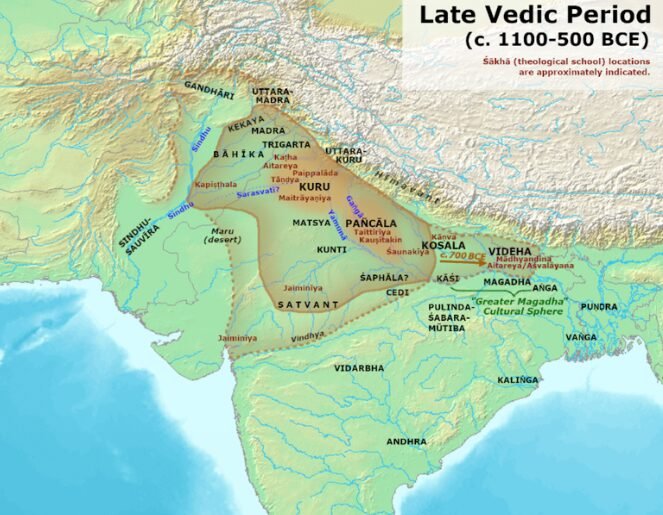
Hinduism, Buddhism, Jainism, and Sikhism each emerged from specific historical contexts, offering unique spiritual perspectives that have shaped Indian society.
Hinduism: The Ancient Roots
Hinduism is often regarded as one of the oldest religions in the world, with roots tracing back to the early Indus Valley Civilization, which existed around 2500 BCE in modern-day Pakistan and northwest India. Unlike most major religions, Hinduism doesn’t have a single founder but evolved over millennia through the synthesis of various cultural and spiritual traditions.

Image: Shiva’s statue in Karnataka, India.
Key Features:
- Vedic Period (c. 1500–500 BCE): The initiation of Hinduism is closely linked to the arrival of the Indo-Aryans, who brought with them the Vedas, ancient texts that laid the foundations of Hindu philosophy, rituals, and cosmology. The Rigveda, the oldest of the four Vedas, contains hymns that praise natural forces, deities, and cosmic order.
- Brahmanism: During this period, a priestly class called Brahmins emerged, performing rituals (yajnas) to invoke the gods and maintain cosmic order. This laid the groundwork for the caste system and the centrality of rituals in early Hinduism.
- Upanishadic Period (c. 800–400 BCE): As spiritual thought progressed, focus shifted from ritualistic practices to philosophical inquiry. The Upanishads, texts that form the concluding part of the Vedas, emphasized concepts such as Brahman (the ultimate reality) and Atman (the soul). This period marked the beginning of key Hindu beliefs like karma (action), samsara (rebirth), and moksha (liberation).
- Epic and Puranic Hinduism (c. 500 BCE – 500 CE): The Mahabharata and the Ramayana, two great epics, along with texts like the Puranas, further shaped Hinduism by emphasizing dharma (duty) and the worship of personal deities like Vishnu, Shiva, and Devi. This era also saw the rise of bhakti (devotion) movements, which promoted a more personal and emotional connection to the divine.
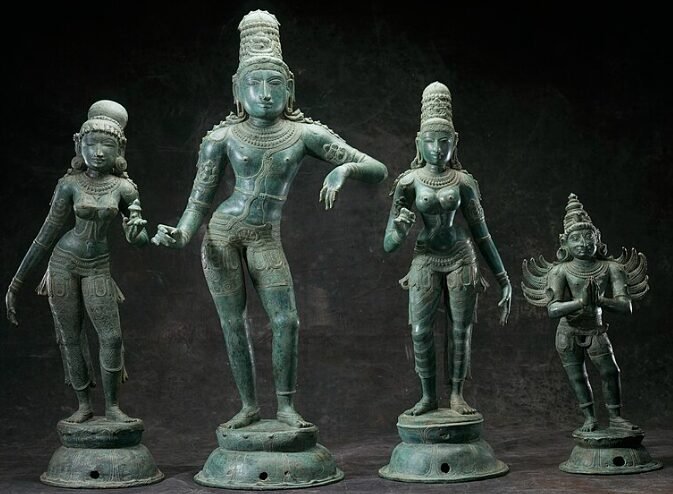
Hinduism’s flexibility and inclusiveness allowed it to absorb a wide range of beliefs, making it the dominant religion in India for centuries. Image: Krishna Rajamannar with His Wives, Rukmini and Satyabhama, alongside His Mount, Garuda, late 12th-13th century.
Buddhism: A Reaction to Ritualism
Buddhism originated in India in the 6th century BCE as a response to the ritualistic and hierarchical nature of Hinduism at the time. Founded by Siddhartha Gautama, later known as the Buddha, Buddhism sought to address the human condition through a focus on individual enlightenment and ethical conduct.

Key Features:
- Life of the Buddha: Siddhartha Gautama was born a prince in the region of modern-day Nepal. After witnessing human suffering, he renounced his luxurious life to seek the truth about existence. After years of ascetic practices, he attained enlightenment under the Bodhi tree in Bodh Gaya, Bihar, and became known as the Buddha, or “The Awakened One.”
- Core Teachings: The Buddha’s teachings are encapsulated in the Four Noble Truths and the Eightfold Path. He taught that life is characterized by suffering (dukkha), and that this suffering is caused by desire and attachment. However, it is possible to overcome suffering by following the Eightfold Path, which advocates ethical conduct, mental discipline, and wisdom. Central to Buddhism is the concept of nirvana, the cessation of suffering and the cycle of rebirth (samsara).
- Spread of Buddhism: Early Buddhism gained popularity due to its rejection of the caste system and its emphasis on equality and individual effort in the pursuit of enlightenment. The Mauryan Emperor Ashoka (r. 268–232 BCE) played a critical role in the spread of Buddhism throughout India and beyond, as he converted to Buddhism after the bloody Kalinga War and became a patron of the faith. Under his rule, Buddhist missionaries traveled to Central Asia, Sri Lanka, and Southeast Asia.
Buddhism remained influential in India until around the 8th century CE when it began to decline, largely due to the resurgence of Hinduism and the rise of devotional movements. However, it continued to thrive in other parts of Asia, becoming a major religion in countries like China, Japan, and Tibet.

The Buddha teaching the Four Noble Truths. Sanskrit manuscript. Nalanda, Bihar, India
Jainism: The Path of Non-violence
Jainism, like Buddhism, originated as a response to the Vedic religion’s ritualism and social hierarchy, though its roots may be even older. Founded by Mahavira (599–527 BCE), Jainism emphasizes non-violence (ahimsa), asceticism, and the pursuit of spiritual liberation through self-discipline.
Key Features:
- Mahavira’s Teachings: Mahavira, the 24th Tirthankara (spiritual teacher), revived and organized the Jain community in the 6th century BCE. He rejected the caste system and preached that all living beings, from humans to plants and animals, possess a soul and are worthy of compassion and respect. This led to the Jain principle of non-violence, which remains central to the religion today.
- Asceticism and Karma: Jains believe that the soul is trapped in a cycle of rebirth due to the accumulation of karma, which is seen as a kind of physical substance that adheres to the soul. To achieve liberation (moksha), one must practice strict asceticism, non-violence, and detachment from worldly pleasures. Jain monks and nuns follow an extremely austere lifestyle, including fasting and walking barefoot to minimize harm to any living creatures.
- Jainism in Indian Society: Jainism, though smaller in numbers compared to Hinduism and Buddhism, has had a significant influence on Indian culture and philosophy, especially in terms of its ethical teachings. Jains have also made important contributions to commerce and education in India.
Image: Pratima of Shri Mahavir Swami at Shri Mahavir Ji temple, Kurauli Rajasthan
Sikhism: A Synthesis of Hindu and Islamic Thought
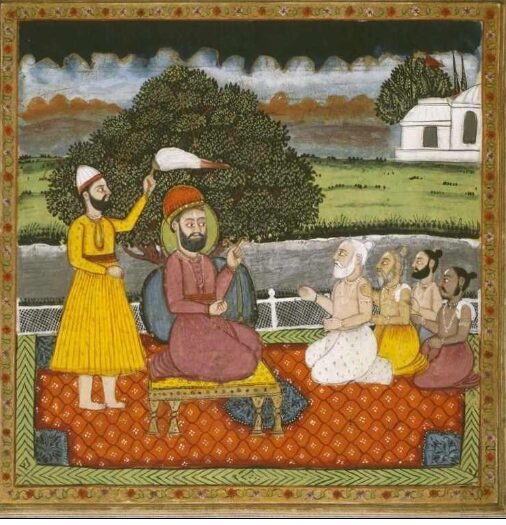
Image: Guru Nanak explaining Sikh teachings to Sadhus
Sikhism is the most recent of the major religions to emerge in India, founded in the 15th century by Guru Nanak (1469–1539) in the Punjab region. Sikhism arose in a context of religious and political tension between Hinduism and Islam, offering a spiritual path that emphasized devotion to one God, equality, and social justice.
Key Features:
- Guru Nanak’s Vision: Guru Nanak was born into a Hindu family but was deeply influenced by both Hindu and Muslim ideas. He rejected the formalism and ritualism of both religions, advocating instead for a direct, personal connection with God. His teachings centered on the idea that there is one God (Waheguru) and that all human beings are equal, regardless of caste, creed, or gender.
- The Gurus and the Guru Granth Sahib: Sikhism developed under the guidance of ten successive Gurus, with Guru Nanak being the first. The last Guru, Guru Gobind Singh, ended the line of human Gurus and declared that the sacred scripture, the Guru Granth Sahib, would henceforth be the eternal Guru. The Guru Granth Sahib contains the hymns and teachings of the Sikh Gurus and other saints from different religious traditions.
- Core Beliefs and Practices: Sikhism emphasizes the importance of honest living, sharing with others, and remembrance of God. Sikhs reject the caste system and ritualistic practices, advocating for an ethical life rooted in seva (selfless service) and simran (meditation on God’s name). The faith also places great emphasis on community life, particularly through the institution of the langar, a community kitchen where free meals are served to all, regardless of background.
- The Khalsa and Martial Tradition: Under Guru Gobind Singh, the Khalsa, a community of initiated Sikhs, was founded in 1699 to defend religious freedom and justice. Members of the Khalsa follow a strict code of conduct and are identifiable by the “Five Ks”: kesh (uncut hair), kara (steel bracelet), kanga (comb), kachera (cotton undergarments), and kirpan (a ceremonial sword).

Sikhism’s unique synthesis of Hindu and Islamic ideas, combined with its commitment to social equality, has made it a distinct and dynamic religious tradition in India and the global diaspora. Image: Golden Temple in Amritsar, Punjab, India, the holiest site of Sikhism
The Influence of Other Religions
In addition to these homegrown religions, India has also been significantly influenced by external religions such as Islam, Christianity, Zoroastrianism, and Judaism. Each of these faiths found a place in India’s religious landscape, enriching its pluralistic tradition.
- Islam: Islam came to India in the 7th century CE with Arab traders, and later through invasions by Turkic and Persian dynasties. By the 12th century, Islamic rule was established in northern India, leading to the formation of the Delhi Sultanate and later the Mughal Empire. Islamic influence in India is profound, seen in architecture, language, music, and cuisine. Sufism, a mystical form of Islam, also played a significant role in shaping Indian spirituality, particularly through its emphasis on love, devotion, and union with the divine.
- Christianity: Christianity reached India as early as the 1st century CE, with the arrival of Saint Thomas the Apostle, according to tradition. Later, European colonial powers like the Portuguese, Dutch, and British further spread Christianity, particularly in southern India and along the western coast. Today, Christianity is a significant minority religion in India.
- Zoroastrianism and Judaism: Zoroastrianism was brought to India by Persian refugees (known as Parsis) fleeing Islamic persecution in the 8th and 9th centuries. Though a small community, the Parsis have had a substantial impact on Indian industry and culture. Similarly, Judaism has a long history in India, with Jewish communities like the Cochin Jews and Bene Israel maintaining a presence for over a millennium.
Frequently Asked Questions

India’s pluralistic tradition has allowed for the coexistence of a wide range of beliefs, making it a land of profound spiritual diversity. This blend of indigenous and foreign influences has made India one of the most spiritually and culturally rich civilizations in human history. Image: Detail of the Phra Prang, central tower of Wat Arun (“Temple of Dawn”) in Bangkok, Thailand, featuring the Vedic god Indra atop the three-headed elephant Erawan (Airavata).
What is the Vedic religion, and when was it practiced?
The Vedic religion refers to the religious practices of the early Indo-Aryans between 1500 BCE and 500 BCE. It was based on the Samhitas, four canonical collections of hymns known as the Vedas, written in archaic Sanskrit. These practices centered on rituals, sacrifices, and invocations to nature and heroic gods.
What are the Samhitas, and what role do they play in Vedic religion?
The Samhitas are four collections of hymns called the Vedas, which include the Rig-Veda, Sama-Veda, Yajur-Veda, and Atharva-Veda. They are the foundational texts of Vedic religion, containing hymns, prayers, and mantras used in rituals and sacrifices.
How did the religious focus shift during the Late Vedic age (9th to 6th centuries BCE)?
During the Late Vedic age, the focus shifted from ritualistic practices to philosophical inquiry, marking the beginning of the Upanishadic or Vedantic phase. This period emphasized understanding the nature of reality, the soul, and the cosmos through the composition of the Upanishads.
What is the meaning of the term “Upanishad,” and what is its significance?
The word “Upanishad” comes from the Sanskrit words upa (near), ni (down), and shad (to sit), meaning “sitting down near” a teacher to gain spiritual knowledge. The Upanishads are philosophical texts that form the earliest sources of Hindu philosophy, focusing on profound concepts like Brahman (ultimate reality) and Atman (the soul).
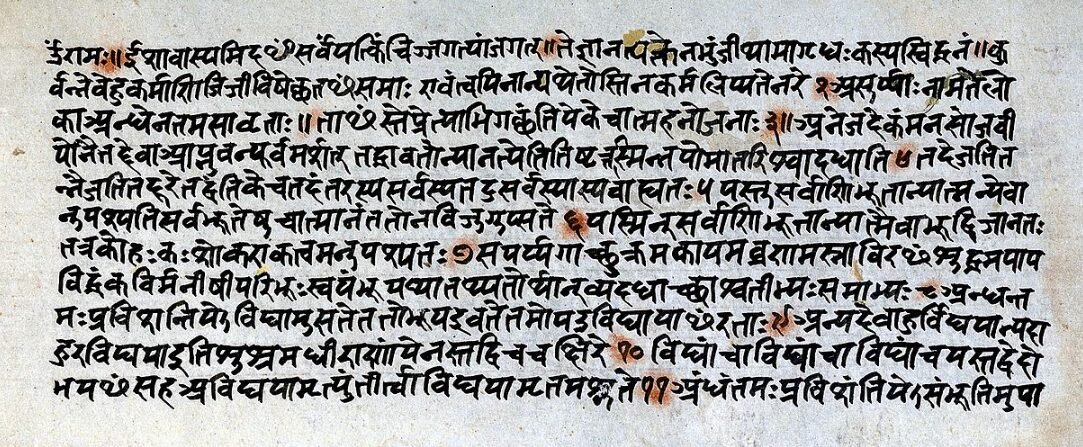
Some of the most significant early Upanishads include the Brihadaranyaka, Jaiminiya, and Chandogya Upanishads. These texts were composed before the rise of Buddhism and are central to the philosophical foundation of Hinduism. Image: A page of Isha Upanishad manuscript
How were the Upanishads and Puranas passed down, and what do they cover?
The Upanishads and Puranas were passed down orally before being written. The Puranas are important religious texts in Hinduism, Jainism, and Buddhism, chronicling the history of the universe, genealogies of gods and kings, and descriptions of cosmology and philosophy.
What role did sacrifices play in Vedic religion?
Sacrifices, or yajnas, were central to Vedic worship. Offerings such as milk, ghee, grains, and the soma plant were made to the gods. These rituals were often complex and required priests to perform various roles. Sacrifices symbolized a connection to divine power and were performed to seek prosperity, long life, and victory.
Who were the main priests in Vedic rituals, and what were their roles?
In Vedic rituals, there were four chief priests:
- Hotri: Recited invocations from the Rig-Veda.
- Adhvaryu: Managed the physical aspects of the sacrifice, using verses from the Yajur-Veda.
- Udgatri: Chanted hymns from the Sama-Veda during soma sacrifices.
- Brahman: Supervised the entire ritual and corrected errors with invocations from the Atharva-Veda.
What was the Ashvamedha, and what was its purpose?
The Ashvamedha, or horse sacrifice, was a significant royal ritual described in the Yajur-Veda. Only a king could perform this ceremony, which was intended to secure power, sovereignty, and prosperity. The ritual involved a year-long wandering of a horse and culminated in its sacrifice to the gods.
How did Vedic religion evolve into Vedanta, and what role did the Upanishads play in this transition?
Vedic religion evolved into Vedanta with the teachings of the Upanishads, which emphasized internal spiritual development over external rituals. The Upanishads introduced key philosophical concepts like Brahman (ultimate reality) and Atman (the soul), laying the groundwork for classical Hinduism, where meditation, knowledge, and liberation (moksha) became central.
What lasting impact did Vedic rituals have on later Hindu practices?
While the emphasis on ritual sacrifices decreased over time, the practice of reciting Vedic hymns and seeking prosperity, wealth, and well-being continues in Hindu ceremonies today. The philosophical insights of the Upanishads, combined with earlier Vedic practices, shaped the rich and enduring spiritual traditions of Hinduism.
FACT CHECK: At World History Edu, we strive for utmost accuracy and objectivity. But if you come across something that doesn’t look right, don’t hesitate to leave a comment below.





