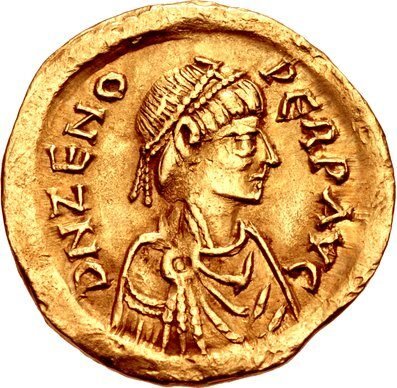
A small Roman bronze coin, known as the semissis, issued during Zeno’s second reign, featured the inscription: d·n·zenon·p·f·aug
Zeno was an Eastern Roman emperor who reigned from 474 to 475 and again from 476 to 491. Despite facing domestic revolts and religious disputes, he played a key role in stabilizing the Eastern Roman Empire while the Western Roman Empire fell.
Early Life and Rise to Power
Zeno, born as Tarasis in Isauria around 425, belonged to the Isaurian people, a group often viewed as barbarians despite centuries of Roman rule. His Greek name, Zeno, was adopted to integrate into Roman aristocracy, a strategic move encouraged by his marriage to Ariadne, daughter of Emperor Leo I. This union cemented his connection to the imperial lineage and paved his way to prominence.
Zeno first gained recognition by exposing a plot involving Ardabur, the son of the influential general Aspar, who had conspired with the Sassanid king. This revelation earned Zeno Emperor Leo I’s trust and a position as comes domesticorum. His military successes, including campaigns against Goths and Huns, further elevated his status, leading to his marriage to Ariadne in 466. Their son, Leo II, became emperor after Leo I’s death, and Zeno was soon crowned co-emperor.
Reign as Emperor
Zeno’s reign began in 474 with promise, but his foreign origins and reliance on Isaurian allies caused widespread unpopularity in Constantinople. Initially, Zeno secured peace with the Vandals, stabilizing trade routes and ending Christian persecutions in their territory. However, internal dissent quickly emerged.
In 475, a coup led by Empress Verina and her brother Basiliscus ousted Zeno, forcing him to flee to Isauria. Basiliscus alienated key supporters, including Illus and Trocundes, who eventually sided with Zeno. By mid-476, Zeno retook Constantinople and resumed his reign, coinciding with the fall of the Western Roman Empire as Odoacer deposed Romulus Augustulus. Zeno recognized Odoacer’s rule in Italy, marking the end of Western imperial authority while nominally reuniting the empire.
Domestic Challenges
Zeno’s second reign was fraught with revolts. Marcian, his brother-in-law, attempted to claim the throne in 479 but was ultimately defeated. More significantly, Illus, Zeno’s former ally, rebelled in 484, declaring Leontius emperor. Zeno besieged their forces in the fortress of Papurius for four years, eventually defeating them through treachery. This victory solidified his control but left lingering resentment among Isaurians.
Relations with the Goths
Theodoric Strabo and Theodoric the Amal, leaders of the Ostrogoths, were persistent threats during Zeno’s reign. Strabo initially supported Basiliscus but later clashed with Zeno. The emperor skillfully played the two leaders against each other, ultimately allying with the Amal after Strabo’s death in 481. To resolve ongoing tensions, Zeno commissioned the Amal to invade Italy and overthrow Odoacer, leading to the establishment of the Ostrogothic Kingdom under Theodoric the Great. This move shifted Gothic influence westward, reducing their presence in the Eastern Empire.
Religious Policies and the Henotikon
Zeno’s reign is notable for his efforts to mediate religious disputes. The Chalcedonian and Miaphysite factions remained deeply divided over the nature of Christ. In 482, Zeno issued the Henotikon, a doctrinal compromise aimed at reconciling these groups. While it succeeded in calming tensions in some regions, it angered the Roman Church. Pope Felix III excommunicated Patriarch Acacius, initiating the Acacian Schism, which persisted until 519.
Zeno also dealt with Samaritan revolts, suppressing their uprisings and reinforcing imperial authority over religious practices. His decision to close the Nestorian-influenced school in Edessa further underscored his commitment to orthodox Christianity.
Suppressing Rebellion and Consolidating Power
Zeno faced rebellion throughout his reign. In addition to Marcian and Illus, he contended with unrest in peripheral regions. His suppression of the Samaritan revolt in 484 exemplified his harsh methods. Zeno’s military strategies, including the use of bribery and alliances, enabled him to maintain control despite persistent challenges.
His ability to delegate tasks to capable subordinates like Illus and later Theodoric the Amal demonstrated his pragmatic approach to governance. However, these alliances were often precarious, as seen in Illus’ eventual betrayal.
Cultural Legacy
Zeno’s reign saw significant cultural and religious developments. He ended the tradition of pagan symbols on imperial coinage, emphasizing Christianity’s centrality to the empire. Additionally, Zeno’s reign marked the consolidation of the Byzantine identity, distinct from the Western Roman Empire.
A curious anecdote from his life involves his documented game of tabula (an early form of backgammon). Zeno’s famously unlucky dice roll became a historical footnote, recorded as one of the earliest “bad beat” stories.
Death and Succession
Zeno died on April 9, 491, after ruling for 17 tumultuous years. His death marked the end of Isaurian dominance in the Byzantine court. Ariadne, his widow, selected Anastasius I, a court official, as his successor, bypassing Zeno’s Isaurian allies. Anastasius’ reign brought stability, ending the Isaurian War sparked by Zeno’s brother Longinus.
Zeno’s reign, though fraught with challenges, played a pivotal role in shaping the Byzantine Empire’s future. His diplomatic handling of the Goths, efforts to mediate religious conflict, and strategic alliances ensured the empire’s survival during a critical period of transition.
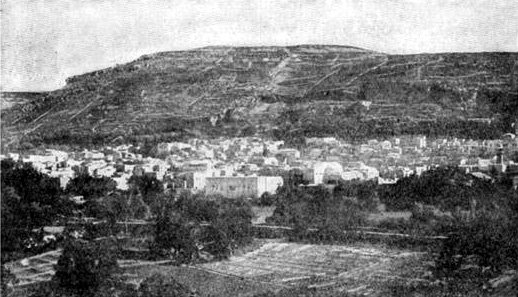
Mount Gerizim is believed by Samaritan sources to be the burial site of Zeno.
Western Historians’ Somewhat Biased Labeling of the Eastern Roman Empire
Frequently Asked Questions about Zeno
How did Zeno come to power?
Originally named Tarasis and of Igosaurian origin, Zeno became an ally of Emperor Leo I. After marrying Leo’s daughter, Ariadne, and serving in high military positions, Zeno became co-emperor with his son Leo II. Upon Leo II’s death, Zeno became sole emperor.
What challenges did Zeno face during his reign?
Zeno’s reign was marked by revolts from figures like Basiliscus, Marcian, and Illus. His barbarian origins and reliance on Isaurian allies made him unpopular with the Byzantine elite and citizens.
What was Zeno’s role in the fall of the Western Roman Empire?
During Zeno’s rule, the Western Roman Empire ended when Odoacer deposed Romulus Augustulus in 476. Odoacer sent the imperial regalia to Zeno, acknowledging him as the theoretical ruler of a reunified empire.
What was the Henotikon, and why was it significant?
The Henotikon, issued by Zeno in 482, aimed to reconcile Chalcedonian and Miaphysite Christians by avoiding explicit reference to Christ’s dual nature. It was rejected by Pope Felix III, leading to the Acacian Schism.
How did Zeno handle the Ostrogoths?
Zeno played the Ostrogothic leaders Theodoric the Amal and Theodoric Strabo against each other. Eventually, he sent Theodoric the Amal to Italy to defeat Odoacer, leading to the establishment of the Ostrogothic Kingdom.
What was Zeno’s legacy in religious and cultural matters?
Zeno’s Henotikon influenced Christian theological debates. He supported Orthodox Christianity but struggled to reconcile divisions. He also promoted cultural changes, including suppressing Samaritan revolts and closing the Nestorian school in Edessa.
How did Zeno’s reign end?
Zeno died in 491 without an heir. His wife, Ariadne, chose Anastasius I as his successor. Legends claim Zeno was buried alive, though these accounts are likely apocryphal.





