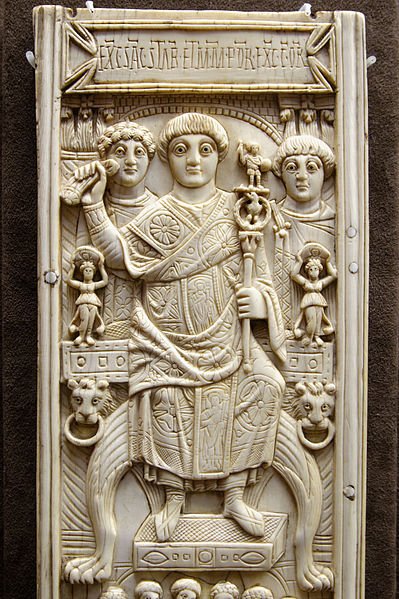
Areobindus depicted on his ivory consular diptych in his consular robes.
Areobindus was an Eastern Roman general and politician, known for his role in the Anastasian War and his consulship in 506.
Origins and Family
Flavius Areobindus Dagalaifus Areobindus was a distinguished Eastern Roman general and statesman who flourished between 479 and 512.
He belonged to an aristocratic lineage that combined Roman and barbarian heritage, making him part of a well-established military and political elite.
His father, Dagalaifus, served as consul in 461 and was of Gothic origin, while his grandfather, Areobindus, held the consulship in 434.
His maternal lineage was equally prestigious; his mother, Godisthea, was the daughter of Ardabur, a general and consul in 447, and the granddaughter of Aspar, the Alan general who was also consul in 434. This lineage positioned Areobindus among the highest echelons of the Eastern Roman elite.
In terms of marital alliances, Areobindus strengthened his political standing by marrying Anicia Juliana shortly after 478. Anicia Juliana was the daughter of the Western Roman emperor Olybrius and his wife Placidia, further integrating Areobindus into imperial circles. This union resulted in at least one known son, Olybrius, who followed in his father’s footsteps and served as consul in 491. Some sources suggest the existence of another descendant, Dagalaiphus, possibly from an earlier marriage, but evidence remains uncertain.
Who were the greatest military generals of the Byzantine Empire?
Military Career and Role in the Anastasian War
Areobindus had a notable military career, serving in various capacities within the Eastern Roman army. One of his recorded early positions was comes sacri stabuli, or Count of the Imperial Stables. Additionally, he was honored with the title of honorary consul, signifying his status within the court.
The most significant episode of his military career took place during the Anastasian War (502–506), a conflict between the Eastern Roman Empire and the Sassanid Persian Empire.
Areobindus was appointed as magister militum per Orientem, a title given to senior military commanders, and was sent to the eastern frontier alongside other prominent generals, including Hypatius and Patricius.
In 503, as war escalated, Areobindus was assigned to defend the strategically crucial city of Dara, a major Roman stronghold near the Persian border.
Areobindus’s service during the Anastasian War demonstrated his competence as a commander, while his tenure as consul in 506 affirmed his status within the empire’s ruling elite.
While his colleagues laid siege to the Persian-held city of Amida, Areobindus was responsible for countering Persian advances near Nisibis. Leading a force of 12,000 soldiers, he successfully repelled an attack from a Persian army originating in Singara and pushed them back to Nisibis. However, despite this early success, the Persians regrouped and received reinforcements from their Hephthalite and Arab allies, forcing Areobindus to withdraw to Constantia and later to Edessa.
In September 503, Persian King Kavadh I besieged Edessa, where Areobindus was stationed. However, the onset of winter and the arrival of Roman reinforcements forced Kavadh to lift the siege and retreat. By the summer of 504, the Eastern Romans had regained some momentum, and Areobindus launched a large-scale raid into Arzanene, a border region controlled by the Persians. His forces faced little resistance, allowing them to devastate large areas before returning to Amida. These actions, combined with other Roman offensives, eventually compelled the Persian ruler to negotiate a truce. Hostilities ceased in the winter of 504–505, and the war came to an end shortly afterward.
Following his successful military campaign, Areobindus was recalled to Constantinople in 505. In recognition of his service, he was granted the prestigious position of consul for the year 506, an esteemed office that symbolized imperial favor and high social standing. His colleague in the consulship was Ennodius Messala, another prominent Roman aristocrat.
Political Career and the 512 Riots
After his consulship, Areobindus largely withdrew from active military service and spent his later years in Constantinople. By 512, he had settled into a retired life, although his name still carried weight in Roman political circles. This became evident when tensions arose between Emperor Anastasius I and the city’s populace over religious disputes.
Anastasius had been promoting miaphysitism, a doctrine that differed from the Chalcedonian Christianity adhered to by much of Constantinople’s population. This religious controversy led to public unrest, culminating in large-scale riots in the capital. In the midst of the chaos, an influential faction of rioters sought to overthrow Anastasius and install a new emperor. Due to his noble lineage and his previous military leadership, Areobindus emerged as a favored candidate among the discontented population.
Although Areobindus was momentarily thrust into the political turmoil of 512, his refusal to engage in rebellion reflected his cautious and loyal disposition.
The rioters gathered outside the residence of his wife, Anicia Juliana, demanding that Areobindus assume the throne. However, Areobindus had no interest in leading a rebellion against the reigning emperor. Recognizing the dangerous implications of the situation, he fled his home and went into hiding. His refusal to participate in the usurpation attempt effectively ended any possibility of his involvement in imperial politics.
There are no records of Areobindus engaging in any further political or military activities after this event. Given his advanced age by that point, he likely passed away soon after 512.
Consular Diptychs and Legacy
As a Roman consul, Areobindus commissioned consular diptychs, which were ivory panels inscribed with his name and titles, symbolizing his official status. These diptychs served as ceremonial gifts and official records of a consul’s tenure. Remarkably, five of Areobindus’ consular diptychs have survived to modern times, making them valuable historical artifacts.
Five examples of Areobindus’ consular diptychs have survived, including two complete ones in Lucca and Zürich.
Two complete diptychs remain preserved today, one in Lucca (CIL XI, 8137) and another in Zürich (CIL XIII, 5245). Additionally, three partial diptychs have been found: two bearing only his name (now housed in Paris and Besançon) and another featuring his titles, currently in Dijon (CIL XIII, 10032). These artifacts provide insights into the artistry, official ceremonies, and political significance of the consulship in late antiquity.
Timeline of Areobindus
c. 430 – His father, Dagalaifus, is born; later consul in 461.
434 – His grandfather, Areobindus, serves as consul.
c. 445 – His mother, Godisthea, is born, daughter of general Ardabur and granddaughter of Aspar.
c. 479 – Areobindus comes into prominence.
After 478 – Marries Anicia Juliana, daughter of Emperor Olybrius.
c. 480 – Birth of his son, Olybrius, future consul in 491.
503 – Commands Roman forces in the Anastasian War, repelling a Persian attack.
504 – Leads a major raid into Arzanene.
505 – Returns to Constantinople.
506 – Serves as consul.
512 – Avoids a riot that sought to proclaim him emperor.
After 512 – Dies.
Frequently Asked Questions
What was Areobindus’ family background?
He came from a distinguished lineage of Roman and barbarian heritage, being the grandson of Aspar and the son of Dagalaifus, both prominent generals and consuls.
Whom did he marry, and who were his descendants?
He married Anicia Juliana, daughter of Western Roman emperor Olybrius, and they had a son, Olybrius, who became consul in 491.
What was his role in the Anastasian War?
As magister militum per Orientem, he commanded troops against the Persians, repelling an attack near Nisibis and later launching a successful raid into Persian territory.
What was his role as consul?
He was awarded the consulship in 506 after his military service, serving alongside Ennodius Messala.
How was Areobindus involved in the 512 riot in Constantinople?
During riots against Emperor Anastasius’ religious policies, the mob sought to proclaim him emperor, but he fled and went into hiding.
When did Areobindus die?
His exact death date is unknown, but he likely died shortly after 512.





