Ereshkigal, the queen of the underworld in Mesopotamian mythology, stands as one of the most enigmatic and complex figures in ancient Mesopotamian religious and mythological thought.
As the ruler of the underworld, her story reveals much about how the ancient Mesopotamians conceived of death, the afterlife, and the balance between life and death.
Over time, Ereshkigal’s role evolved as the underworld itself underwent reimaginings in the mythologies of Sumer, Akkad, and Babylon.
This exploration of her role in Mesopotamian mythology will delve into her origins, her role in the pantheon, her relationships with other deities, and her depiction in key myths that explain the Mesopotamian understanding of death and the afterlife.
READ MORE: Most Famous Ancient Mesopotamian Deities
Origins and Early Role
Ereshkigal’s origins as queen of the underworld are somewhat obscure. Some scholars believe that her association with the underworld emerged later in Mesopotamian history, possibly evolving from earlier conceptions of other gods as rulers of the underworld. One prominent theory posits that Ninazu, a god of the underworld, may have been seen as its ruler before Ereshkigal assumed this role. This reflects the fluidity of religious belief in early Mesopotamian thought, where various deities could hold different dominions, depending on time and region.
In the early myths, Ereshkigal’s role is not always clearly defined as supreme ruler of the underworld, and it appears that multiple gods were considered rulers of the dead.
However, over time, she emerged as the dominant figure associated with the land of the dead.
By the later Babylonian period, Ereshkigal was firmly established as the primary goddess of the underworld, responsible for the souls of the dead, with her domain taking on a darker and more definitive character in Mesopotamian cosmology.
The underworld in Mesopotamian thought was a bleak, inhospitable place where souls resided after death. It was neither a place of punishment nor reward, but rather a shadowy realm where the dead existed in a diminished state.
Unlike later conceptions of the afterlife in other cultures, such as the Egyptian belief in judgment and paradise or damnation, Mesopotamians viewed the afterlife as an inevitable descent into a joyless existence under the rule of Ereshkigal.
Role in the Pantheon
As queen of the underworld, Ereshkigal held an important, albeit grim, position in the Mesopotamian pantheon. She was responsible for overseeing the dead and ensuring that the proper order of the afterlife was maintained. Although Ereshkigal’s cult was never as widespread or prominent as that of gods associated with life, fertility, or war, her role was crucial in the cosmic balance of Mesopotamian belief. Death was a constant reality in the ancient world, and Ereshkigal’s rule over the underworld reminded people of the inevitability of mortality and the power of death.
Ereshkigal’s domain was called various names, including Kur, Irkalla, or Kigal, depending on the time and region. The Mesopotamian underworld was a place from which there was no return, symbolized by its impenetrable gates and fearsome guards. It was believed that once a soul entered the underworld, it was impossible to leave, unless granted special permission or rescued by a god, as seen in some myths.
Ereshkigal, in Mesopotamian mythology, was the goddess of the underworld, known as Kur in Sumerian and later as Irkalla.
Though her cult was limited, Ereshkigal was recognized as a powerful figure. She was associated with a group of deities known as the “transtigridian snake gods,” including Ninazu, Tishpak, and Inshushinak, who were connected to the underworld. However, Ereshkigal’s power did not extend beyond her realm, and she rarely intervened in the affairs of the living.
Ereshkigal’s underworld was also a place where gods from the upper realms could not freely travel. The gates of the underworld were closely guarded, and those entering had to follow strict rules, including removing items of clothing or power, as seen in several myths. The careful control of entry into her domain reinforced Ereshkigal’s authority over the land of the dead.
Relationship with Nergal

Nergal depicted with a lion-headed mace and sword on a cylinder seal from Larsa.
One of the most significant developments in Ereshkigal’s mythology is her relationship with Nergal, the god of war, plagues, and death. Nergal is a complex deity who, over time, became associated with the underworld and eventually became Ereshkigal’s consort. Their union is crucial to understanding how Mesopotamian myths attempted to reconcile different traditions of death and underworld deities.
In earlier traditions, Nergal was a god of destruction and disease, feared for his ability to bring death and devastation to the living. However, as Ereshkigal’s role as queen of the underworld solidified, Nergal was paired with her, likely as an effort to reconcile the various regional beliefs about the underworld. This union between Nergal and Ereshkigal represented a merging of the northern and southern Mesopotamian traditions.
Their marriage is depicted in two surviving versions of the myth. In both versions, the gods hold a banquet to which Ereshkigal, as queen of the underworld, cannot attend. She sends her vizier, Namtar, to represent her. Nergal, disrespectful to Namtar, is ordered to descend to the underworld to atone. Guided by the god Ea, Nergal passes through the seven gates of the underworld, stripping away his power and possessions as he descends.
Ereshkigal ruled the realm of the dead, sometimes referred to as Irkalla, alongside her husband, Nergal.
In one version, Ereshkigal plans to kill Nergal upon his arrival. However, Nergal overpowers her, and just as he is about to slay her, Ereshkigal pleads for her life, offering to marry him and share her power. In another version, Nergal spends six days with Ereshkigal as her lover but leaves the underworld, enraging her. When Namtar attempts to bring him back, Ea helps Nergal evade capture, though he eventually returns to Ereshkigal, becoming her consort.
Nergal’s role as Ereshkigal’s consort helped consolidate his association with the underworld and death, making him one of the central deities of the Mesopotamian afterlife. Their union also represents the balance between destructive forces (Nergal) and the inevitability of death (Ereshkigal), a theme that runs throughout Mesopotamian cosmology.
Ereshkigal in the Myth of Inanna’s Descent

In Sumerian mythology, Ereshkigal is portrayed as the older sister of Inanna, the goddess of love and war, in the famous poem Inanna’s Descent to the Underworld. Image: Ancient Akkadian cylinder seal depicting Inanna crushing a lion while Ninshubur stands in front of her paying.
Ereshkigal’s most famous appearance in Mesopotamian mythology is in the myth of Inanna’s Descent into the Underworld. Inanna, the goddess of love, fertility, and war, seeks to expand her power by descending into the underworld, ruled by her older sister, Ereshkigal. This myth highlights the tension between life, represented by Inanna, and death, represented by Ereshkigal.
In the myth, Inanna passes through the seven gates of the underworld, where she is required to remove a piece of clothing or an item of power at each gate, symbolizing her gradual loss of authority. By the time she reaches Ereshkigal, she is naked and powerless. Ereshkigal’s control over the underworld is complete, and she orders Inanna to be judged by the seven judges of the underworld, who declare her guilty. Inanna is killed, and her body is hung on a hook for all to see.
Inanna’s minister, Ninshubur, pleads with the gods to rescue her, and the god Enki agrees to help. He creates two beings who enter the underworld and revive Inanna with the water and food of life. Although Inanna is resurrected, the law of the underworld requires that she find a replacement to take her place. Inanna eventually chooses her husband, Dumuzid, who has not mourned her death.

Ancient Sumerian cylinder seal impression depicts god Dumuzid being tortured by galla demons in the underworld.
This myth reinforces Ereshkigal’s absolute authority over the dead, as even the powerful goddess Inanna cannot escape the judgment and power of the underworld without outside help. Ereshkigal, in this context, represents the inescapable reality of death and the limits of divine power in the face of mortality.
The myth also presents Ereshkigal as the necessary counterbalance to Inanna’s life-affirming powers. Ereshkigal’s role as the ruler of the underworld ensures that there is an order to the cosmos, where death follows life, and the dead are confined to their appropriate realm.
READ MORE: Most Famous Myths from Ancient Mesopotamia
Ereshkigal’s Role in Other Myths
Beyond her roles in the myths of Nergal and Inanna, Ereshkigal appears in other Mesopotamian myths, though often in a more secondary capacity. In the myth of Ningishzida’s Journey to the Netherworld, Ereshkigal receives Ningishzida, a vegetation god, when he descends to the underworld each year. This myth is part of the broader agricultural cycle, symbolizing the death and rebirth of crops and the passage of seasons.
Ereshkigal also appears in The Underworld Vision of an Assyrian Prince, where she is listed alongside other underworld deities, including her consort, Nergal. In some versions of Mesopotamian mythology, Ereshkigal is paired with Gugalanna, a deity who dies before the events of Inanna’s Descent into the Underworld. Gugalanna is sometimes described as the father of Ninazu, though over time, his identity became conflated with Nergal.
In some traditions, Ereshkigal is also the mother of Nungal, a goddess associated with prisons. Nungal’s connection to the underworld reinforces the idea of confinement and the inevitability of death in Mesopotamian cosmology.
Cultural Influence and Syncretism
Ereshkigal’s influence extended beyond Mesopotamia, as her character and role were adapted and syncretized with other deities in neighboring cultures. Among the Hurrians, Ereshkigal was identified with the underworld goddess Allani. Over time, the distinction between the two goddesses blurred, and Allani became a title for Ereshkigal.
Similarly, the Hattian death god Lelwani, originally a male deity, was gradually identified with Ereshkigal, leading to his transformation into a female figure. This blending of deities across cultures shows how Ereshkigal’s role as queen of the underworld resonated with other ancient Near Eastern peoples, who saw her as a powerful figure representing the inevitable force of death.
In later Greek traditions, Ereshkigal was associated with Hecate, the goddess of magic and the underworld. While the Greeks likely had little knowledge of Mesopotamian religious practices, the name “Ereschkigal” appeared in some Greek magical texts, possibly to add an air of mystery to their spells. These references show how Ereshkigal’s influence persisted even as Mesopotamian civilization declined.
“Queen of the Great Earth”
Ereshkigal was also called Ninkigal, meaning “Lady of the Great Earth.” Despite her significant role in the underworld, her cult was relatively small, with her primary temple located in Kutha, a city associated with Nergal.
Conclusion
Ereshkigal, the queen of the underworld in Mesopotamian mythology, represents the inescapable power of death and the afterlife in ancient Mesopotamian thought. Her role evolved over time, from a figure among several deities associated with the underworld to the dominant ruler of the dead.
Through her relationships with other gods, particularly Nergal and Inanna, Ereshkigal’s mythology underscores the importance of death in maintaining cosmic balance. Although her cult may not have been as widespread as those of gods associated with life or fertility, Ereshkigal’s role was indispensable in Mesopotamian religion, symbolizing the inevitable and unyielding force of death that all beings must face.
Frequently asked questions

Ereshkigal’s name, meaning “Queen of the Great Earth,” highlights her connection to the subterranean world. Image: The “Queen of Night Relief” from the Old Babylonian Period may depict Ereshkigal or Ishtar.
What role did Ninazu play before Ereshkigal became prominent?
Some researchers believe that Ninazu initially fulfilled the role of ruler of the underworld before Ereshkigal became a significant figure. This suggests that early Mesopotamian beliefs about the underworld were fluid, with various deities holding this role at different times and in different regions.
How did Ereshkigal’s relationship with Nergal develop in Mesopotamian mythology?
Ereshkigal and Nergal became consorts, ruling the underworld together. This partnership likely arose as a way to reconcile different traditions, where Nergal, originally a god of war and disease, became her co-ruler. They appear together in myths about the underworld, and their union helped integrate diverse regional beliefs about the afterlife.
What happens in the myth of Inanna’s Descent into the Underworld?
In this myth, Inanna seeks to extend her power to the underworld, ruled by her sister Ereshkigal. As Inanna passes through the seven gates of the underworld, she is stripped of her clothing and powers. When she reaches Ereshkigal, she is judged guilty, killed, and her body is hung on a hook. Eventually, Enki sends beings to revive her, and she is allowed to leave the underworld, but only by replacing herself with another soul, which becomes her husband, Dumuzid.
How do scholars interpret the relationship between Inanna and Ereshkigal?
Scholars often view Inanna and Ereshkigal as representing opposite forces. Inanna symbolizes life, love, and the heavens, while Ereshkigal embodies death and the underworld. Their relationship in mythology highlights the contrast between life and death.
What is the myth of Ereshkigal’s marriage to Nergal?
In this myth, Ereshkigal sends her vizier Namtar to a divine banquet, where Nergal disrespects him. Ereshkigal demands Nergal come to the underworld, where the two eventually become lovers. In one version, Nergal is warned not to engage with Ereshkigal, but he does, leading to a conflict that ends with him becoming her consort and co-ruler of the underworld.
What are the two versions of Nergal and Ereshkigal’s story?
In one version, Nergal attacks Ereshkigal when he reaches her throne, threatening to kill her before she pleads for her life and promises to become his wife. In the other version, Nergal spends six days with Ereshkigal but then escapes, only to be tricked into returning. In both versions, Nergal eventually becomes the co-ruler of the underworld.
What role does Ereshkigal play in the myth of Ningishzida’s Journey to the Netherworld?
In this myth, Ereshkigal is the goddess who receives Ningishzida, a vegetation god, each year when he descends to the underworld. This annual journey reflects the cyclical nature of life, death, and rebirth in Mesopotamian mythology.
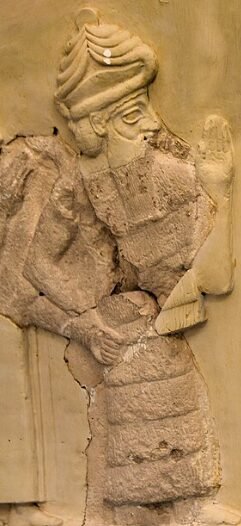
Ningishzida with snakes on his shoulders depicted on a Gudea relief, 2000 BCE.
How does Ereshkigal’s husband vary across myths?
In some myths, Ereshkigal’s husband is Gugalanna, a deity whose identity is somewhat ambiguous. In Inanna’s Descent into the Underworld, Gugalanna is already dead, while in other inscriptions, he is mentioned as the father of Ninazu. Over time, the name Gugalanna became synonymous with Nergal.
Who was Nungal, and what was her connection to Ereshkigal?
Nungal was a goddess associated with prisons, and she was considered Ereshkigal’s daughter in some texts. In one fragmentary text, Nungal appears alongside Ereshkigal and the healing goddess Nintinugga. Another text suggests that Ereshkigal had a son with Enlil, her vizier Namtar.

Image: A statue portraying the god Enlil.
How did Ereshkigal’s influence extend beyond Mesopotamia?
Ereshkigal’s influence spread beyond Mesopotamia, particularly in Hurrian mythology, where she was conflated with the underworld goddess Allani. Among the Hittites and Luwians, she was connected with the Sun Goddess of the Earth. Over time, Ereshkigal became synonymous with Allani, losing her individual identity.
How was Ereshkigal linked to Greek traditions?
In later Greek traditions, Ereshkigal was associated with Hecate, the goddess of magic and the underworld. In some magical spells, Hecate is referred to as “Hecate Ereschkigal,” though scholars believe this was a superficial reference, likely used to add an exotic element to Greek depictions of the underworld, with no direct connection to Mesopotamian beliefs.
Was Ereshkigal abducted?
Famed Assyriologist Samuel Noah Kramer proposed that Ereshkigal was originally abducted by the Kur (a term referring to mountains or the underworld) and forced to become queen of the underworld, similar to the Greek myth of Persephone. However, modern scholars dispute this view, interpreting the passage in question as describing a dowry assigned to Ereshkigal rather than an abduction.
Modern scholars reject the idea that Kur was a specific monster that abducted Ereshkigal. Instead, they interpret Kur as a vague term referring to mountains, foreign lands, or the underworld itself. The passage traditionally viewed as describing Ereshkigal’s abduction is now understood as a dowry assignment rather than a forced descent into the underworld.
READ MORE: Notable Ancient Mesopotamian Inventions





