The story of Eros and Psyche is one of the most enchanting and profound tales in Greek mythology, encapsulating themes of love, trust, and the transformative power of the human spirit. This myth, primarily known through the narrative in Apuleius’s “Metamorphoses” (also called “The Golden Ass”), tells the journey of Psyche, a mortal woman, and Eros, the god of love, whose relationship overcomes divine opposition and personal trials.
In this narrative, World History Edu offers deep insights into the human condition, the nature of love, and the interplay between mortals and gods.

Psyché et l’amour (1626–29) by Simon Vouet – Psyche lifts a lamp to view the sleeping Cupid.
The Characters
Psyche: In Greek, the word “psyche” means both “soul” and “butterfly,” symbolizing transformation and immortality. Psyche is depicted as an exceptionally beautiful mortal woman, whose beauty rivals that of the goddess Aphrodite.
Eros: Also known as Cupid in Roman mythology, Eros is the god of love and desire. He is often portrayed as a youthful, winged figure carrying a bow and arrows, which he uses to ignite love in the hearts of gods and mortals.
Aphrodite: The goddess of love and beauty, Aphrodite plays a pivotal role in the tale as both the catalyst for Psyche’s trials and the eventual unifier of the lovers.
The Myth
Divine Jealousy: The story begins with Psyche’s extraordinary beauty, which draws the admiration of people far and wide. This adulation leads to the neglect of Aphrodite’s temples, inciting her jealousy. To exact her revenge, Aphrodite sends her son Eros to make Psyche fall in love with the most despicable of men. However, upon seeing Psyche, Eros himself is captivated by her beauty and, instead of following his mother’s orders, he secretly becomes her lover.
The Unseen Lover: Eros arranges for Psyche to be carried by the West Wind, Zephyrus, to a magnificent palace where she is attended by invisible servants. Here, Eros visits her every night in complete darkness, forbidding her to see him. Despite the odd circumstances, Psyche falls deeply in love with her mysterious husband, who she cannot see.
Betrayal of Trust: Psyche’s curiosity, fueled by the insidious advice of her jealous sisters, leads her to break the one condition of her relationship: not to look upon Eros. One night, she lights an oil lamp to gaze upon her sleeping lover. Mesmerized by his divine beauty, she accidentally spills hot oil on him, awakening him. Eros, feeling betrayed, flees, leaving Psyche in despair.
Trials and Tribulations: Determined to win back Eros, Psyche seeks the help of Aphrodite, who imposes a series of near-impossible tasks upon her. These tasks symbolize Psyche’s journey through hardship and self-discovery:
- Sorting Seeds: Aphrodite demands that Psyche sort a vast heap of mixed seeds by nightfall. Eros secretly aids her by sending ants to accomplish the task.
- Golden Fleece: Psyche must gather wool from dangerous, golden-fleeced rams. With the help of a river god, she learns to collect the wool caught on brambles, avoiding the rams.
- Water from the Styx: She is sent to fetch water from the treacherous river Styx, which is guarded by dragons. An eagle, sent by Eros, helps her fill the flask.
- Box of Beauty: The final task requires Psyche to descend into the Underworld and retrieve a box containing a fragment of Persephone’s beauty. Psyche succeeds but, overcome by curiosity, opens the box, falling into a death-like sleep from its infernal contents.
Divine Intervention: Witnessing Psyche’s unwavering determination, Eros finally intervenes. He rescues her from her deep slumber and, moved by their plight, petitions Zeus to grant Psyche immortality. Zeus agrees, and Psyche is given ambrosia, the food of the gods, making her immortal.
Union and Celebration: The tale concludes with the reconciliation of Eros and Psyche and their marriage on Mount Olympus, blessed by the gods. Even Aphrodite’s initial hostility is transformed into acceptance, as she acknowledges Psyche’s worthiness.
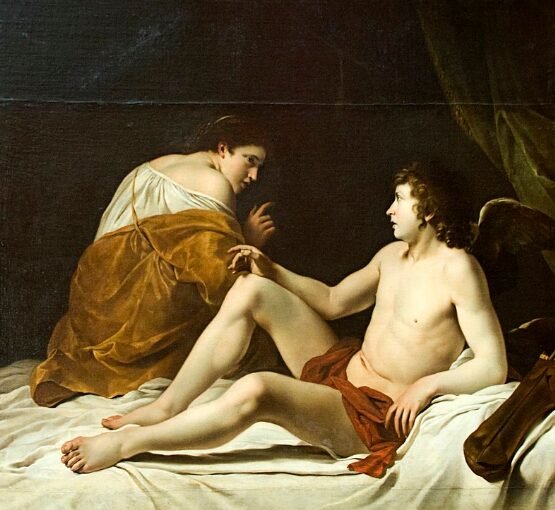
Image: Italian painter Orazio Gentileschi exposed the erotic vulnerability of the male figure in his Cupid and Psyche (1628–30)
Themes and Symbolism
Love and Trust: Central to the story is the theme of trust. Psyche’s betrayal of Eros’s trust by looking at him in the light symbolizes the fragility of love and the importance of faith within relationships. Love, the story suggests, thrives on trust and is jeopardized by suspicion and betrayal.
Transformation and Redemption: Psyche’s journey from mortal to immortal reflects the transformative power of love and perseverance. Her trials are symbolic of the human experience of suffering and the redemptive potential of enduring love. The narrative echoes the idea that true love is resilient and capable of overcoming even the most daunting obstacles.
The Feminine Journey: Psyche’s story is also a profound exploration of the feminine journey. Her name itself, meaning “soul,” emphasizes the inner journey of self-discovery and personal growth. Through her trials, Psyche transitions from a naïve girl to a wise and strong woman, capable of confronting and overcoming challenges.
Divine and Mortal Interaction: The interaction between gods and mortals in this myth highlights the complex relationships and interdependencies between the divine and human realms. The gods, despite their power, are shown to possess human-like emotions and flaws. This interplay adds a rich layer to the narrative, illustrating that divine favor or disfavor can significantly impact mortal lives.
Symbolism of the Butterfly: Psyche’s association with the butterfly is significant. Just as a butterfly undergoes metamorphosis from a caterpillar, Psyche’s journey symbolizes the soul’s evolution and transformation. The butterfly also represents the soul’s immortality and the beauty that emerges from struggle and perseverance.

Image: Psyche et L’Amour (1889) by French painter William Bouguereau.
Psychological Interpretations
The tale of Eros and Psyche has been analyzed extensively from a psychological perspective, particularly within the framework of depth psychology. Swiss psychiatrist and psychotherapist Carl Jung and other psychoanalysts have interpreted the myth as an allegory of the individuation process—the journey towards self-realization and wholeness.
Eros as the Animus: In Jungian terms, Eros can be seen as the animus, the masculine aspect of a woman’s psyche, representing her inner life force and creative energy. Psyche’s relationship with Eros, her animus, is central to her journey towards individuation.
Psyche’s Trials as Inner Work: The trials that Psyche undergoes symbolize the inner work required for personal growth. Each task represents a step in the process of integrating different aspects of the self, overcoming inner conflicts, and achieving a balanced and harmonious psyche.
The Integration of Opposites: The union of Eros and Psyche at the end of the myth symbolizes the integration of opposites within the individual. Psyche’s immortality represents the attainment of a higher state of consciousness and the harmonious blending of the mortal and divine aspects of the self.

Image: Cupid Flying Away from Psyche (between 1872 and 1881) by Edward Burne-Jones
Cultural Impact and Legacy
The story of Eros and Psyche has left an indelible mark on Western culture and has been a source of inspiration for countless works of art, literature, and psychology. Its themes of love, transformation, and the soul’s journey continue to resonate across different mediums and eras.
Art: The myth has inspired many artists, from ancient sculptures to Renaissance paintings and modern interpretations. The imagery of Psyche being carried by Zephyrus, her trials, and her eventual union with Eros have been depicted in various art forms, symbolizing different aspects of the human experience.
Literature: In literature, the story has been retold and reinterpreted in numerous ways. It appears in poetry, novels, and plays, often used to explore themes of love, betrayal, and redemption.
Psychology: The psychological dimensions of the myth have been influential in the field of depth psychology. The story’s exploration of the soul’s journey and the transformative power of love continues to inform psychological theories and therapeutic practices.

The myth of Eros and Psyche is a timeless tale that captures the essence of human experience through its exploration of love, trust, and transformation. Psyche’s journey, marked by trials and ultimate redemption, mirrors the inner journey of the soul towards self-realization and immortality. Image: Cupid and Psyche (1843) by Jean-Pierre Saint-Ours





