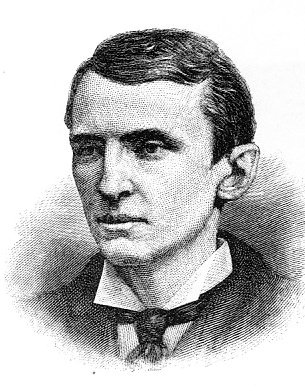
Ferdinand Ward (1851–1925)
Ferdinand De Wilton Ward Jr. (1851–1925) was an American financier and one of the most notorious swindlers in U.S. history. He rose to fame as the “Young Napoleon of Finance” due to his apparent financial acumen and success. However, he later became infamous as “the Best-Hated Man in the United States” after his elaborate Ponzi scheme collapsed, causing financial ruin for many, including prominent figures like former U.S. President Ulysses S. Grant. Below, World History Edu explores Ward’s background, rise to prominence, fraudulent schemes, and eventual downfall.
Early Life and Background
Born in 1851 in Geneseo, New York, Ferdinand Ward was the son of Reverend Ferdinand De Wilton Ward and Jane Ward. His parents had served as missionaries in India before returning to the United States, where they raised Ferdinand and his younger brother. Ward’s early life was marked by a modest upbringing, but his ambitions quickly outgrew his circumstances.
In 1873, Ward moved to New York City, where he began working as a clerk at the Produce Exchange. Even at this early stage, his unethical tendencies were evident. He embezzled money from a Sunday School and laundered it through a bank to elevate his financial standing. In 1877, Ward married Ella Champion Ward, née Green, an heiress whose family’s wealth further bolstered his ambitions.
The Ponzi Scheme: Rise and Fall of Grant & Ward
In 1880, Ward established his own banking and brokerage firm. One of his earliest investors was James D. Fish, president of the Marine National Bank. Fish became a key accomplice in Ward’s fraudulent operations. Ward also forged connections with Ulysses S. “Buck” Grant Jr., the son of former U.S. President Ulysses S. Grant. Buck’s brother, a college roommate of Ward’s, introduced them, leading to a business partnership.
Formation of Grant & Ward
Ward and Buck Grant partnered to create the firm Grant & Ward. Ward exploited the Grant name to attract investors, claiming he had insider access to lucrative government contracts. These claims were bolstered when President Grant himself became a full partner after investing $100,000. Ward ran the firm as a Ponzi scheme, using borrowed securities repeatedly as collateral for loans and paying earlier investors with funds from new ones. Promising high returns of 2-3% per month, Ward amassed significant wealth, drawing in numerous investors, including prominent figures like Thomas Nast.
Lavish Lifestyle
While his fraudulent activities remained undiscovered, Ward enjoyed extraordinary wealth. His earnings reached $9 million, allowing him to purchase a luxurious brownstone in New York City and a sprawling 25-acre estate in Connecticut. The Grants also appeared to prosper from the scheme, further cementing Ward’s reputation as a financial genius and earning him the moniker “The Young Napoleon of Wall Street.”
Collapse of the Scheme
On May 4, 1884, the scheme unraveled. Ward’s fraudulent activities caused the collapse of Grant & Ward, the Marine National Bank, and the financial ruin of many investors, including the Grant family. Ulysses S. Grant Sr. took a personal loan of $150,000 from his friend William H. Vanderbilt in an attempt to save the firm, but the effort was futile. The Panic of 1884 ensued, with widespread financial losses reverberating across the country. Ward, facing exposure, fled.

Legal Consequences
Ward was eventually captured, brought before the New York Supreme Court, and charged with fraud. He showed no remorse during his trial, justifying his actions by stating that he had to “rob Peter to pay Paul.” Found guilty, Ward was sentenced to ten years in prison and incarcerated at Sing Sing.
Life in Prison
Despite his conviction, Ward managed to live relatively comfortably in prison, leveraging his connections for privileges. He served six years before being released. However, during his imprisonment, his life took another significant blow. His wife, Ella, passed away in 1890 and left her estate in trust for their son, Clarence, until he reached 25. This effectively deprived Ward of access to her wealth, leaving him financially destitute upon his release.
Post-Prison Years
After his release from prison, Ward made various unsuccessful attempts to rebuild his fortune. He even pursued legal avenues and reportedly tried to orchestrate a failed kidnapping of his son, Clarence, to reclaim control of the inheritance. In 1894, Ward married Isabella Ward, née Storer, but his public prominence had faded.
Although Ward occasionally commented on the collapse of Grant & Ward and the financial ruin of Ulysses S. Grant, he spent his later years in relative obscurity. His efforts to regain his earlier stature and wealth never materialized.
Legacy and Family Connections
Ward died in 1925 at the age of 74, leaving behind a tarnished legacy as one of the most infamous financial fraudsters of his time. His second wife, Isabella, passed away a year later.
While Ferdinand Ward’s actions caused untold suffering, they also led to greater awareness and regulatory measures aimed at preventing similar schemes in the future.
Despite the scandal surrounding Ferdinand Ward, his descendants went on to lead notable lives. His grandson, F. Champion Ward, became a vice president at the Ford Foundation, contributing significantly to education and philanthropy. His great-grandson, Geoffrey C. Ward, authored A Disposition to Be Rich, a biography published in 2013 that detailed Ferdinand Ward’s life and the impact of his fraudulent activities on his family and society.
Analysis of Ward’s Methods and Impact
Ward’s Ponzi scheme was characterized by its sophistication and audacity. By exploiting the trust of prominent individuals and leveraging the Grant name, Ward created an illusion of legitimacy that masked the fraudulent nature of his operations. His repeated use of the same securities as collateral and his practice of paying older investors with funds from new ones are hallmarks of Ponzi schemes, which continue to plague financial systems to this day.
The collapse of Grant & Ward had far-reaching consequences. It not only destroyed the financial stability of many individuals but also contributed to the Panic of 1884, a nationwide economic downturn. The personal toll on the Grant family was immense, tarnishing their reputation and leaving Ulysses S. Grant Sr. in financial ruin during his final years.
remains a pivotal figure in the history of financial fraud in the United States.

Frequently Asked Questions about Ferdinand Ward
FACT CHECK: At World History Edu, we strive for utmost accuracy and objectivity. But if you come across something that doesn’t look right, don’t hesitate to leave a comment below.





