
Engraved portrait of Perrault by French artist Gérard Edelinck.
Claude Perrault played a key role in designing the east façade of the Louvre, designed the Paris Observatory, and proposed projects like the Arc de Triomphe du Thrône and the connection between the Louvre and Tuileries Palace.
Early Life and Education
Claude Perrault was born on September 25, 1613, in Paris, France. He came from an affluent and educated family, which fostered his broad intellectual pursuits. His younger brother, Charles Perrault, later became famous for his fairy tales, including “Cinderella.” Claude, however, followed a different path, dedicating his life to the study of medicine, architecture, and the natural sciences.
Perrault pursued medical studies at the University of Paris, where he earned his degree in 1642. Though he was trained as a physician, his interests extended beyond medicine into the realms of physics, mechanics, and engineering. His polymathic nature allowed him to contribute significantly to multiple fields, making him one of the most versatile minds of his time.
The French Academy of Sciences and Scientific Contributions
Perrault was one of the first members of the French Academy of Sciences, founded in 1666 under the patronage of King Louis XIV and his finance minister, Jean-Baptiste Colbert. This institution was instrumental in fostering scientific progress in France, and Perrault’s contributions to it were substantial. His expertise in anatomy led him to collaborate on the publication Mémoires pour servir à l’histoire naturelle des animaux (1676), a collection of anatomical studies carried out by the Academy.
Beyond anatomy, Perrault delved into physics and mechanics. His work in acoustics was particularly influential. In Oeuvres diverses de Physique et de Mecanique, he explored theories of sound propagation, media, and resonance. He examined how vibrations influenced consonance and dissonance in music, offering a scientific basis for musical harmony. His contributions to physics extended to broader natural phenomena, reflecting his deep curiosity about the physical world.
Architectural Achievements: The Louvre and Beyond
Though he had no formal training in architecture, Perrault’s mathematical and engineering expertise led him to become one of the key figures in 17th-century French architecture. He was a member of the Petit Conseil, a committee appointed by King Louis XIV to design the new east façade of the Louvre Palace. This group included renowned figures such as architect Louis Le Vau and artist Charles Le Brun, but it was Perrault who played the most decisive role in shaping the final design.
Construction of the east façade began in 1667 and was largely completed by 1674. Perrault’s vision for the Louvre was heavily influenced by classical architecture, drawing upon Vitruvian principles. His design featured a colonnade with Corinthian columns, emphasizing symmetry and grandeur. One of his major engineering contributions was the possible introduction of iron tie rods behind the entablature, which helped reinforce the structure against stress and shifting forces.
Although the east façade remains one of his most well-known works, Perrault also devised plans to connect the Louvre with the Tuileries Palace. Though these plans were never fully realized, they demonstrate his ambitious vision for urban architectural harmony.
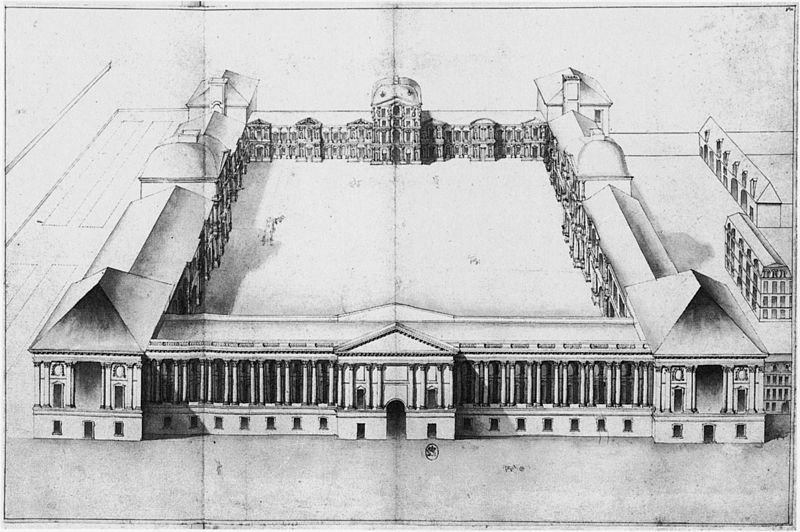
A 1668 drawing, attributed to Perrault, depicting a design for the Louvre’s east façade.
Claude Perrault challenged rigid classical ideals, emphasizing that aesthetic beauty is subjective, aligning him with the Moderns in the intellectual discourse of his time.
The Paris Observatory and Other Architectural Works
Another of Perrault’s architectural achievements was the design of the Paris Observatory, constructed between 1667 and 1669. As a research institution under the French Academy of Sciences, the Observatory was designed with precision and scientific functionality in mind. Its layout and orientation reflected a keen awareness of astronomical requirements, solidifying its status as one of the most significant scientific buildings of the time.
Perrault also proposed a design for a triumphal arch on Rue Saint-Antoine, known as the Arc de Triomphe du Thrône. Though only partially completed, his design was chosen over those of established architects such as Le Vau and Le Brun. The structure was notable for its innovative use of interlocking stones without mortar, a technique that allowed the arch to form a cohesive, inseparable mass.
When the arch was dismantled in the 19th century, it was discovered that Perrault had used this method to enhance its stability.
Additionally, he devised plans for the reconstruction of Sainte-Geneviève Church in Paris, which, although unexecuted, demonstrated his interest in religious architecture.
Literary Contributions: Vitruvius and Architectural Theory
Perrault was not only an architect but also an influential writer on architectural theory. He translated and annotated Les Dix Livres d’Architecture de Vitruve, the French edition of Vitruvius’ Ten Books on Architecture, published in 1673. His translation was not merely a linguistic exercise but included extensive commentary that modernized Vitruvian principles for the 17th century. His work remains a crucial reference for scholars studying classical architectural theory.
In 1683, he published Ordonnance des cinq espèces de colonnes selon la méthode des anciens, a treatise on the five classical orders of architecture. Unlike earlier theorists who treated classical proportions as immutable, Perrault argued that aesthetic beauty was subjective and influenced by cultural and temporal contexts. This perspective challenged rigid classical doctrines and introduced a more flexible approach to architectural design.

Influence on Architectural Aesthetics
Perrault’s theories contributed to the intellectual debate between the Ancients and the Moderns, a discourse that extended beyond architecture into literature and the sciences. His assertion that architectural proportions were not absolute but based on human perception anticipated later developments in architectural aesthetics. His work laid the foundation for questioning classical ideals and paved the way for the evolving architectural styles of the 18th century.
His role in shaping French classicism was significant. By blending scientific rigor with architectural creativity, Perrault helped establish the framework for monumental French architecture, influencing later architects who sought to merge engineering with artistic expression.
The Legacy of Claude Perrault
Perrault’s contributions spanned multiple disciplines, making him a remarkable figure of the 17th century. His scientific research enriched the fields of medicine, anatomy, physics, and acoustics. As an architect, he played a pivotal role in defining the grandeur of Paris through his work on the Louvre and the Paris Observatory. His translations and treatises on architecture provided a new intellectual framework that shaped architectural thought for generations.
Despite his influence, Perrault faced criticism and controversy during his lifetime. His architectural theories, which questioned rigid classical proportions, met resistance from traditionalists. His role in the Louvre project was also contested, with some historians attributing more credit to Le Vau. Nevertheless, his impact is undeniable.
Perrault passed away on October 9, 1688, in Paris. Today, his work remains integral to the history of architecture and science. The east façade of the Louvre continues to stand as one of the most celebrated examples of French classicism.
His treatises are still studied by architects and historians, and his scientific investigations continue to be recognized for their contributions to early modern knowledge.





