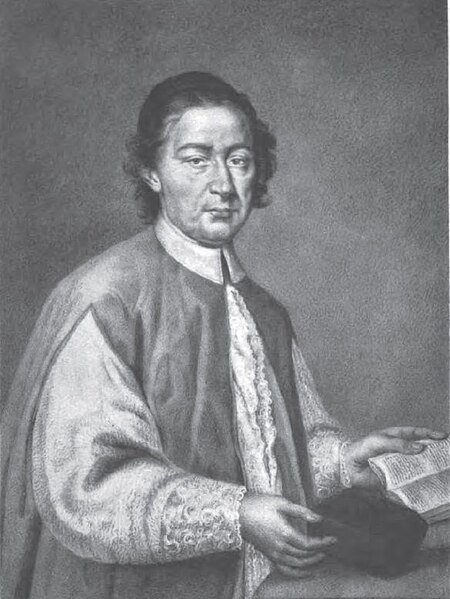
Giuseppe Simone Assemani
Giuseppe Simone Assemani was a Lebanese Maronite orientalist, Vatican librarian, and Catholic bishop, known for his extensive work on Eastern Christian manuscripts.
Early Life and Education
Giuseppe Simone Assemani was born on July 27, 1687, in Hasroun, a village in Mount Lebanon. His surname, Assemani, is a patronymic derived from the name Simeon, which was common in his family, a lineage distinguished for its contribution to Oriental studies. As a young boy, he demonstrated exceptional intellectual abilities, prompting his family to send him to the Maronite College in Rome in 1703.
Giuseppe Simone Assemani worked with Syriac, Arabic, Greek, Latin, Coptic, Persian, and other Eastern languages.
The Maronite College was a significant center for the education of Eastern Christian scholars, and here Assemani honed his linguistic and theological skills. He excelled in the study of Syriac, Arabic, and other Eastern languages, completing his studies in 1709. Even before graduating, he had written three essays on Syriac grammar and theology, which garnered the attention of Pope Clement XI. His early works displayed a remarkable understanding of linguistic structures and theological concepts, foreshadowing his later scholarly achievements.
Early Career and Manuscript Collection
Upon graduation, Assemani was assigned to work in the Vatican Library, where he was entrusted with cataloging manuscripts brought from Egypt in 1707 by his brother Elias. In 1710, he was appointed as scriptor Orientalis (scribe of Oriental manuscripts) and became a translator for Arabic and Syriac texts. His expertise made him a valuable advisor to the Congregation for the review and reform of the Eastern liturgical books.
In the same year, Assemani was ordained a priest, marking a significant milestone in his career. He received papal authorization in 1711 to transition from the Maronite Church to the Latin Church, which allowed him greater influence in the Vatican and the Catholic world. Between 1715 and 1717, he embarked on an extensive journey across Wadi El Natrun, Cairo, Damascus, and Lebanon, collecting manuscripts of theological and historical importance. His travels resulted in the acquisition of approximately 150 manuscripts, which became part of the Vatican Library’s esteemed collection.
Contributions to the Maronite Church and Second Expedition
In 1735, Pope Clement XII sent Assemani to the East again, where he presided over the Maronite Synod of Mount Lebanon in 1736. This event was crucial in shaping the modern Maronite Church, as it laid the foundation for new ecclesiastical regulations and liturgical reforms. His influence in Rome and his intimate knowledge of Eastern Christianity allowed him to mediate disputes within the Maronite hierarchy and strengthen the ties between the Maronite Church and the Vatican.
Giuseppe Simone Assemani was a remarkable scholar whose contributions to the preservation and study of Eastern Christian traditions remain unparalleled.
During this second journey, Assemani gathered an even larger collection of manuscripts, amassing around 2,000 texts. Among his most significant acquisitions was the Codex Assemanius, an ancient evangeliary obtained in Jerusalem in 1736. His dedication to preserving Eastern Christian heritage was evident in his meticulous efforts to safeguard and document these manuscripts, many of which were at risk of being lost to history.
Later Years and Vatican Library Leadership
In 1739, Assemani returned to Rome, where he was appointed First Librarian of the Vatican Library. In this role, he embarked on an ambitious project to edit and publish many of the valuable manuscripts he had collected. His work was not limited to academic pursuits; he was also appointed by Carlo di Borbone as an official chronicler of the Kingdom of Naples, further solidifying his reputation as a historian.
His scholarly output during this period was immense. He translated works of early Christian writers, compiled bibliographies of Syriac authors, and classified Byzantine texts. His ability to synthesize vast amounts of historical and theological knowledge set him apart as one of the most influential Orientalists of his time.
In recognition of his contributions, he was appointed bishop on December 1, 1766, and consecrated as the titular Archbishop of Tyre on December 7, 1766. His consecration was presided over by Cardinal Henry Benedict Stuart, Duke of York, with assistance from his nephew Stefano Evodio Assemani, another noted Orientalist.
Death and Legacy
Assemani passed away in Rome on January 13, 1768. Tragically, part of his extensive work was lost in a fire that broke out in his apartment on August 30, 1768. Despite this loss, his legacy endures through the manuscripts he collected, the ecclesiastical reforms he influenced, and the scholarly works he authored.
His contributions were not confined to a single discipline; he was a historian, linguist, theologian, and archivist. His efforts to preserve and disseminate knowledge about Eastern Christianity provided future scholars with invaluable resources.
Major Works by Giuseppe Simone Assemani
Bibliotheca Orientalis Clementino-Vaticana
One of Assemani’s most monumental works, Bibliotheca Orientalis Clementino-Vaticana, was an ambitious attempt to catalog and analyze Eastern manuscripts housed in the Vatican Library. Published between 1719 and 1728, this work was initially intended to be in four parts:
- Syriac and allied manuscripts (Orthodox, Church of the East, and Syriac Orthodox traditions)
- Arabian manuscripts, covering both Christian and Islamic texts
- Coptic, Ethiopian, Persian, and Turkish manuscripts
- Syrian and Arabian manuscripts not distinctly theological
Although only the first part was completed, the work remains a foundational reference for scholars of Oriental studies. A German abridgment was later published by August Friedrich Pfeiffer in the 18th century.
Other Notable Publications
In addition to Bibliotheca Orientalis, Assemani authored and edited several other significant works:
- Ephraemi Syri opera omnia (1737–1746): A compilation of works by Ephrem the Syrian, an early Christian theologian and hymnographer.
- Codex Canonum Ecclesiae Graecae (1762): A collection of Greek ecclesiastical canons.
- Bibliotheca Juris Orientalis (1762–1766): A five-volume exploration of Eastern legal traditions.
- De Scriptoribus Syris Orthodoxis (1719): A study of Syriac Orthodox writers and their contributions.
- Kalendaria Ecclesiae Universae (1755): A six-volume work detailing liturgical calendars from both Eastern and Western Christian traditions.
- Rudimenta Linguae Arabicae (1732): A foundational text for learning Arabic, which also included a Christian catechism.
- Italicae Historiae Scriptores (1751–1753): A historical work on the Kingdoms of Naples and Sicily.
Unpublished Works
Assemani had also planned several works that remained unpublished due to his death and the unfortunate fire that destroyed part of his collection. Some of these included:
- The Ancient and the New Syria (9 volumes)
- Cathedrals of the Eastern Church (6 volumes)
- Euchologia Eastern Church (7 volumes)
Influence on Future Scholarship
Assemani’s contributions to Oriental studies were profound and far-reaching. His meticulous cataloging of Eastern manuscripts helped preserve a wealth of historical, theological, and linguistic knowledge. His translations and commentaries provided invaluable insights into early Christian traditions, particularly those of the Syriac and Arabic-speaking Christian communities.
Moreover, his role in shaping the Maronite Church through the 1736 synod established many of the structural and liturgical reforms that continue to influence Maronite practices today. His scholarly works became essential references for later Orientalists and theologians, ensuring his enduring impact on ecclesiastical and academic fields alike.
Timeline of Giuseppe Simone Assemani (1687 – 1768)
1687 – Born on July 27 in Hasroun, Mount Lebanon, into the distinguished Assemani family.
1703 – Sent to the Maronite College in Rome for theological and linguistic studies.
1707 – His brother Elias brings early Christian manuscripts from Egypt, sparking his cataloging work.
1709 – Graduates and attracts the attention of Pope Clement XI due to his expertise in Syriac and Arabic studies.
1710 – Appointed scriptor Orientalis and translator; ordained as a priest on September 21.
1711 – Receives papal authorization to transition from the Maronite to the Latin Church.
1715-1717 – Travels to the Middle East, collecting about 150 valuable manuscripts for the Vatican Library.
1735 – Sent on a second mission to the East, presiding over the Maronite Synod of Mount Lebanon.
1736 – Brings back 2,000 manuscripts, including the Codex Assemanius.
1738 – Returns to Lebanon for ecclesiastical duties.
1739 – Appointed First Librarian of the Vatican Library.
1766 – Consecrated titular Archbishop of Tyre on December 7.
1768 – Dies in Rome on January 13; part of his work is lost in a fire later that year.
Frequently Asked Questions
What was Giuseppe Simone Assemani’s most significant contribution to scholarship?
His Bibliotheca Orientalis Clementino-Vaticana, a catalog of Eastern Christian manuscripts in the Vatican Library.
How did he acquire manuscripts for the Vatican Library?
Through expeditions to Egypt, Lebanon, Syria, and other Eastern regions, amassing thousands of rare texts.
What was his role in the Maronite Church?
He presided over the 1736 Maronite Synod of Mount Lebanon, shaping modern Maronite Church governance.
Why was he nicknamed “The Great Assemani”?
Due to his encyclopedic knowledge and major contributions to Oriental studies.
What happened to part of his work after his death?
A fire in his apartment in 1768 destroyed some of his unpublished manuscripts.
What was his last major ecclesiastical role?
He was appointed titular Archbishop of Tyre in 1766.





