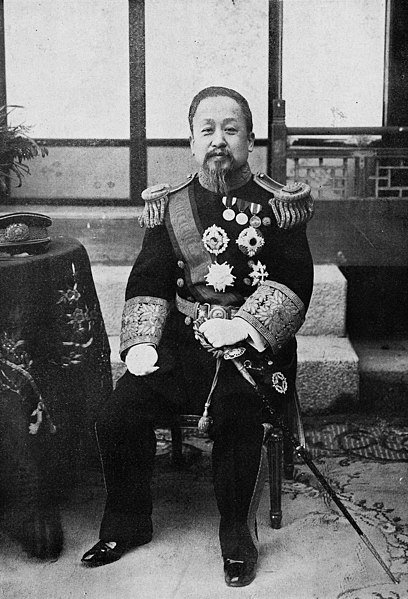
Gojong
Gojong was the last king of Joseon and the first emperor of the Korean Empire. He ruled Korea for 43 years, overseeing Korea’s transition from a kingdom to an empire and making significant efforts to modernize and maintain its sovereignty.
Early Life and Ascension
Gojong, born Yi Myeongbok (이명복; 李命福) on September 8, 1852, in Jeongseonbang, Seoul, was a member of the House of Yi, the royal family of the Joseon Dynasty. His father, Yi Ha-eung, known as Grand Internal Prince Heungseon, and his mother, Lady Min, came from influential aristocratic backgrounds. Following the death of King Cheoljong without an heir, the Andong Kim clan, which held significant political power at the time, selected Yi Myeongbok as the next ruler. He was given the title of Prince Ik-seon and entered the palace on December 9, 1863.
At just twelve years old, Gojong was crowned King of Joseon on December 13, 1863, at the Injeong Gate of Changdeokgung Palace. Because of his young age, his father, Prince Heungseon Daewongun, acted as regent, holding substantial power over the court. Gojong’s early reign coincided with a period of strict isolationism in Korea, while neighboring Japan was undergoing rapid modernization after the Meiji Restoration.
The Daewongun’s Regency and Early Challenges
During Prince Heungseon Daewongun’s regency, Korea pursued an aggressive policy of isolationism, resisting foreign influences and maintaining a strict Confucian order. The Daewongun was responsible for persecuting both foreign and native Catholics, which triggered French and American expeditions to Korea in 1866 and 1871, respectively. His regency also saw the restoration of Gyeongbokgung Palace and the dismantling of the Seowon, private academies that had become centers of factional power.
However, by 1873, Gojong declared his assumption of direct royal authority, ending his father’s regency. The Daewongun retired in 1874, but his influence lingered, and Queen Min (later known as Empress Myeongseong) and her family, the Yeoheung Min clan, gained increasing control over court politics. Queen Min, known for her intelligence and political acumen, filled key government positions with her relatives, securing her family’s dominance in the royal court.
External Pressures and Unequal Treaties
Gojong’s reign coincided with a period of growing external threats as imperial powers sought to expand their influence over Korea. Japan, having rapidly modernized, sought to extend its sphere of influence to Korea. In 1876, following Japan’s victory over Korea in a brief conflict near Ganghwa Island, Gojong was forced to sign the Treaty of Ganghwa, Korea’s first unequal treaty. This agreement granted extraterritorial rights to Japanese citizens and opened the ports of Busan, Chemulpo (Incheon), and Wonsan to Japanese trade.
The Treaty of Ganghwa marked the beginning of Korea’s vulnerability to foreign powers. While Gojong sought to balance competing interests by engaging with both China and Russia, his efforts ultimately proved futile. Korea became a battleground for regional powers, leading to increasing instability.
Imo Incident and Gapsin Coup
In 1882, Korea experienced the Imo Incident, a violent uprising sparked by grievances within the military. The traditional army, neglected and unpaid, revolted when a new, modernized military unit was established. The Daewongun seized the opportunity to regain power temporarily, but Queen Min sought the intervention of Qing China, which dispatched 3,000 troops to suppress the rebellion and restore her family’s control.
Two years later, in 1884, the Gapsin Coup, a failed attempt by reform-minded Korean elites to overthrow the conservative government, underscored the deep divisions within the Korean ruling class. The coup, supported by pro-Japanese factions, was swiftly crushed by Chinese forces, further entrenching Qing influence over Korea.
Modernization Efforts and Internal Reforms
Despite these challenges, Gojong recognized the need for modernization to preserve Korea’s sovereignty. He initiated the Gwangmu Reform, which aimed to modernize the military, establish a modern education system, and promote industrialization. Gojong established new government ministries, modeled after Western institutions, and worked to strengthen Korea’s economy by encouraging the development of industries such as mining and textiles.
However, his reforms faced opposition from traditionalist factions, and his reliance on foreign advisers and support further eroded public confidence. Although Gojong’s efforts represented a significant step toward modernization, they were perceived as insufficient by progressive elements, including the Independence Club, which was disbanded in 1898 due to fears of republicanism.
Establishment of the Korean Empire
In 1894, Japan’s victory over China in the First Sino-Japanese War ended China’s suzerainty over Korea. Following this, Korea declared its independence, and in 1897, Gojong proclaimed the establishment of the Korean Empire, assuming the title of Emperor. His coronation took place at Hwangudan Altar in Seoul, and the name of the state was changed from Joseon to the Great Korean Empire.
This move was intended to assert Korea’s sovereignty and distance the nation from its former tributary status to China. However, Gojong’s actions drew the ire of Japan, which viewed Korea’s independence as a threat to its regional ambitions.

Portrait of Gojong at age 49, painted by Chae Yong-sin.
Assassination of Queen Min and Increasing Japanese Influence
As Japan’s influence in Korea grew, Queen Min emerged as a key opponent of Japanese interference. She actively sought Russian support to counter Japan’s growing power. This antagonized Japanese interests, and on October 8, 1895, Japanese agents, under the orders of Japanese Minister Miura Gorō, assassinated Queen Min at Gyeongbokgung Palace. Her brutal murder shocked the Korean people and further inflamed anti-Japanese sentiment.
Following her assassination, Gojong and his court sought refuge at the Russian legation in Seoul in 1896, where he governed for nearly a year. This period, known as the “King’s internal exile,” underscored the vulnerability of the Korean monarchy.
Diplomatic Isolation and the Loss of Sovereignty
Gojong’s attempts to secure international support to protect Korea’s independence proved unsuccessful. Despite his efforts to appeal to Western powers, including dispatching emissaries to the Hague Peace Conference in 1907, Korea’s plight was largely ignored by the international community.
Gojong’s efforts to modernize Korea and secure its independence were sincere but ultimately unsuccessful in preventing Japan’s annexation.
After Japan’s victory in the 1904–1905 Russo-Japanese War, Japan emerged as the dominant power in East Asia. In 1905, Korea was forced to sign the Japan–Korea Treaty, which stripped Korea of its diplomatic sovereignty and placed it under Japanese control. Gojong refused to recognize the treaty’s legitimacy and sought to rally international support against Japan’s encroachment. However, his efforts were in vain.
Forced Abdication and Life in Deoksugung
Gojong’s defiance led to his forced abdication on July 20, 1907. He was replaced by his son, Yi Cheok, who became Emperor Sunjong. After his abdication, Gojong was confined to Deoksugung Palace, where he lived under strict surveillance. His attempts to escape and establish a government in exile abroad were unsuccessful, and Korea’s fate was sealed when Japan formally annexed the Korean Empire in 1910.
Although Gojong retained the honorary title of “King Emeritus Yi of Deoksu,” he was effectively powerless. Japan absorbed the Korean imperial family into the Japanese aristocracy, and Gojong’s influence was reduced to a ceremonial role.
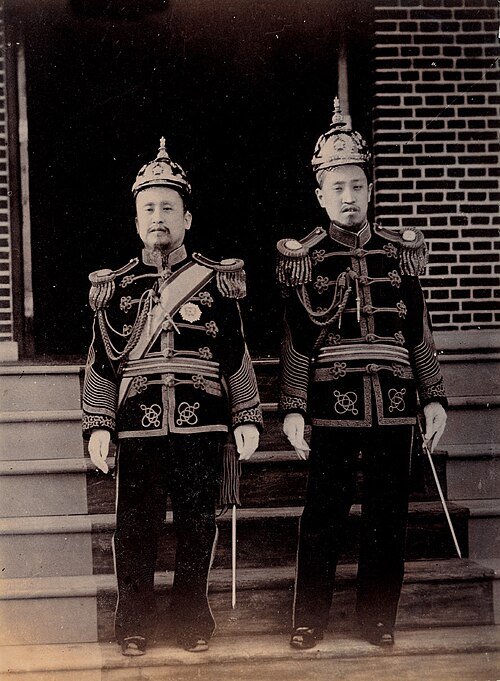
Gojong and Crown Prince Sunjong (adorned with Pickelhaube helmets).
Death and Legacy
Gojong died on January 21, 1919, in Deoksugung Palace. Although the official cause of death was recorded as a cerebral hemorrhage, widespread rumors suggested that he had been poisoned by Japanese agents. His sudden death became a catalyst for the March First Movement, a nationwide protest against Japanese colonial rule that galvanized the Korean independence movement.
Gojong’s legacy is a complex one. He is remembered as a monarch who faced overwhelming challenges during a tumultuous period in Korean history.
Gojong was buried alongside his wife, Empress Myeongseong, at the imperial tomb of Hongneung in Namyangju, Gyeonggi Province. His funeral, attended by a massive crowd, symbolized the enduring resistance of the Korean people against Japanese domination.

Timeline of Gojong of Korea
-
September 8, 1852: Gojong, born Yi Myeongbok, is born into the royal House of Yi in Seoul, Joseon.
-
December 13, 1863: Gojong is crowned King of Joseon at the age of twelve, with his father, Prince Heungseon Daewongun, acting as regent.
-
1873: Gojong assumes full royal authority, ending his father’s regency and beginning his direct rule.
-
1876: The Treaty of Ganghwa is signed, granting Japan extraterritorial rights and opening Korean ports to Japanese trade.
-
1897: Gojong proclaims the Korean Empire, declaring himself emperor to assert Korea’s independence.
-
1905: Korea loses its diplomatic sovereignty after the Japan–Korea Treaty is signed, placing the country under Japanese control.
-
July 20, 1907: Gojong is forced to abdicate by Japan and is replaced by his son, Sunjong.
-
January 21, 1919: Gojong dies in Deoksugung Palace under suspicious circumstances, fueling the March First Movement for Korean independence.
Frequently Asked Questions
How did Gojong ascend to the throne?
Gojong was chosen by the powerful Andong Kim clan after King Cheoljong died without an heir. He was crowned at the age of twelve in 1863, with his father, Prince Heungseon Daewongun, acting as regent until Gojong assumed full royal authority in 1873.
What was the significance of the Treaty of Ganghwa in 1876?
The Treaty of Ganghwa marked Korea’s first unequal treaty, granting Japan extraterritorial rights and opening three Korean ports to Japanese trade. It initiated a period of foreign encroachment that led to Korea’s eventual loss of sovereignty.
How did Gojong attempt to modernize Korea?
Gojong introduced the Gwangmu Reform, which aimed to modernize Korea’s military, industry, and education. He established a constitutional framework and promoted industrial development, but his reforms were ultimately insufficient to protect Korea from external threats.
What was the impact of Queen Min’s assassination?
Queen Min, a strong opponent of Japanese interference, was assassinated by Japanese agents in 1895. Her death intensified anti-Japanese sentiment in Korea and forced Gojong to seek refuge in the Russian legation, highlighting Japan’s growing dominance over Korea.
Why did Gojong proclaim the Korean Empire in 1897?
Gojong proclaimed the Korean Empire in 1897 to assert Korea’s independence after China’s defeat in the First Sino-Japanese War. He aimed to strengthen Korea’s international standing and end its tributary relationship with China.
What led to Gojong’s forced abdication in 1907?
Following Japan’s victory in the Russo-Japanese War, Japan gained control over Korea. Gojong’s efforts to resist Japanese influence led to his forced abdication in 1907, and he was replaced by his son, Sunjong.
How did Gojong’s death influence Korean resistance?
Gojong’s death in 1919, suspected by many to be the result of poisoning by the Japanese, became a catalyst for the March First Movement. This nationwide protest against Japanese rule invigorated the Korean independence movement.





