
The architectural design of a Hindu temple in Sunak, Gujarat.
The study of Hindu architecture exposes one to an extensive knowledge about the elements, styles, symbolism, and evolution of temple architecture within Hinduism.
This architectural tradition, developed over millennia, reflects the sacred cosmology, philosophical tenets, and artistic brilliance of the Hindu civilization. The temples serve as a microcosm of the universe, blending divine principles with structural ingenuity.
From simple cave shrines to towering temple complexes, Hindu architecture is distinguished by its regional diversity and intricate iconography.
The Evolution of Hindu Temple Architecture
Hindu temples evolved from rock-cut shrines and cave temples to sophisticated structural edifices made of stone and brick. The earliest sanctuaries, found in the Mauryan and Gupta periods (c. 3rd century BCE–6th century CE), were largely modest in form, consisting of simple cells (garbhagriha) housing a deity. Over time, two primary architectural styles emerged—the Nagara style of North India and the Dravida style of South India, along with a third hybrid form known as the Vesara style, which synthesized elements of both.
Through their structural ingenuity and devotion-infused artistry, Hindu temples remain profound expressions of spirituality, community, and cosmic harmony.
The foundational principles of Hindu temple design are codified in ancient texts like the Shilpa Shastras and the Vastu Shastra. These scriptures prescribe not just the temple’s layout but also its proportional systems, sacred measurements, and alignments with celestial bodies, ensuring that the structure embodies both material and spiritual dimensions.
Key Elements of Hindu Temples
Hindu temples, irrespective of their regional variations, share certain fundamental elements that collectively shape their symbolic and functional purpose.
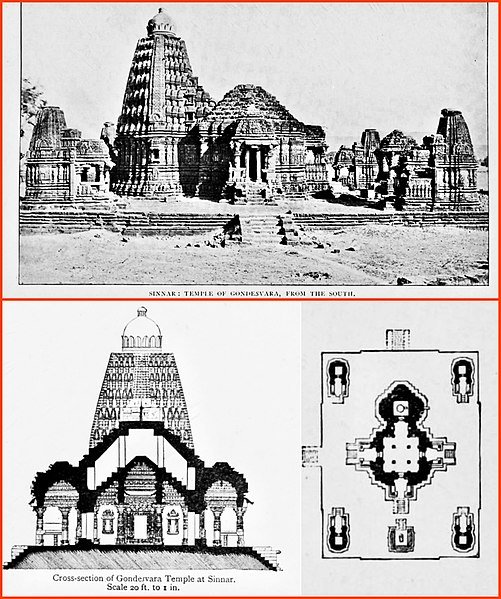
The architectural design of the Gondeshwar temple near Nashik, Maharashtra.
Garbhagriha (Sanctum Sanctorum)
The garbhagriha is the innermost sanctum where the temple’s principal deity is enshrined. It is typically a small, dimly lit chamber, signifying the divine womb (garbha) and representing the cosmic axis (brahmasutra) that connects earthly existence with the heavens. The sanctum is often square in shape, as per Vastu Shastra’s sacred geometry, ensuring harmony and balance.
Shikhara and Vimana
The shikhara (in Nagara style) and the vimana (in Dravida style) are the towering superstructures above the garbhagriha, symbolizing Mount Meru, the mythical cosmic mountain. The Nagara shikhara is curvilinear and rises in a pyramidal form, while the Dravida vimana is stepped, often crowned with a domed structure known as the stupi.
Mandapa (Pillared Hall)
The mandapa is a pillared hall leading to the sanctum, serving as a space for devotees to gather, pray, and participate in religious ceremonies. Larger temples may have multiple mandapas, such as mukhamandapa (entrance porch) and mahamandapa (great hall), each increasingly elaborate and adorned with sculptural details.
Mandapa is a pillared hall leading to the garbhagriha, used for rituals and gatherings.
Antarala (Vestibule)
Connecting the mandapa to the garbhagriha is the antarala, a narrow transitional passageway. This space marks a spiritual threshold, guiding the devotee from the external world into the sacred presence of the deity.
Antarala is a small antechamber leading to the inner sanctum (garbhagriha) of a temple.
Gopuram (Gateway Tower)
A striking feature of South Indian temple architecture, the gopuram is a monumental gateway tower adorned with intricate carvings of deities, mythological scenes, and floral motifs. These towering gateways serve as visual beacons, marking the sacred precinct of the temple.
Pradakshina Patha (Circumambulatory Path)
Encircling the garbhagriha is the pradakshina patha, a circumambulatory passage allowing devotees to walk around the sanctum in a clockwise direction, symbolizing devotion and cosmic alignment.
Jagati (Temple Platform)
Many Hindu temples are elevated on a raised platform known as the jagati, which not only enhances their visual grandeur but also signifies the separation of the sacred space from the secular world.
Torana (Decorative Gateway)
Some temples feature ornate toranas, or decorative archways, which frame the entrance. These gateways, adorned with intricate sculptures, symbolize the threshold between the material and spiritual realms.
Kalasas and Amalakas
At the temple’s pinnacle sits the kalasa, a metal or stone finial often shaped like a sacred pot, representing prosperity and divine energy. In Nagara temples, an additional crowning element, the amalaka, is a fluted stone disc believed to symbolize the sun.
Amalaka is a large fluted stone disc, inspired by the amla (myrobalan) fruit, placed atop Nagara temple towers.
Yali (Guardian Beasts)
Commonly found in South Indian temples, yalis are mythical lion-like creatures carved onto pillars and gateways, serving as protectors of the sacred space.
Regional Variations in Hindu Architecture
The distinction between Nagara, Dravida, and Vesara styles is based on regional preferences, construction techniques, and artistic conventions.
Nagara Style (North India)
The Nagara style is characterized by its curvilinear shikhara, multiple projections known as rathas, and intricately carved exteriors. It includes several subtypes:
- Latina Shikhara: A single curvilinear spire, seen in temples like the Kandariya Mahadeva Temple in Khajuraho.
- Shekhari Shikhara: A central spire surrounded by smaller subsidiary spires, as in the Lakshmana Temple, Khajuraho.
- Bhumija Shikhara: A unique pattern where miniature spires create a web-like appearance, found in temples of western India.
Dravida Style (South India)
The Dravida style, predominant in Tamil Nadu, features a pyramidal vimana, elaborate gopurams, and extensive use of sculptures.
- Vimana: A stepped, pyramidal superstructure culminating in a stupi, seen in the Brihadeshwara Temple.
- Mandapas: Spacious pillared halls used for processions and festivals.
- Gopurams: Towering entrance gateways decorated with vibrant sculptures.
- Water Tanks: Temple complexes often include pushkarinis, sacred water reservoirs used for ritual purification.
Vimana is the pyramidal tower of Dravida temples, often crowned with a small dome.
Vesara Style (Hybrid of Nagara and Dravida)
Emerging in the Deccan region, Vesara temples blend the best of both styles. They incorporate the curved shikhara of Nagara temples with the layered vimana of Dravida temples. Notable examples include the Hoysaleswara Temple in Karnataka, where intricate sculptures and elegant forms merge seamlessly.
Dravida is the style of temple architecture dominant in southern India.
Symbolism in Hindu Temple Architecture
Every architectural element in a Hindu temple has symbolic significance. The temple itself is conceived as a mandala, a geometric diagram representing cosmic order. The garbhagriha symbolizes the soul, while the shikhara represents spiritual ascent. The temple’s axial alignment with celestial bodies reinforces its cosmic significance.
Garbhagriha is the innermost sanctuary or “womb chamber” of a temple, where the principal deity is enshrined.
The sculptural program of Hindu temples is equally profound. Deities, celestial beings, dancers, and mythical creatures adorn temple walls, narrating stories from Hindu epics like the Ramayana and Mahabharata. Erotic sculptures, such as those seen in Khajuraho, symbolize divine union and spiritual transcendence rather than mere sensuality.
Sikhara is the rising tower above the garbhagriha in Nagara temples, also a decorative top in Dravida temples.
Notable Hindu Temples Across India
Hindu temples showcase remarkable diversity across regions, each embodying unique architectural traditions and devotional practices.
North India
- Kandariya Mahadeva Temple, Khajuraho: A pinnacle of Nagara architecture, known for its elegant shikhara and intricate carvings.
- Konark Sun Temple, Odisha: Designed as a colossal chariot of the sun god Surya, featuring exquisite stone wheels and dynamic sculptures.
- Jagannath Temple, Puri: An iconic Nagara temple famous for its annual Rath Yatra (chariot festival).
South India
- Brihadeshwara Temple, Thanjavur: A grand Chola-period temple with an imposing vimana and elaborate frescoes.
- Meenakshi Temple, Madurai: Renowned for its towering gopurams adorned with thousands of vibrantly colored sculptures.
- Virupaksha Temple, Hampi: A Dravida-style temple set amidst the ruins of the Vijayanagara Empire.
Western and Central India
- Somnath Temple, Gujarat: A Jyotirlinga shrine showcasing the resilience of Hindu architectural traditions.
- Dilwara Temples, Rajasthan: Jain temples known for their ethereal marble carvings.
- Mahakaleshwar Temple, Ujjain: One of the twelve Jyotirlingas, embodying ancient temple construction techniques.
Frequently Asked Questions
What is Adisthana in Hindu temple architecture?
Adisthana is the raised platform on which a temple is built, often decorated with intricate carvings.
Who is Nataraja?
Nataraja is a representation of Shiva as the cosmic dancer, used as a decorative motif.
What is the function of an Ardhamandapa?
Ardhamandapa serves as the entrance porch or portico of a temple, providing a transition space before the main hall.
What is a Bhoga Mandapa?
Bhoga Mandapa is a hall in Orissan temples used for the preparation and distribution of consecrated food.
What is a Ratha in Nagara temples?
Ratha refers to projections on the outer walls of a Nagara temple; it also represents the chariot of Surya, often depicted with spoked wheels.
What are Ghana Dvara in temple design?
Ghana Dvara are symbolic blind doorways of the garbhagriha, allowing the deity’s energy to radiate outward.
What does Devalaya mean?
Devalaya is a general term for a temple, meaning “the dwelling place of a god.”
What is housed in the Nandi Mandapa?
Nandi Mandapa is a pavilion that houses the sacred bull Nandi, Shiva’s mount.
What is Vastu-Purusa-Mandala?
Vastu-Purusa-Mandala is the symbolic, symmetrical floor plan guiding Hindu temple design.
What does Tala represent in temple architecture?
Tala refers to the individual tiers of a vimana tower.
What is Kirtimukha?
Kirtimukha is a fierce lion or monster face with a missing lower jaw, typically placed above doorways.
What is Vyala (Yali)?
Vyala, or Yali, is a lion-like mythical creature frequently sculpted in Hindu temples.





