
The guillotine
The guillotine is one of the most infamous execution devices in history. Known for its association with the French Revolution, this apparatus was designed for efficient and humane beheadings. It consists of a tall frame supporting a sharp, weighted blade, which, when released, swiftly decapitates the condemned person whose neck is secured at the bottom. Though it became a symbol of terror, the guillotine was initially introduced as a means to standardize and humanize executions.
Early Precursors
The principle of a weighted blade executing a person dates back long before the guillotine’s adoption in France. A literary reference to a similar device appears in the Old French High History of the Holy Grail (c. 1210), describing a blade that drops to sever heads. The Halifax Gibbet, used in England, and the Scottish Maiden, introduced in 1564, were both early forms of mechanical beheading machines. The Maiden was used until 1716 and is now displayed in the National Museum of Scotland.
The guillotine’s role in history extends beyond the French Revolution.
The Halifax Gibbet, first recorded in 1280, consisted of a wooden frame and an axe blade mounted on a sliding mechanism. It was used primarily for punishing thieves, though its use declined after Oliver Cromwell abolished capital punishment for petty theft.
Germany, Ireland, and Italy also used variations of beheading devices. An illustration in Petrarch’s De remediis utriusque fortunae (1532) depicts a device similar to the Halifax Gibbet. Ireland’s Holinshed’s Chronicles (1577) suggests that a similar machine was used in 1307 for the execution of Murcod Ballagh.
The Invention of the Guillotine
French physician Joseph-Ignace Guillotin proposed a more humane method of execution to the French National Assembly on October 10, 1789. Though opposed to the death penalty, he suggested that beheadings should be done with a simple mechanical device to ensure quick and painless deaths. His name became synonymous with the invention, despite not being its creator.
A guillotine is an execution device designed for beheading, consisting of a tall frame, a weighted angled blade, and a pillory-like restraint.
Antoine Louis, a surgeon and Secretary to the Academy of Surgery, developed the final design of the guillotine in collaboration with Tobias Schmidt, a German engineer. The executioner Charles-Henri Sanson claimed in his memoirs that King Louis XVI, a locksmith by hobby, suggested the use of an angled blade for more efficiency.
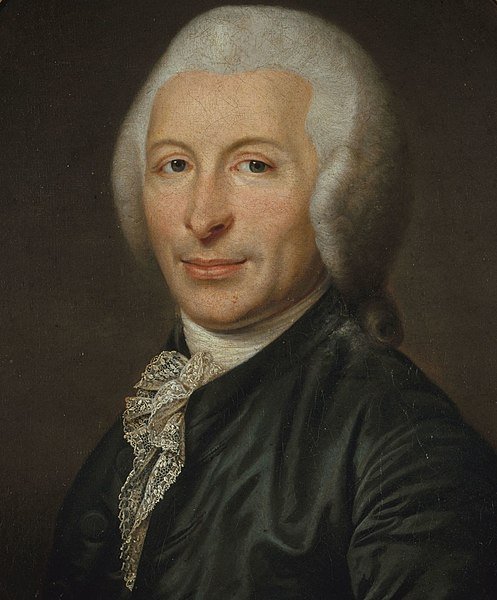
Joseph-Ignace Guillotin
First Use of the Guilotine in France
The first execution by guillotine occurred on April 25, 1792, when highwayman Nicolas Jacques Pelletier was beheaded in Paris. The event drew a large crowd, and the device was deemed a success, as it eliminated the potential for botched beheadings that had plagued sword and axe executions.
The Guillotine During the French Revolution
The guillotine became infamous during the Reign of Terror (1793–1794), during which the revolutionaries executed thousands of people, including King Louis XVI (January 21, 1793) and Queen Marie Antoinette (October 16, 1793). Revolutionaries saw it as a symbol of justice, while their opponents viewed it as an instrument of oppression.
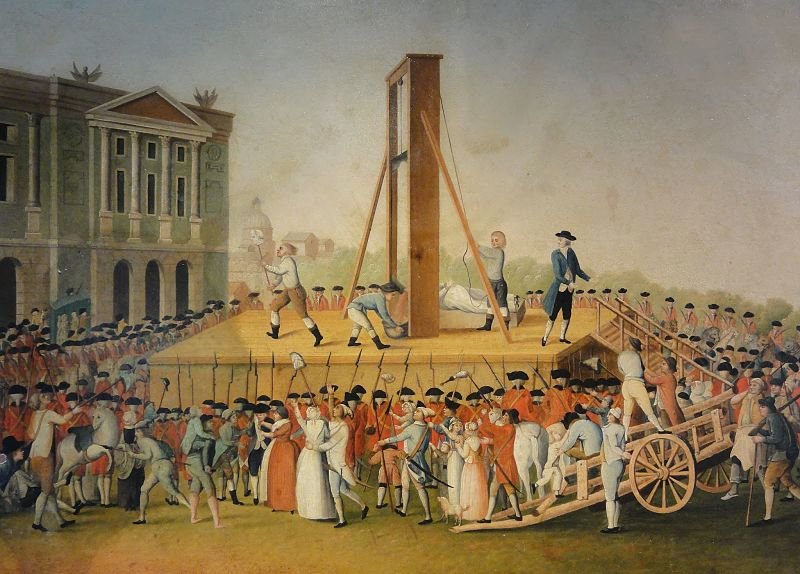
The execution of Queen Marie Antoinette on October 16, 1793.
Executions became public entertainment. Crowds gathered in the Place de la Révolution to witness beheadings, often bringing food and discussing the day’s victims. Vendors sold souvenirs and execution programs.
As the Reign of Terror intensified, its own architects faced execution. Georges Danton, Saint-Just, and Maximilien Robespierre were all guillotined in 1794, marking the end of the radical phase of the Revolution.

Later Use and Decline
After the French Revolution, the guillotine remained France’s official execution method. It was moved from public squares to prison courtyards in 1832, ensuring more controlled executions.
In 1939, the last public execution in France took place. Eugen Weidmann, a convicted murderer, was beheaded outside Saint-Pierre Prison. The unruly behavior of the spectators led the government to prohibit public executions thereafter.
The guillotine was used in French Guiana, Guadeloupe, and Martinique, with its last Caribbean execution occurring in 1965. It also saw use in New Caledonia and Tahiti.
In Germany, the guillotine (called Fallbeil) became common in the 19th century. The Nazis executed around 16,500 prisoners with guillotines between 1933 and 1945, including Sophie Scholl and other members of the White Rose resistance group.
Third Reich (1933- 1945): History, Meaning, Atrocities, and Symbols
Abolition of the Guillotine
France continued using the guillotine until the abolition of capital punishment in 1981. The last execution occurred on September 10, 1977, when Hamida Djandoubi, a convicted murderer, was beheaded in Marseille. The guillotine remained in the French penal code until capital punishment was officially banned in 1981 under President François Mitterrand.
Was the Guillotine Painless?
Despite its reputation for swiftness, debate exists about whether victims experienced pain. Eyewitness accounts suggest post-execution movement of facial muscles and eyes. French doctor Gabriel Beaurieux (1905) observed a decapitated head responding to stimuli for up to 15 seconds.
Ethical Debates
While some viewed the guillotine as humane, others condemned it as a dehumanizing instrument of mass execution. The French Revolution’s excessive use of the guillotine was particularly criticized, with many arguing it contributed to the Revolution’s eventual downfall.
Debate exists as to whether the guillotine was truly painless; some eyewitnesses claimed decapitated heads showed signs of awareness for a few seconds.
The Guillotine’s Legacy
The guillotine remains a powerful symbol in history and popular culture. It appears in literature, films, and even as a motif for revolutionary justice. Some of its nicknames include:
- La Veuve (The Widow)
- Le Rasoir National (The National Razor)
- La Bécane (The Machine)
- Le Massicot (The Paper Trimmer)
Despite its grim history, the guillotine’s impact on legal and ethical discussions of capital punishment persists. It highlights the balance between justice, deterrence, and human rights.





