The passing of philosophy to religion and the death of Hypatia mark a significant turning point in history. Hypatia was a renowned philosopher, mathematician, and teacher in Alexandria. Unfortunately, she was brutally murdered by a Christian mob in 415 AD.
Her death is often seen as symbolic of the shift from a world where reason and philosophical inquiry were highly valued to one where religious dogma increasingly dominated intellectual life. To explore this complex transition, World History Edu takes an in-depth look at Hypatia’s life and the broader cultural, religious, and philosophical currents that led to this tragic event.

Hypatia (c. 350–370 – March 415 AD) was a Neoplatonist philosopher, mathematician, and astronomer from Alexandria, Egypt, part of the Eastern Roman Empire. Image: From “Hypatia” (1885) by English painter Charles William Mitchell portrays a scene inspired by Charles Kingsley’s 1853 novel Hypatia.
Hypatia’s Life and Work
Hypatia was born in Alexandria around 350 AD, a time when the city was one of the most important intellectual centers of the Roman Empire.
Alexandria was home to the famous Library of Alexandria and was a melting pot of cultures, ideas, and religions. Hypatia’s father, Theon, was a well-known mathematician and philosopher, and he played a major role in her education. Hypatia herself became a leading scholar in Neoplatonism, a school of thought rooted in the works of Plato but heavily influenced by the mystical teachings of Plotinus.
As a Neoplatonist, Hypatia believed that reality was rooted in a single, ultimate source of goodness and unity. This philosophy sought to explain the relationship between the one perfect source of all existence (the “One”) and the many imperfect things that exist in the world.

Hypatia constructed plane astrolabes, ancient astronomical instruments. She symbolized the philosophical pursuit of knowledge and rationality, leaving a profound legacy as a leading thinker of her era. Image: An astrolabe from the 11th century
Hypatia’s lectures attracted students from across the Roman world, and she became a respected figure in Alexandria. She was known not only for her intellectual prowess but also for her character, which was described as virtuous, disciplined, and modest.
Hypatia’s life, however, was not confined to philosophy. She also made significant contributions to mathematics and astronomy. She wrote commentaries on the works of great mathematicians like Diophantus and Apollonius of Perga. Hypatia also invented several scientific instruments, including the astrolabe, which was used for astronomical measurements.
Renowned as a teacher and wise counselor, Hypatia is the earliest recorded female mathematician with significant documentation of her life.
But despite her achievements in the realms of philosophy and science, Hypatia’s life was marked by the growing tension between pagan and Christian communities in Alexandria. This tension would ultimately lead to her downfall and death.
The Philosophical Landscape of Late Antiquity
To understand the significance of Hypatia’s death, it’s important to explore the broader philosophical and religious landscape of late antiquity. During this period, the Roman Empire was undergoing profound changes, not only politically but also culturally and religiously. Christianity, which had been persecuted for centuries, became the dominant religion after Emperor Constantine’s conversion in the early 4th century. This shift had a major impact on philosophical and intellectual life.
Philosophy, particularly Neoplatonism, had long been intertwined with pagan religious practices. Philosophers like Plotinus and Porphyry had sought to reconcile their metaphysical speculations with traditional religious rituals. However, as Christianity grew in influence, many of the ideas that had been central to pagan philosophy were increasingly seen as heretical or incompatible with Christian doctrine.
This period also saw a decline in the intellectual authority of philosophy itself. In earlier centuries, philosophers were revered as wise men who could offer guidance on how to live a good life. But by the time of Hypatia, many Christian leaders viewed philosophy with suspicion, seeing it as a potential threat to the purity of Christian faith. While some Christian thinkers, such as Augustine, sought to integrate aspects of Neoplatonism into their theology, others rejected it outright as a dangerous form of paganism.
The Rise of Christianity and Religious Conflict
As Christianity became more institutionalized, its leaders began to assert their authority over all aspects of life, including intellectual and philosophical pursuits. This led to a growing conflict between Christian and pagan communities, particularly in cities like Alexandria, where both groups coexisted uneasily.
The rise of Christianity was not just a religious movement; it was also a political one. Christian bishops, particularly in cities like Alexandria, wielded immense power. The bishop of Alexandria, Cyril, played a key role in the events leading up to Hypatia’s death. Cyril was a staunch defender of Christian orthodoxy and saw the continued influence of pagan philosophers like Hypatia as a threat to the Christianization of Alexandria.
The conflict between Christians and pagans was exacerbated by political tensions. Orestes, the Roman prefect of Alexandria, was a supporter of Hypatia and represented the Roman imperial authority, which was still somewhat tolerant of paganism. Orestes and Cyril clashed over control of the city, and Hypatia, as a prominent pagan intellectual and close advisor to Orestes, became a target of Cyril’s supporters.

Cyril of Alexandria (c. 376–444), Patriarch of Alexandria, was a pivotal figure in early Christian theology. Recognized as a Church Father and Doctor of the Church, he earned the titles “Pillar of Faith” and “Seal of all the Fathers,” despite being declared a heretic by Nestorian bishops. His influence shaped Christian doctrine during the Roman Empire’s peak in Alexandria. Image: Icon of St. Cyril of Alexandria
The Death of Hypatia

An 1866 illustration by French scientist and writer Louis Figuier in Vies des savants illustres depicts the imagined assault on Hypatia.
In 415 AD, Hypatia was brutally murdered by a Christian mob. According to historical accounts, she was seized by a group of men, stripped naked, and dragged through the streets of Alexandria before being killed. Her body was then mutilated and burned. This horrific act was not just a personal attack on Hypatia but also a symbolic act aimed at silencing the voice of pagan philosophy in Alexandria.
The exact motives behind Hypatia’s murder are still debated by historians. Some argue that her death was the result of a personal vendetta, as she was seen as a threat to Cyril’s authority. Others suggest that her murder was part of a broader campaign by Christian extremists to eliminate paganism from Alexandria.
What is clear, however, is that Hypatia’s death marked a turning point in the history of philosophy and religion. Her murder symbolized the decline of classical philosophy and the rise of Christian dogma as the dominant intellectual force in the Roman world. After Hypatia’s death, the intellectual life of Alexandria, once a vibrant center of learning, began to decline.
The Legacy of Hypatia’s Death
Hypatia’s death has been interpreted in various ways by later generations. For some, she is seen as a martyr for philosophy, a symbol of the tragic end of the classical intellectual tradition. Her murder represents the loss of a world where reason and inquiry were valued, and the beginning of an era dominated by religious orthodoxy and intolerance.
For others, Hypatia’s death is a cautionary tale about the dangers of religious extremism. The mob that killed her was motivated by a desire to protect their religious beliefs, but in doing so, they destroyed one of the greatest intellectuals of their time. This event serves as a reminder of the need for tolerance and open-mindedness in intellectual and religious life.
Although no physical depictions of Hypatia survive, her reputation as a scholar and teacher earned her widespread admiration.
In more recent years, Hypatia has become a symbol of feminist empowerment. As one of the few women to achieve prominence in the male-dominated world of ancient philosophy, her life and work have been celebrated by those who seek to highlight the contributions of women to the history of science and philosophy.
Did you know…?

Hypatia of Alexandria, a Neoplatonist philosopher, mathematician, and astronomer, was renowned for her intellect, tolerance, and influence during late antiquity. Image: ‘”Hypatia” at the Haymarket theatre. Philammon declaring his love for Hypatia’. Print from the first page of The Graphic, 21 January 1893.
Though a pagan, she was remarkably tolerant of Christians, and all her known students were Christian, including Synesius of Cyrene. Synesius, later a bishop of Ptolemais, maintained a long correspondence with Hypatia, and his surviving letters are key sources about her life and teachings. He praised her as a philosopher of incredible reputation, devoted to apatheia, a state of emotional liberation.
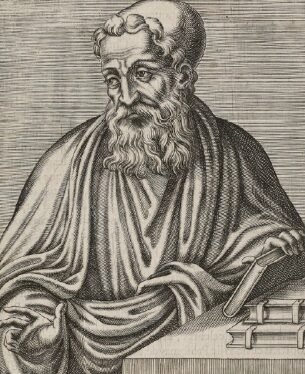
Synesius of Cyrene (c. 373–414) was a Greek philosopher and bishop of Ptolemais in Cyrenaica (modern Libya). Born into a wealthy family near Cyrene, he became a prominent figure in early Christian thought. Image: Portrait of Synesius of Cyrene from a publication by French priest and explorer André Thevet, 1584
Christian historians Socrates of Constantinople and Philostorgius also highlighted her intellectual achievements. Socrates described her as surpassing all contemporary philosophers, teaching principles of Plato and Plotinus, and engaging confidently in public assemblies, admired for her dignity and virtue. Philostorgius noted her exceptional mathematical abilities, while Hesychius of Alexandria credited her with extraordinary talent in astronomy.
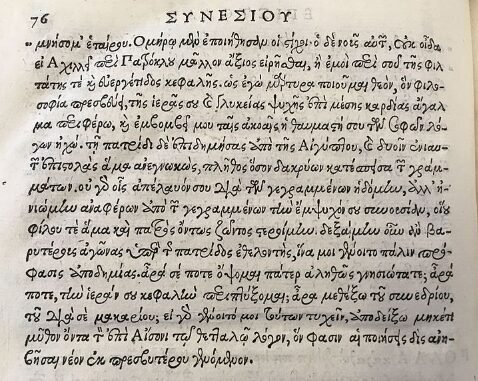
Scholars suggest Hypatia may have edited Ptolemy’s Almagest, informed by her father Theon’s commentary. Hypatia’s intellectual achievements and her role as a teacher made her a prominent figure in late antiquity. Image: Original Greek text of one of Synesius’s seven extant letters to Hypatia from a 1553 printed edition
Damascius, a later historian, emphasized her beauty, intelligence, and virtue, recounting her lifelong commitment to celibacy. According to his account, Hypatia rejected a suitor by displaying her menstrual rags, declaring his attraction was to physicality, not true beauty. This act deterred his pursuit, showcasing her sharp intellect and ability to assert her independence.
The Transition from Philosophy to Religion
The death of Hypatia represents a broader cultural and intellectual transition from a world in which philosophical inquiry and rational thought were central to intellectual life, to one in which religious authority and dogma became dominant. This transition was not sudden or absolute, but it was marked by several key developments.
First, the rise of Christianity brought with it a new way of thinking about knowledge and truth. In the classical world, philosophers like Plato and Aristotle had sought to understand the nature of reality through reason and observation. They believed that the human mind was capable of grasping universal truths through the use of logic and evidence. However, Christian thinkers introduced the idea that certain truths could only be known through divine revelation. This shift in epistemology had profound implications for the way knowledge was pursued and valued.
Second, the institutionalization of Christianity led to the decline of the philosophical schools that had been the centers of intellectual life in the ancient world. Many of these schools were either closed or transformed into Christian institutions. The famous Library of Alexandria, which had been a symbol of the classical intellectual tradition, was eventually destroyed, and with it, much of the knowledge that had been accumulated over centuries.
Hypatia authored a commentary on Diophantus’s Arithmetica, possibly interpolated into the surviving text, and on Apollonius of Perga’s Conic Sections, though this work is lost.
Finally, the transition from philosophy to religion also involved a change in the way intellectual authority was understood. In the classical world, philosophers were seen as independent thinkers who could challenge established beliefs and offer new ways of understanding the world. In the Christian world, however, intellectual authority was increasingly vested in the Church, and dissenting views were often suppressed. This shift from an open, pluralistic intellectual culture to a more closed and dogmatic one had lasting consequences for the development of Western thought.
Conclusion
The passing of philosophy to religion and the death of Hypatia mark a pivotal moment in the history of Western intellectual life. Hypatia’s murder was not just the tragic end of a brilliant thinker; it symbolized the decline of a philosophical tradition that had valued reason, inquiry, and the pursuit of truth. In its place, a new religious orthodoxy arose, one that prioritized faith and divine revelation over philosophical speculation. While Christianity brought with it its own intellectual traditions, the loss of the classical philosophical heritage was keenly felt by later generations.
Frequently asked questions

Hypatia was a philosopher and mathematician from Alexandria, Egypt, who lived between c. 370-415 CE. She was well-known for her contributions to mathematics and her role as a teacher, attracting wide audiences in a male-dominated field. Image: Depiction of Hypatia
What does Hypatia’s death symbolize in history?
Hypatia’s death symbolizes the shift from the philosophical traditions of antiquity, which embraced reason and inquiry, to the dominance of Christianity, where religious authority took precedence over intellectual freedom.
Who was Hypatia’s father, and what role did he play in her education?
Hypatia’s father was Theon, a mathematician and the last professor at the Alexandrian University. He played a crucial role in educating Hypatia in mathematics and philosophy, helping her to write commentaries on important works like those of Euclid and Ptolemy.

Euclid’s textbook the Elements was the standard teaching mathematics book, particularly for geometry, for more than two millennia.
Why did Hypatia become a target of Christian hostility in Alexandria?
Hypatia became a target of Christian hostility because of her close relationship with Orestes, the Roman prefect of Alexandria, and her influence over him. Orestes resisted converting to Christianity, and Cyril, the archbishop of Alexandria, blamed Hypatia for his refusal, viewing her as a hindrance to Christianizing the city.
What were the broader religious and cultural tensions in Alexandria during Hypatia’s time?
Alexandria was divided between pagans, Christians, and Jews. Under Emperor Theodosius I, pagan practices were outlawed, and Christian leaders, including Cyril, sought to root out pagan influences. The conflict between Christians and other religious groups intensified, with riots and violence marking the city’s religious landscape.
Icon of St. Cyril of Alexandria
What role did Orestes and Cyril play in the conflict between pagans and Christians?
Orestes, the pagan prefect, sought to maintain peace and resisted Cyril’s efforts to impose Christianity on the city. Cyril, on the other hand, encouraged violent actions against Jews and pagans. His hostility toward Orestes was exacerbated by the latter’s friendship with Hypatia, whom Cyril saw as an obstacle to converting the city to Christianity.
How did Hypatia die?
In 415 CE, Hypatia was attacked by a Christian mob incited by followers of Cyril. She was dragged from her chariot, stripped naked, beaten to death, and her body was mutilated and burned. Her murder was a brutal act aimed at eliminating her influence as a prominent pagan intellectual in Alexandria.
What impact did Hypatia’s death have on Alexandria’s intellectual community?
Hypatia’s death led to the exodus of intellectuals from Alexandria, many fleeing to Athens, where pagan teachings were still somewhat free. The city, once a major center of learning, transformed into a Christian stronghold, marking the decline of its role as a hub for philosophical inquiry.
What was the relationship between Orestes and Hypatia, and why did it cause tension with Cyril?
Orestes and Hypatia had a close relationship, with Orestes valuing her intellectual counsel. Cyril believed Hypatia’s influence over Orestes was the reason he refused to convert to Christianity, which fueled Cyril’s animosity toward her and contributed to her eventual death.

In the 18th century, English Deist John Toland altered details of Hypatia’s death to craft an anti-Catholic narrative, vilifying Cyril extensively.
What broader transition did Hypatia’s murder signify in Alexandria?
Hypatia’s murder marked the transition of Alexandria from a city of pagan philosophy to one dominated by Christian orthodoxy. It symbolized the broader cultural shift from the intellectual traditions of antiquity to a religiously controlled society, where philosophy and reason were subordinated to religious authority.
What was the aftermath of Hypatia’s death for Cyril and Orestes?
After Hypatia’s death, Orestes eventually reconciled with Cyril and converted to Christianity, ending the conflict between their factions in Alexandria. Cyril faced no punishment for his involvement in Hypatia’s murder and was later canonized as a saint by the Christian church.
How is the “passage from philosophy to religion” reflected in Hypatia’s story?
The “passage from philosophy to religion” is reflected in Hypatia’s story through the decline of pagan intellectualism and the rise of Christian dominance. Her death symbolized the replacement of philosophical inquiry with religious authority, marking the end of an era where reason was valued above faith.





