Iron Age Britain refers to the period in prehistory when iron became the primary material for tools and weapons in the British Isles, marking a significant technological and cultural transformation.
This period followed the Bronze Age and is generally considered to have begun around 800 BC and lasted until the Roman invasion of AD 43. During this time, Britain saw the development of new social structures, economic systems, and cultural practices that shaped the lives of its people.
The Iron Age was marked by regional diversity, with different areas of Britain experiencing distinct cultural developments.
In this extended explanation, World History Edu delves into the history of Iron Age Britain, explore major facts about its people, their social organization, technology, art, and interactions with the wider world.

Reconstruction of a roundhouse from the Iron Age
Historical Background of the British Iron Age
The Iron Age in Britain began when iron-working technology spread to the region, following the end of the Bronze Age. The transition from bronze to iron was not sudden but rather gradual, with early iron-working coexisting alongside bronze production. By around 500 BC, iron had become the dominant material for tools and weapons, largely replacing bronze.
Iron-working technology likely arrived in Britain through contact with mainland Europe, particularly through the Celts, who are often credited with bringing iron tools and weapons to the British Isles. The Celts were a group of Iron Age tribes that spread across much of Europe, and although the term “Celtic” is primarily linguistic, the culture associated with them left a significant imprint on Iron Age Britain. However, it is important to note that Britain was not culturally or politically unified during the Iron Age. Instead, it was made up of numerous tribes, each with its own distinct identity, customs, and ways of life.
While there is no single event that marks the beginning of the Iron Age in Britain, the widespread use of iron marks a key turning point in the region’s development. Iron was more abundant than bronze, which relied on the importation of tin and copper, and its properties made it more versatile and durable. The introduction of iron tools improved agricultural productivity, allowed for more effective warfare, and enabled new forms of craftsmanship.
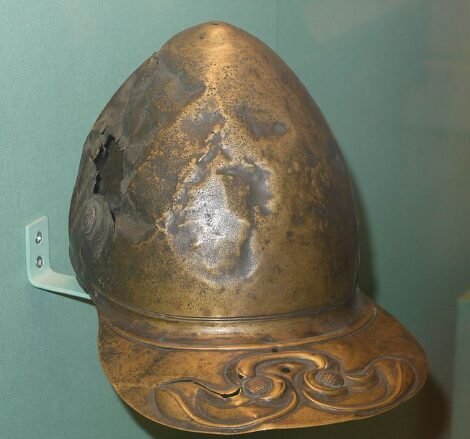
The Meyrick Helmet
Social and Political Organization
Iron Age Britain was a time of significant social and political transformation. Unlike the centralized societies of the Roman Empire or the Greek city-states, Iron Age Britain was characterized by a fragmented and tribal society. There was no overarching political authority or state; instead, power was distributed among numerous tribes, each with its own leadership and governance structures. Some of the most well-known tribes from this period include the Catuvellauni, Trinovantes, and Iceni in southern England, and the Picts in Scotland.
Tribes were often led by chieftains or kings, who exercised control over a particular region. These leaders were likely supported by a warrior elite who helped maintain their authority. Wealth and status in Iron Age society were often associated with the control of land and livestock, as well as the ability to provide protection and leadership during times of conflict.

Reconstruction of Earth House in the Iron Age
Iron Age Britain was primarily a rural society, with most people living in small farming communities. Settlements ranged from small hamlets to larger hill forts, which were often located on elevated sites and served as centers of power and defense. These hill forts could house hundreds, or even thousands, of people and were often enclosed by large earthworks and ditches. Some of the most famous hill forts from this period include Maiden Castle in Dorset and Danebury in Hampshire.
Trade and communication between different tribes were common, and there is evidence of long-distance trade with continental Europe. Goods such as pottery, metalwork, and foodstuffs were exchanged, and this trade helped to spread ideas and technologies across different regions of Britain. However, relations between tribes were not always peaceful, and there is evidence of frequent warfare, both within Britain and with neighboring peoples.
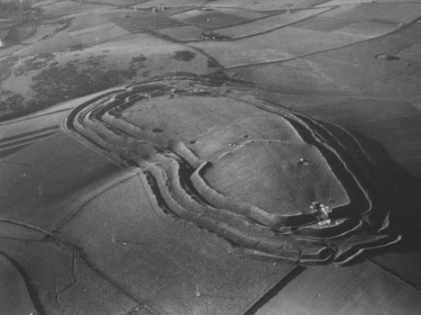
Maiden Castle, located in Dorset, is one of Europe’s largest hill forts, covering 47 acres. It dates back to the Iron Age and served as a defensive stronghold and settlement for local tribes.
Agriculture and Economy
The economy of Iron Age Britain was largely based on agriculture. Farming was the main source of sustenance and wealth for most people, and the introduction of iron tools helped to improve agricultural productivity. Iron ploughs, for example, allowed farmers to cultivate heavier soils that had previously been difficult to work with bronze or wooden tools. This increased the amount of land that could be farmed, leading to a rise in food production and population growth.
Crops commonly grown in Iron Age Britain included wheat, barley, oats, and beans. These crops were processed into bread, porridge, and other staple foods. Livestock was also an important part of the agricultural economy, with cattle, sheep, pigs, and horses being raised for meat, milk, wool, and transport. The surplus from farming allowed for trade with neighboring communities, as well as the production of goods for local use.
In addition to agriculture, metalworking, pottery, and textile production were important industries in Iron Age Britain. Iron tools, weapons, and ornaments were crafted by skilled artisans, and pottery was used for storage, cooking, and trade. Textiles, made from wool and other materials, were produced using large upright looms, and evidence suggests that people in Iron Age Britain had a strong sense of fashion, wearing brightly colored clothes and decorative accessories.
Trade played a crucial role in the economy of Iron Age Britain, both within the island and with the wider world. Goods such as grain, livestock, and metalwork were traded between tribes, and there is evidence of long-distance trade with continental Europe. Luxury items like wine and glass beads, which were not produced in Britain, were imported from Europe, demonstrating the connections Iron Age Britons had with other cultures.

Iron Age beaker from Santon, Suffolk, displayed at Cambridge University Museum of Archaeology and Anthropology.
Technology and Craftsmanship
The Iron Age is defined by the use of iron, and the development of iron-working technology had a profound impact on British society. Iron tools and weapons were stronger and more durable than those made from bronze, and iron was more readily available than the materials needed for bronze production.
The process of smelting iron involved heating iron ore in a furnace until it became molten. This process required a higher temperature than bronze smelting, and it took time for people to develop the techniques needed to work with iron. Once the technology was mastered, however, it revolutionized many aspects of life in Iron Age Britain.
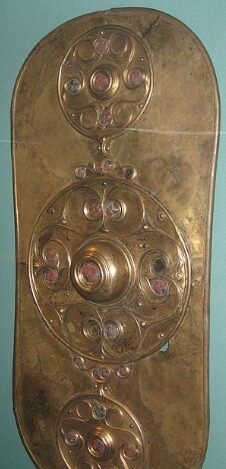
The Battersea Shield
Iron was used to make a wide variety of tools, including ploughs, sickles, and axes for farming, as well as weapons such as swords, spears, and shields for warfare. These tools and weapons were not only more effective than their bronze counterparts but also allowed for the development of new agricultural and military techniques.
Craftsmanship in Iron Age Britain extended beyond metalworking. Pottery was widely produced, and while much of it was functional, there were also decorative items, often with intricate patterns and designs. Textile production was another important craft, with wool being spun into yarn and woven into cloth using looms. The brightly colored textiles worn by Iron Age Britons were often dyed using natural pigments, and people adorned themselves with brooches, pins, and other accessories.
Art from the British Iron Age is characterized by abstract, curvilinear designs, often referred to as La Tène art after the European Iron Age culture that influenced it. These designs were commonly used to decorate metalwork, pottery, and personal ornaments. The art of the British Iron Age reflects both local traditions and influences from continental Europe, showing the interconnectedness of Iron Age cultures across the region.
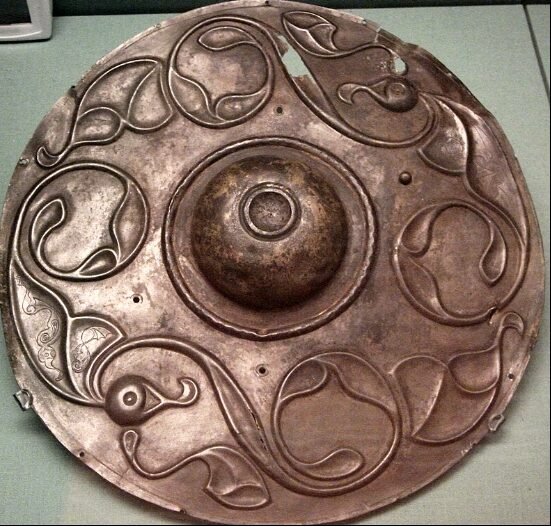
The Wandsworth Shield is an Iron Age shield boss in the La Tène style, showcasing intricate Celtic design. It’s displayed in Room 50 of the British Museum.
Religion and Ritual Practices
Religion played a central role in the lives of Iron Age Britons, although much of what we know about their beliefs and practices comes from archaeological evidence and later Roman accounts. The people of Iron Age Britain worshipped a wide variety of gods and goddesses, many of whom were associated with natural features such as rivers, forests, and mountains. Offerings of weapons, jewelry, and other valuable items were often made in these places, and many of these items have been found in rivers, lakes, and bogs.
One of the most important religious figures in Iron Age Britain was the Druid, a priestly class that is known primarily from Roman sources. Druids were believed to be responsible for leading religious ceremonies, making sacrifices, and offering guidance on legal and political matters. Some Roman writers, such as Julius Caesar, described the Druids as practicing human sacrifice, although it is difficult to know how accurate these accounts are.
Festivals and religious rituals in Iron Age Britain were closely tied to the agricultural calendar. One of the most significant festivals was Samhain, celebrated on November 1, which marked the end of the harvest and the beginning of the winter season. It was believed to be a time when the boundary between the living and the dead was blurred, and spirits could cross into the world of the living. This festival is still celebrated today as Halloween.
Another important festival was Beltane, celebrated on May 1, which marked the beginning of the warm season and the time for moving livestock to summer pastures. Other festivals, such as Lughnasadh (celebrating the ripening of crops) and Imbolc (celebrating the return of spring), were also tied to the agricultural year and reflected the close connection between Iron Age Britons and the natural world.
Burial practices in Iron Age Britain varied across regions and over time. In some areas, bodies were cremated, while in others, they were buried in tombs or pits. Some burials included grave goods, such as weapons, tools, and jewelry, indicating a belief in an afterlife where these items would be useful. The most elaborate burials were likely reserved for individuals of high status, such as chieftains or warriors.

Roundhouse in the Iron Age
Hill Forts and Settlements
Hill forts are among the most iconic features of Iron Age Britain. These large, fortified settlements were typically built on elevated ground and surrounded by ditches, ramparts, and palisades. The purpose of hill forts is still debated by archaeologists, but they were likely used for a combination of defense, trade, and social gatherings.
Some hill forts, such as Maiden Castle in Dorset, were vast complexes that could house thousands of people. These sites were not only defensive strongholds but also centers of political and economic power. Smaller hill forts and fortified enclosures were also common and were often used as refuges during times of conflict.
In addition to hill forts, there were many smaller settlements across Iron Age Britain. These included roundhouses, which were circular dwellings with thatched roofs, and stone houses, particularly in areas like Cornwall. These settlements were typically agricultural in nature, with families living in close proximity to their livestock and farmland.
Archaeological evidence suggests that Iron Age communities were highly self-sufficient, producing much of what they needed for daily life. However, they also engaged in trade with neighboring communities and with continental Europe, exchanging goods such as metalwork, pottery, and foodstuffs.
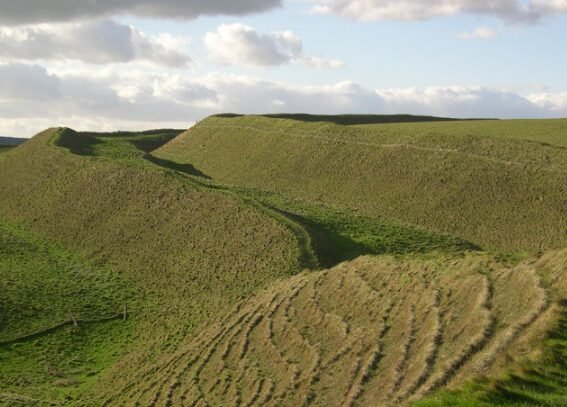
Hill forts, such as Maiden Castle in Dorset, were large fortified sites used for seasonal gatherings and trade, rather than permanent settlements. There are about 3,000 hill forts scattered across Britain.
Warfare and Conflict
Warfare was a common feature of life in Iron Age Britain, and many of the tools and weapons produced during this period were designed for battle. Iron swords, spears, and shields were widely used, and there is evidence of frequent skirmishes between different tribes. The construction of hill forts and other defensive structures suggests that conflict was a constant concern for Iron Age communities.

The Witham Shield in the British Museum
The reasons for warfare in Iron Age Britain were likely varied. Some conflicts may have been over control of resources such as land and livestock, while others may have been driven by personal rivalries or the desire for political power. Raiding was also a common practice, with tribes attacking each other to steal goods or capture slaves.
Despite the prevalence of conflict, there is also evidence of diplomacy and alliances between tribes. Some tribes may have formed coalitions to defend against common enemies, while others engaged in trade and cultural exchanges.

Celtic scabbards from the Iron Age
The Roman Invasion and Romanisation of Britain
The Iron Age in Britain came to an end with the Roman invasion in AD 43, led by Emperor Claudius. The Romans quickly established control over the southern half of Britain, bringing with them new technologies, governance structures, and cultural practices. This process of Romanisation transformed much of Britain, particularly in the south, where Roman towns, roads, and villas were built.
However, Roman control was not uniform across Britain. While the southern regions were thoroughly Romanised, other areas, particularly in the north and west, remained largely under the control of local tribes. The Picts in Scotland and the Silures in Wales, for example, continued to resist Roman rule, and the Romans eventually built Hadrian’s Wall to mark the northern boundary of their empire.
Despite the initial resistance, many aspects of Roman culture were adopted by the people of Britain. Roman goods such as pottery, glass, and coins were widely traded, and Roman law, architecture, and religion began to influence local customs. The Romanisation of Britain did not happen overnight, and many Iron Age practices, particularly in rural areas, continued for centuries after the Roman conquest.

Long before the invasion, trade between Britain and Rome had begun. Luxury goods like wine were exchanged for British grains, slaves, and minerals, and diplomatic ties helped spread Roman influence even before AD 43.
Conclusion
Iron Age Britain was a time of significant technological, social, and cultural change. The introduction of iron tools and weapons revolutionized agriculture, warfare, and craftsmanship, while the fragmented, tribal society of the period gave rise to diverse and locally distinct cultures. Hill forts, settlements, and religious practices from the Iron Age continue to fascinate archaeologists and historians, offering insights into the lives of the people who lived in Britain before the arrival of the Romans.
Although the Roman invasion marked the end of the Iron Age, many aspects of Iron Age society persisted well into the Roman period. The legacy of the Iron Age can still be seen in Britain today, from the ancient hill forts that dot the landscape to the continued celebration of festivals like Samhain. The Iron Age was a defining period in British history, laying the foundations for the development of the region’s later cultures and societies.

The Uffington White Horse, England
Questions and Answers about the British Iron Age

The British Iron Age refers to a period in the prehistory of Great Britain when iron became the dominant material for tools and weapons, replacing bronze. It lasted from around 800 BC to the Roman invasion in AD 43. Image: Silchester Iron Age town, England
How does the British Iron Age differ from the Bronze Age?
The Bronze Age relied heavily on bronze, an alloy of copper and tin, whereas the Iron Age saw iron become the primary material for tools and weapons due to its abundance and superior strength.
Why is Ireland excluded from the British Iron Age?
Ireland had its own distinct Iron Age culture, separate from that of Great Britain, which is why it is not included in discussions of the British Iron Age.
What impact did the use of iron have on Iron Age communities in Britain?
The use of iron provided stronger, more accessible tools and weapons, allowing for advances in agriculture, warfare, and daily activities. This shift also likely influenced changes in social structures.

The Battersea Cauldron, dating from 800 to 650 BCE, was recovered from the River Thames in Battersea, London. It’s currently on display in Room 50 at the British Museum.
Was the British Iron Age culturally uniform across the region?
No, the British Iron Age was marked by local diversity. Different tribes and groups had their own distinct ways of life, and there was no uniform set of tools or cultural practices across the region.
How did southern Britain become more connected with mainland Europe during the Iron Age?
Through trade and cultural exchanges, southern Britain developed stronger connections with mainland Europe, particularly in areas like art, craftsmanship, and political structures.
What marked the end of the British Iron Age?
The Roman invasion of Britain in AD 43 marked the beginning of the end of the Iron Age, as Roman culture, technology, and governance gradually replaced local Iron Age practices in the southern parts of Britain.
Romanisation refers to the process by which Roman culture, architecture, military practices, and social customs replaced the local Iron Age culture in southern Britain after the Roman invasion. This marked the transition into Roman Britain.
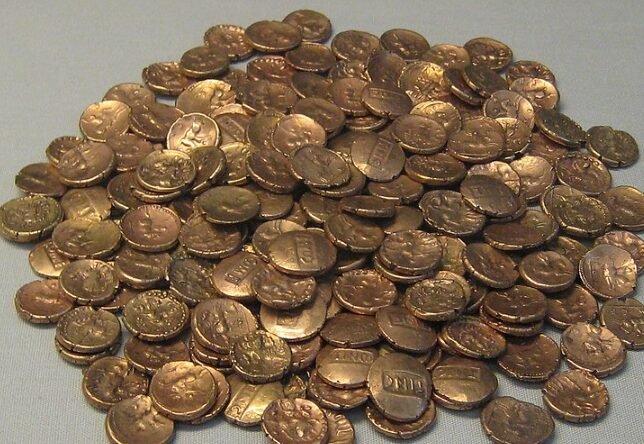
The Roman invasion in AD 43 marked the beginning of the end for the Iron Age, but many customs and beliefs persisted, especially in areas where Roman control was weak or absent.
How is the idea of a “Celtic” culture often imagined, and why is it misleading?
The term “Celtic” primarily refers to a group of related languages rather than a shared cultural identity. While Celtic languages were spoken across parts of Europe, the people who spoke them did not necessarily share a uniform culture, and different regions had their own unique practices and influences.
“Celtic” culture is often imagined based on archaeological finds like art, weaponry, and religious practices. However, different Celtic-speaking groups were influenced by their local environments and historical circumstances, leading to distinct cultural variations. It is misleading to assume a single, unified Celtic culture across all these regions.
What does archaeological evidence suggest about cultural unity among Celtic-speaking peoples?
While there were some shared characteristics, such as art styles and burial practices, there was no overarching cultural unity connecting all Celtic-speaking groups. For example, the social structures and religious beliefs in Gaul were different from those in Britain or Ireland.

Bronze comb from the Iron Age
What foods were commonly eaten by Iron Age Britons?
Iron Age Britons ate bread, grains, porridge, meat, honey, dairy products, and even beer, which was not unlike modern diets in some ways.
Agriculture was central to Iron Age society, with crops and livestock providing sustenance. Farming also facilitated trade with nearby settlements.

The discovery of glass gaming pieces in burials indicates that Iron Age people enjoyed board games, and the presence of weaving looms shows that fashion and textiles were also important.
How did religious festivals in Iron Age Britain relate to agriculture?
Religious festivals were linked to the agricultural calendar. Beltane (May 1) celebrated the start of the warm season, and Lughnasadh (August 1) marked the ripening of crops. Samhain (November 1) signified the end of the agricultural year.
What do we know about Iron Age religious practices?
Iron Age Britons worshipped up to 400 gods and goddesses. Rituals often included offerings of weapons, animals, and other valuable items in rivers, lakes, and bogs.
Who were the Druids, and what role did they play in Iron Age society?
The Druids were Celtic priests who led religious ceremonies. Most of what we know about them comes from Roman descriptions, which mention practices like human sacrifice.

Lindow Man, a well-preserved male body found in a peat bog in Cheshire, provided valuable insights into life and death during the Iron Age. He was about 25 years old, with a trimmed beard and moustache, and likely died violently as part of a religious sacrifice.





