
Nepali artist Araniko’s painting of a young Kublai
Kublai Khan (1215–1294), grandson of Genghis Khan and son of Tolui, was the founder of the Yuan dynasty in China and the Great Khan of the Mongol Empire, though his influence over the western khanates was limited.
Early Life and Background
Kublai Khan was born on September 23, 1215, as the fourth son of Tolui, the youngest son of Genghis Khan, and Sorghaghtani Beki, a Nestorian Christian and politically astute woman. As a child, Kublai was exposed to Mongol traditions and leadership values but was also deeply influenced by his mother’s administrative wisdom and her preference for Buddhism.
At an early age, Kublai showed an affinity for Han Chinese culture. Genghis Khan, impressed by his young grandson’s intelligence, encouraged his upbringing with Buddhist teachings and cultural refinement. Kublai’s political training began early, as he managed appanages and learned the complexities of governance.
Rise to Power
Kublai’s ascent began in earnest when his elder brother Möngke became Great Khan in 1251 and appointed Kublai to administer northern China. Kublai quickly proved to be an adept administrator, improving agricultural output, curbing corruption, and fostering cultural integration. His efforts earned him recognition among Mongol nobles and the Han Chinese elite.
In 1260, following Möngke’s death, a power struggle ensued between Kublai and his younger brother Ariq Böke. Both declared themselves Great Khan in separate kurultais (Mongol assemblies), leading to the Toluid Civil War (1260–1264). Kublai’s military superiority, political alliances, and control over key territories enabled him to emerge victorious, securing his position as Great Khan.
Founding of the Yuan Dynasty
Kublai formally established the Yuan dynasty in 1271, adopting the dynastic name “Great Yuan.” This marked a significant shift in Mongol governance, as Kublai sought to integrate Chinese administrative systems while maintaining Mongol traditions. The dynasty’s capital was moved to Dadu (modern-day Beijing), reflecting Kublai’s vision of a unified Chinese empire under Mongol rule.
By 1279, Kublai completed the conquest of the Song dynasty, becoming the first non-Han emperor to rule all of China proper. His reign extended over vast territories, including Mongolia, Korea, and parts of Siberia, making the Yuan dynasty one of the largest empires in history.
Administrative Reforms
Kublai’s governance was characterized by efforts to balance Mongol authority with Chinese bureaucracy. He retained traditional Mongol institutions, such as military organization and tribal loyalties, but also adopted Chinese systems of taxation, provincial administration, and Confucian rituals to legitimize his rule.
Key reforms included:
- He revitalized the Grand Canal, expanded trade networks, and issued paper currency (jiaochao) to streamline commerce, though inflation became a persistent issue.
- Kublai promoted religious tolerance, patronized Buddhist monasteries, and supported the arts, science, and education. He also established schools to train Confucian scholars and officials.
- The Yuan dynasty codified laws that blended Mongol and Chinese traditions, creating a relatively stable legal system despite ethnic tensions.
Military Campaigns and Expansion
Kublai’s military campaigns aimed to solidify his control over Asia and extend Yuan influence. Key campaigns included:
- Conquest of Song China: The Yuan forces, equipped with advanced siege technology and naval power, achieved victory at the Battle of Yamen in 1279, marking the fall of the Song dynasty.
- Invasions of Japan: Kublai launched two failed invasions of Japan (1274 and 1281). Both campaigns were thwarted by typhoons (kamikaze winds) and Japanese resistance, marking a significant setback for the Yuan.
- Southeast Asia: Kublai’s forces launched expeditions into Vietnam, Burma, and Java, achieving mixed results. While some regions became tributary states, others resisted Mongol rule.
- Central Asia: Kublai faced ongoing resistance from Kaidu, a descendant of Ögedei Khan, and other Mongol princes. This rivalry underscored the fragmentation of the Mongol Empire.
Cultural and Scientific Contributions
Under Kublai’s reign, the Yuan dynasty became a hub of cultural exchange and innovation. The Silk Road flourished, facilitating trade and the spread of ideas between East and West. Notable achievements included:
- Muslim and Chinese scholars collaborated on advanced astronomical instruments and calendars.
- Also, Kublai supported painters, poets, and historians, fostering a vibrant cultural scene. He commissioned historical works, including official Yuan chronicles.
- The Yuan dynasty saw advancements in military technology, shipbuilding, and printing, many of which were influenced by interactions with foreign experts.
Challenges and Decline
Despite his accomplishments, Kublai faced significant challenges during his later years.
First, costly military campaigns and mismanagement of paper currency led to inflation and economic instability.
Also, the Mongol Empire’s divisions deepened, with the Golden Horde, Ilkhanate, and Chagatai Khanate operating as independent entities.
Kublai struggled to maintain control over distant territories, including uprisings in Manchuria and Tibet.
The death of Kublai’s beloved wife Chabi and his son Zhenjin left him despondent. He withdrew from active governance, and his health deteriorated due to obesity and related ailments.
Death and Legacy
Kublai Khan died on February 18, 1294, leaving behind a complex legacy. He is remembered as a visionary ruler who blended Mongol and Chinese traditions, establishing a dynasty that left a lasting impact on China. The Yuan dynasty continued until 1368, when it was overthrown by the Ming dynasty, but Kublai’s achievements as a unifier and innovator endure in history.
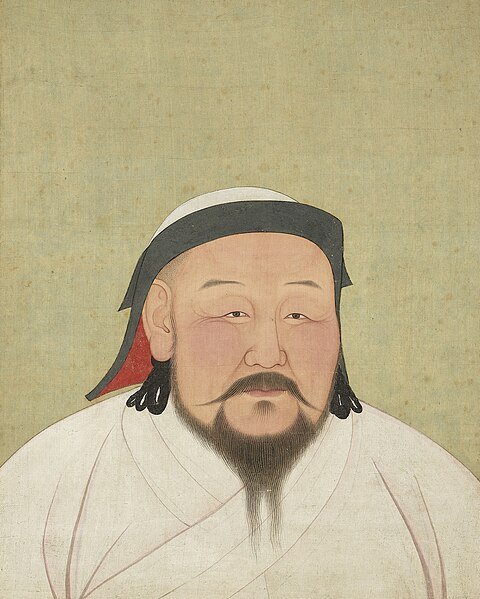
A portrait by the artist Araniko, created shortly after Kublai’s death in 1294.





