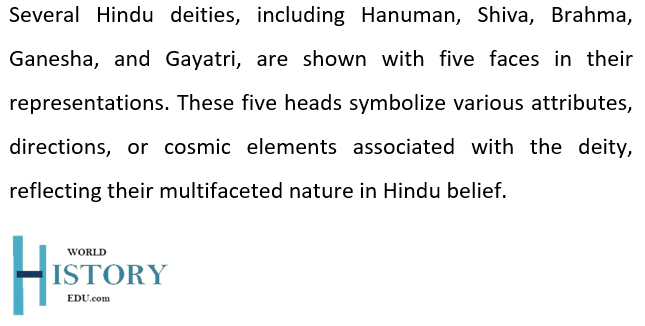
Panchamukha is a concept in Hindu iconography where deities are depicted with five heads. Image: The 10th century five headed Shiva, Sadashiva, Cambodia
In Hinduism, deities are often represented with multiple heads, arms, or bodies to signify their power, wisdom, and their ability to preside over different aspects of the universe. One such important concept is Panchamukha, which refers to the depiction of a deity with five faces (Sanskrit: पञ्चमुख, Pañcamukha, “five faces”).
Each of the five faces typically corresponds to a specific aspect of the deity, symbolizing diverse qualities, cosmic elements, directions, or attributes.
The Panchamukha concept is significant in various forms of Hindu iconography and theology, manifesting across different deities such as Hanuman, Shiva, Brahma, Ganesha, and the goddess Gayatri.
Although the significance of the Panchamukha form varies for each deity, it usually symbolizes the multifaceted nature of divine power and control over the universe.
In the article below, World History Edu explores the concept of Panchamukha, examining its meaning, representations, and importance in Hindu mythology and religious practice.
READ MORE: Principal Deities in Hinduism
The Meaning of Panchamukha
The word Panchamukha is derived from two Sanskrit terms: panch meaning “five,” and mukha meaning “face.” Therefore, Panchamukha literally translates to “five faces.” In Hindu iconography, deities with five faces are believed to embody their ability to oversee and govern the five cardinal directions (north, south, east, west, and the upward direction or zenith), and sometimes, the five elements of nature (earth, water, fire, air, and ether).
In essence, Panchamukha represents the deity’s omnipresence and omnipotence, their ability to exist and influence all directions and elements simultaneously. The five heads also reflect the deity’s capacity to manifest different aspects of existence—creation, preservation, destruction, illusion, and liberation—demonstrating the holistic and interconnected nature of reality in Hindu philosophy.
Panchamukha Hanuman

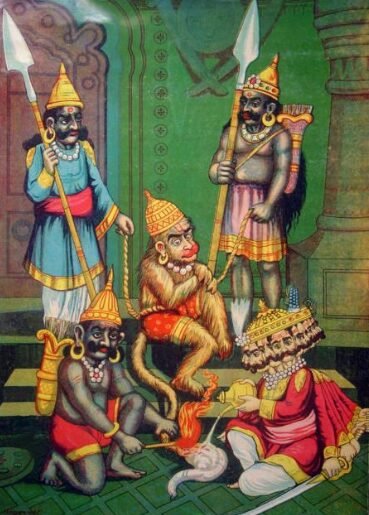
In one Ramayana narrative, Hanuman uses his five faces to extinguish five lamps simultaneously, defeating the demon Ahiravana and rescuing Rama and Lakshmana from sacrifice in the netherworld, Patala. Image: The Panchamukhi Hanuman Statue at Shirdi in Maharashtra, India.
One of the most notable examples of the Panchamukha form is Panchamukhi Hanuman, a five-faced representation of the monkey god, Hanuman. In this form, each of Hanuman’s five faces represents a different deity associated with Lord Vishnu, and each face is oriented in a specific cardinal direction, symbolizing his power to control and protect all directions of the universe. The faces of Panchamukha Hanuman are as follows:
- Hanuman’s own face (east) – Represents strength, valor, and protection. As the central and eastern face, it symbolizes Hanuman’s role as a devoted servant of Lord Rama and his leadership in protecting the righteous.
- Narasimha’s face (south) – Narasimha, the lion-faced incarnation of Vishnu, represents fierce protection and the destruction of evil forces. Facing south, this face reflects Narasimha’s power to annihilate demonic entities and protect devotees from malevolent influences.
- Varaha’s face (north) – Varaha, the boar incarnation of Vishnu, symbolizes the earth and restoration. His northern face signifies the power of Varaha in upholding the earth and restoring balance to the cosmos, particularly when it is threatened by disorder or destruction.
- Garuda’s face (west) – Garuda, Vishnu’s eagle mount, represents speed, fearlessness, and the ability to transcend physical limitations. Facing west, Garuda’s face symbolizes protection from obstacles, poisons, and dark forces, and the swift removal of dangers.
- Hayagriva’s face (upward/zenith) – Hayagriva, the horse-headed deity, represents knowledge and wisdom. His upward-facing head symbolizes spiritual knowledge and the transcendence of ignorance, guiding devotees toward liberation and enlightenment.
Panchamukhi Hanuman is particularly important in the Tantric tradition, where his five faces are invoked for protection, spiritual power, and the dispelling of negative influences. One of the earliest textual references to this form can be found in the Hanumat Rahashyam, a Tantric treatise. In the Panchamukhahanumat Kavacham, a section of this text, the five-faced form of Hanuman is described in detail, with each face and direction holding significant meaning.
In Hindu mythology, this form of Hanuman plays a crucial role in regional variations of the Ramayana. One such story involves the demon king Ahiravana, who captures Rama and Lakshmana in the netherworld of Patala and prepares to sacrifice them to a goddess. To save them, Hanuman assumes his Panchamukha form, slays the goddess, and extinguishes five lamps simultaneously using his five faces, thus defeating Ahiravana and rescuing Rama and Lakshmana. This act symbolizes Hanuman’s divine strength, bravery, and protective nature.
Panchamukha Shiva
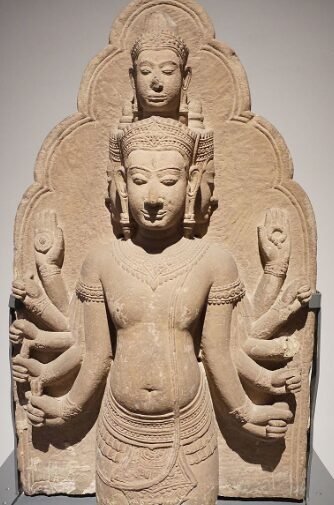
16th-century Panchamukha Shiva, Ayutthaya. Photograph from the National Museum in Bangkok, Thailand.
Another important deity represented in the Panchamukha form is Lord Shiva. In this depiction, Shiva is shown with five faces, each representing a different aspect of his divinity and cosmic function. The five faces of Panchamukha Shiva are as follows:
- Ishana (upward face) – The upward-facing head, Ishana, represents the aspect of Shiva associated with knowledge and pure consciousness. It is linked to spiritual wisdom and the transcendent nature of Shiva beyond the material world. Ishana is depicted in a copper hue and is considered the face of supreme knowledge.
- Tatpurusha (eastern face) – The eastern face, Tatpurusha, represents Shiva as the soul and as the deity governing over the organs of action and sensation. This face is associated with physical vitality and action and is depicted in a yellow hue.
- Vamadeva (western face) – The western face, Vamadeva, symbolizes Shiva’s peaceful and benevolent nature. It is connected to the ego and the element of fire, representing the transformative and regenerative powers of Shiva. This face is depicted in red.
- Aghora (southern face) – Aghora, the southern face, is the most fierce and wrathful aspect of Shiva. It represents his destructive power and control over time and death. Aghora governs intellect and righteousness, and it is depicted in a blue hue.
- Sadyojata (northern face) – The northern face, Sadyojata, represents Shiva as the creator and is associated with the element of earth. This face symbolizes the material world, the mind, and the soma (nectar of immortality), and it is depicted in white.
Panchamukha Shiva represents the complete and holistic nature of the deity, embodying creation, preservation, destruction, and the transcendence of worldly phenomena. In Shaivism, this form is often meditated upon to achieve balance, spiritual growth, and liberation (moksha).
Brahma’s Five Heads

Depiction of Brahma and Bhairava
Brahma, the Hindu god of creation, is typically depicted with four heads. However, in ancient Hindu legends, it is said that Brahma originally had five heads. The story of Brahma’s fifth head is both symbolic and theological, representing the themes of creation, desire, and cosmic hierarchy.
According to one legend, after Brahma created a goddess (identified variously as Saraswati, Savitri, or Gayatri), he became infatuated with her, despite her being his spiritual daughter. The goddess, out of respect, circumambulated Brahma. Unable to control his desire to continuously look at her, Brahma manifested four additional heads so that he could see her from every direction. This act of uncontrolled desire led to his downfall, and he exhausted his merit due to this inappropriate behavior.
In another myth, Brahma’s fifth head is linked to a conflict between Brahma and Shiva. After Brahma claimed superiority over Shiva, his fifth head began making disparaging remarks against him. In response, Shiva manifested his fierce form and either sliced off Brahma’s fifth head with his fingernail or commanded his aspect, Bhairava, to perform the act. This story reflects the superiority of Shiva over Brahma in certain traditions and the idea that Brahma’s creative powers are secondary to Shiva’s role as the ultimate destroyer and restorer of cosmic order.
The story of Brahma’s five heads carries a moral lesson about the dangers of unchecked desire and pride, as well as the necessity of maintaining balance in the universe.
Panchamukha Ganesha
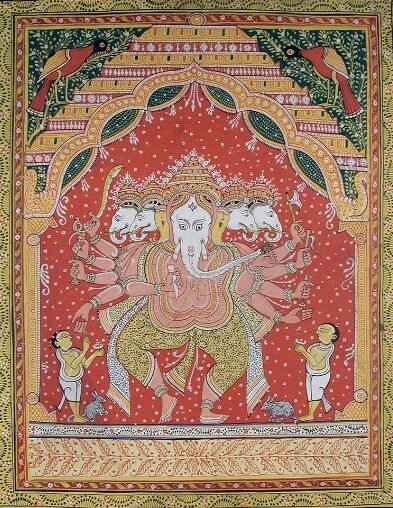
Panchamukha Ganesha
Ganesha, the elephant-headed god of wisdom and remover of obstacles, is sometimes depicted with five faces in a form known as Heramba or Panchamukha Ganesha. In this form, Ganesha’s five heads symbolize different aspects of existence and consciousness, particularly the five koshas, or sheaths, which cover the soul in Hindu philosophy. These koshas represent the layers of the human self, ranging from the physical body to the deepest spiritual core:
- Annamaya Kosha (physical body) – The first head of Panchamukha Ganesha represents the physical body, which is sustained by food and material nourishment.
- Pranamaya Kosha (life force) – The second head symbolizes the life force or energy (prana) that sustains the body and connects it to the environment.
- Manomaya Kosha (mind) – The third head represents the mind, which governs thoughts, emotions, and sensory experiences.
- Vijnanamaya Kosha (wisdom) – The fourth head symbolizes wisdom, intellect, and discernment, representing higher knowledge and the ability to make conscious decisions.
- Anandamaya Kosha (bliss) – The fifth and innermost head represents the blissful state of the soul, which is the essence of spiritual liberation and unity with the divine.
Panchamukha Ganesha is an important symbol in certain Hindu sects, particularly in South India, and is often worshipped for the removal of obstacles, the attainment of wisdom, and spiritual growth. The five-headed form of Ganesha reinforces the idea that the deity presides over the entire spectrum of human existence, from the physical to the spiritual.
Gayatri’s Five Faces
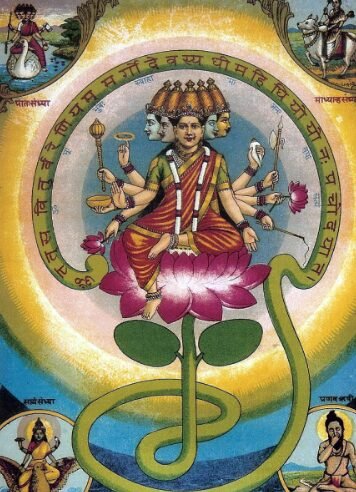
Illustration by Raja Ravi Verma depicts the goddess seated on a lotus, with five heads and ten hands.
The goddess Gayatri, the personification of the Gayatri Mantra, is another deity depicted with five faces in Hindu iconography. Each face of Gayatri represents an important aspect of the Vedic tradition and the cosmic order:
- First face (Rigveda) – The first face represents the Rigveda, the oldest of the four Vedas, associated with knowledge and hymns of praise to the gods.
- Second face (Yajurveda) – The second face symbolizes the Yajurveda, which is connected to ritual and the performance of sacrificial ceremonies.
- Third face (Samaveda) – The third face represents the Samaveda, associated with musical chants and the performance of devotional songs during rituals.
- Fourth face (Atharvaveda) – The fourth face symbolizes the Atharvaveda, which includes knowledge related to healing, protection, and the practical aspects of life.
- Fifth face (Ultimate Reality or Brahman) – The fifth face represents the Ultimate Reality, or Brahman, the supreme truth that underlies and unites the entire universe.
Gayatri’s five faces symbolize her mastery over the Vedas and her role as the embodiment of the divine knowledge that permeates all aspects of existence. As the goddess of wisdom and learning, Gayatri is revered for guiding individuals toward spiritual enlightenment and unity with the cosmic order.
Temples Dedicated to Panchamukhi Hanuman
The worship of Panchamukhi Hanuman is widespread, with several temples dedicated to this unique form of the deity. Some of the most notable temples include:
- Panchmukhi Hanuman Temple in Basatiyawala, Haryana – Located near Kalesar National Park in Haryana, this temple is a significant pilgrimage site for devotees of Hanuman. The temple is dedicated to the five-faced form of Hanuman and attracts worshippers seeking protection and blessings.
- Panchmukhi Hanuman Temple in Karachi, Pakistan – This ancient temple, located in the Sindh province of Pakistan, is believed to be around 1,500 years old. Despite being in a predominantly non-Hindu region, the temple remains an important religious site for the local Hindu community.
These temples serve as centers of devotion and spiritual practice, where worshippers offer prayers to Panchamukhi Hanuman for protection, courage, and the removal of obstacles in their lives.
Frequently Asked Questions
Panchamukhi Hanuman is primarily found in the Tantra tradition and is believed to have emerged in the 15th century CE. It is not widely considered part of mainstream Hinduism.
What is Panchamukhi Hanuman, and what do the five faces represent?
Panchamukhi Hanuman, or Panchamukha Anjaneya, is a form of Hanuman depicted with five faces. Each face represents a different deity associated with Vishnu and is oriented in a cardinal direction: Hanuman faces east, Narasimha faces south, Varaha faces north, Garuda faces west, and Hayagriva faces upward (toward the sky).
How is Shiva represented in his panchamukha form, and what does each face symbolize?
Shiva’s panchamukha form has five faces, each symbolizing a different aspect of his divine attributes:
- Ishana (upward face): Knowledge and nature (copper hue).
- Tatpurusha (eastern face): Touch and action (yellow hue).
- Vamadeva (western face): Ego and fire (red hue).
- Aghora (southern face): Intellect and righteousness (blue hue).
- Sadyojata (northern face): Mind and soma (white hue).
What is the legend behind Brahma’s five heads, and how did he lose one?
Brahma once had five heads, but one was severed by Shiva. In one story, Brahma created a goddess and became infatuated with her, manifesting extra heads to see her continuously. In another legend, Brahma’s fifth head insulted Shiva, who then severed it, either with his fingernail or through his aspect, Bhairava.
What does the five-faced form of Ganesha, known as Heramba or Panchamukha Ganesha, represent?
Panchamukha Ganesha represents the five koshas, or sheaths, which correspond to different layers of human existence:
- Annamaya Kosha: Physical body.
- Pranamaya Kosha: Life force or energy.
- Manomaya Kosha: Mind.
- Vijnanamaya Kosha: Intellect or wisdom.
- Anandamaya Kosha: Blissful or spiritual self.
What is the significance of Gayatri’s five faces in Hindu iconography?
Gayatri, the personification of the Gayatri Mantra, is depicted with five faces. Four faces represent the four Vedas, while the fifth face symbolizes the Ultimate Reality, or Brahman.
Where are temples dedicated to Panchamukhi Hanuman located?
Panchamukhi Hanuman is honored in several temples, including the Panchmukhi Hanuman Temple in Basatiyawala, Haryana, near Kalesar National Park, and another temple in Karachi, Pakistan, which is said to be around 1,500 years old.