Parvati in Hinduism: Origin Story & Relationship with Shiva

Hindu goddess Parvati together with her child Ganesha.
Parvati is one of the most important and revered goddesses in Hinduism. She is considered the goddess of power, energy, love, beauty, devotion, harmony, nourishment, and motherhood. Along with Lakshmi and Sarasvati, she forms part of the Tridevi, a trio of goddesses who are complementary to the male Trimurti (Brahma, Vishnu, and Shiva). Among the three, Parvati is primarily associated with Shiva, one of the principal deities in Hinduism. Parvati’s complex and multifaceted nature makes her an essential figure in Hindu religious texts, rituals, and theology.

Etymology and Alternate Names
The name “Parvati” comes from the Sanskrit word “parvata,” meaning mountain, and she is often referred to as “daughter of the mountains.” She is the daughter of the Himalaya Mountains, also known as Himavan, and Mena, and is sometimes called “Haimavati” to indicate her connection to the mountains. Parvati is known by various other names and forms, depending on her roles and characteristics. Some of these include:
- Uma: Often associated with light and tranquility.
- Gauri: Signifying fairness and beauty, often depicted as having a golden complexion.
- Shakti: Referring to the concept of divine feminine power.
- Durga: In her warrior form, she is a fierce protector of the righteous.
- Kali: As Kali, she is the goddess of destruction, often seen as an avenger against evil forces.
These names reflect different aspects of Parvati, from her gentle, nurturing side to her more fierce and powerful manifestations.
Parvati in the Tridevi
In the Tridevi, Parvati is paired with Shiva, Lakshmi with Vishnu, and Sarasvati with Brahma. Together, these goddesses represent three essential forces: creation, preservation, and destruction, which are embodied by Brahma, Vishnu, and Shiva, respectively. While the male deities symbolize the cosmic functions of these forces, the goddesses are seen as the active energy that enables them.
Parvati’s primary role in the Tridevi is connected with destruction and transformation. However, her association with Shiva, who represents the destructive force in the universe, does not limit her to destruction alone. Parvati complements Shiva’s ascetic, world-denying tendencies by embodying creativity, fertility, and life-giving energy. Her presence draws him into worldly engagements and affirms life, balancing his more isolated and austere tendencies.

Shiva with Parvati. Shiva is depicted three-eyed, the Ganges flowing through his matted hair, wearing ornaments of serpents and a skull garland, covered in ashes, and seated on a tiger skin
Parvati’s Absence in Vedic Texts and Later Appearance
Unlike other deities in Hinduism, such as Vishnu or Indra, Parvati does not have a significant presence in the early Vedic texts. Her first clear appearance occurs during the epic period of Hinduism (400 BCE – 400 CE), particularly in the Mahabharata and Ramayana, as well as the Puranas, which are collections of mythological and historical narratives.
The lack of mention in the Vedas has often been noted by scholars, but Parvati’s later emergence does not diminish her importance in the overall Hindu pantheon. By the time the Puranas were composed, she had gained a prominent position in Hindu theology and myth. She is recognized in these texts as the reincarnation of Sati, Shiva’s first wife, who died by self-immolation after her father insulted Shiva.
Parvati and Shiva: Cosmic Union and Household Life
Parvati’s relationship with Shiva is central to her mythology. Shiva is often depicted as an ascetic who renounces the world, seeking spiritual enlightenment through meditation and austerities. His nature is one of world-denial, which is associated with the ultimate goal in Hinduism: liberation (moksha) from the cycle of birth and death. Parvati, on the other hand, represents the affirming force of life. Her love for Shiva brings him out of his ascetic withdrawal and into marriage, symbolizing the union of asceticism and family life.
According to Hindu mythology, Parvati undergoes severe penances to win Shiva’s affection. Her devotion and perseverance eventually lead Shiva to accept her as his consort. This union is more than a simple marriage; it is a symbolic representation of the balance between renunciation and engagement with the world. Shiva without Parvati is incomplete, and vice versa. This idea is depicted in the Ardhanarishvara form, where Shiva and Parvati are merged into one being, half-male and half-female. The union of these two deities reflects the Hindu concept of duality in the universe—light and dark, male and female, creation and destruction—coming together in harmony.
In many myths, Parvati plays the role of the ideal wife, always devoted to Shiva and supporting him in his endeavors. Yet, her role is not limited to that of a devoted spouse. She is also a powerful goddess in her own right, embodying shakti, the cosmic energy that drives the universe. As the shakti of Shiva, Parvati is the source of his power. Without her, Shiva’s destructive energy would remain inert. Parvati thus represents the dynamic, creative aspect of the divine, while Shiva symbolizes the passive, transcendental aspect.
Parvati as Mother
In Hindu mythology, Parvati is also the mother of two major deities: Ganesha, the elephant-headed god of wisdom and remover of obstacles, and Kartikeya, the god of war. Her role as mother further reinforces her position as the nurturing, life-giving goddess.
- Ganesha: According to myth, Parvati created Ganesha out of clay to guard her chambers while she bathed. When Shiva attempted to enter, Ganesha, following his mother’s orders, prevented him. This angered Shiva, who beheaded Ganesha. Realizing his mistake, Shiva replaced Ganesha’s head with that of an elephant, making him one of the most beloved gods in Hinduism. Parvati’s role in Ganesha’s creation underscores her maternal and creative powers.
- Kartikeya: Kartikeya, also known as Skanda or Murugan, is Parvati’s second son and is widely worshipped, particularly in southern India. He is often depicted as a warrior god, leading divine forces against evil. Parvati’s role in raising Kartikeya highlights her nurturing and protective qualities as a mother.

Image: Kartikeya’s statue, located at Batu Caves in Malaysia.
Philosophical Role: Shakti and Cosmic Energy
One of the key philosophical aspects of Parvati is her role as shakti, which means “power” or “energy.” In Hinduism, shakti refers to the dynamic, creative energy of the universe, and it is considered to be feminine in nature. Every male deity has a corresponding shakti or female counterpart, without whom he is powerless. In this sense, Parvati is the shakti of Shiva, and together they represent the balance of power and energy in the cosmos.
In various Hindu traditions, particularly in Shaivism (the worship of Shiva) and Shaktism (the worship of the goddess), Parvati is viewed as more than just a supportive figure for Shiva. She is the cosmic force that sustains and energizes the universe. In this role, she is seen not only as a mother and nurturer but also as the fundamental energy that drives creation, sustenance, and destruction. Shiva, without Parvati’s energy, would remain inert, while Parvati’s energy without Shiva’s control would be chaotic. Together, they create balance and harmony in the universe.
Parvati in Shaivism and Shaktism
In Shaivism, Parvati plays a crucial role in the liberation (moksha) of souls. She is considered the embodiment of grace, guiding devotees towards Shiva and ultimately towards spiritual enlightenment. Her role as a model devotee herself, undergoing penance to win Shiva’s love, serves as an example of dedication and devotion for followers. Devotees often look to her for blessings in their spiritual practice, seeking her grace to overcome obstacles and achieve union with the divine.
Shaktism, a major sect of Hinduism that focuses on the worship of the goddess, regards Parvati as a central figure. In Shaktism, she is considered a compassionate and nurturing form of Mahadevi, the supreme goddess. She is also closely associated with other fierce forms of the goddess, such as Durga and Kali. In this tradition, Parvati is not merely Shiva’s consort, but a powerful, independent deity who is the source of all creation and cosmic energy. Her fierce forms, such as Durga and Kali, are worshipped for their ability to destroy evil and protect the righteous.
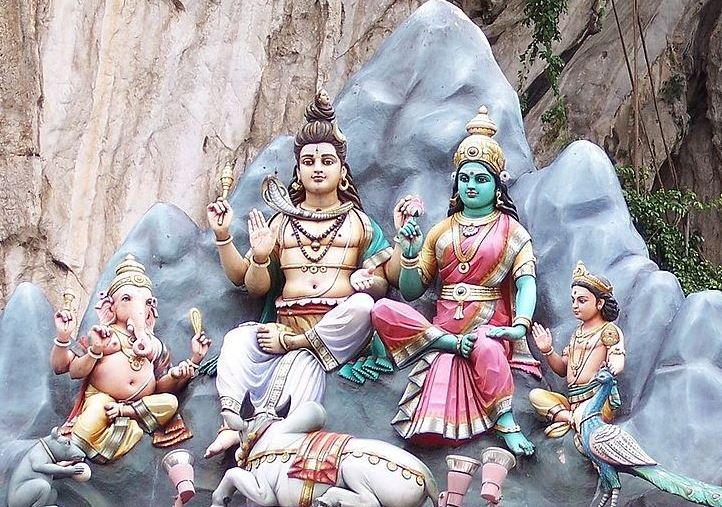
Image: Parvati (upper right) with Shiva (upper left) and sons Ganesha (leftmost) and Kartikeya (rightmost).
Forms and Manifestations of Parvati
Parvati is worshipped in many forms, each representing different aspects of her divine personality. Some of her most notable forms include:
- Durga: Durga is Parvati’s warrior form, who rides a lion and carries weapons to fight evil. She is celebrated during the festival of Navaratri, where her victory over the buffalo demon Mahishasura is commemorated.
- Kali: As Kali, Parvati takes on a more terrifying aspect, symbolizing destruction and transformation. Kali is often depicted with dark skin, fierce eyes, and a garland of skulls, representing her power to destroy evil and ignorance.
- Annapurna: In this form, Parvati is the goddess of nourishment and food. She is seen as the provider of sustenance to all beings and is worshipped for blessings of abundance and fertility.
- Bhuvaneshwari: As Bhuvaneshwari, Parvati is seen as the ruler of the universe. She represents the cosmic order and is associated with space and creation.
- Lalita: Lalita is another form of Parvati, symbolizing beauty, grace, and charm. She is worshipped as the goddess of love and desire.
These forms of Parvati are worshipped across India and Southeast Asia, each with its own set of rituals, festivals, and iconography.

Hindu goddess Annapurna, one of the manifestations of Parvati, offering alms to Shiva
Parvati’s Iconography and Symbolism
Parvati is often depicted as a beautiful woman with a calm and serene demeanor, usually seated beside Shiva. She is typically shown with two or four arms, holding symbols of fertility and power, such as a lotus, a trident, or a mirror. Her skin is often portrayed as golden or light, emphasizing her association with beauty and prosperity.
In some depictions, Parvati is shown with her children, Ganesha and Kartikeya, emphasizing her role as a mother. In temples dedicated to Shiva and Parvati, she is often represented as the yoni (a symbol of the feminine principle), which complements Shiva’s linga (the male principle). Together, these symbols represent the creative force of the universe.
In her warrior forms, such as Durga or Kali, Parvati is depicted as fierce and powerful, often wielding weapons and riding a lion or tiger. These images symbolize her ability to protect and defend the righteous while destroying evil forces.

Festivals and Worship of Parvati
Parvati is worshipped throughout the Hindu world, and several important festivals are dedicated to her. One of the most significant is Navaratri, a nine-day festival celebrating the goddess in her various forms, particularly Durga. During this festival, devotees perform rituals, offer prayers, and observe fasts to seek the goddess’s blessings for prosperity, protection, and spiritual growth.
Another important festival is Teej, which celebrates Parvati’s devotion to Shiva and is especially popular among women. Married women fast and pray for the well-being of their husbands and for marital bliss, while unmarried women seek good husbands by worshipping Parvati.
In temples, offerings to Parvati often include fruits, flowers, and sweets. Devotees seek her blessings for fertility, protection, and spiritual advancement. She is also invoked in marriage rituals, where couples pray for her blessings for a harmonious and prosperous life together.
Questions and Answers about Parvati
Parvati is a key goddess in Hinduism, worshipped as the goddess of power, energy, nourishment, love, beauty, harmony, devotion, and motherhood. She is one of the principal goddesses and is part of the Tridevi, alongside Lakshmi and Sarasvati.
What other names is Parvati known by?
Parvati is also called Uma and Gauri in Hindu tradition.
What is the Tridevi, and who are its members?
The Tridevi refers to the trio of major goddesses in Hinduism: Parvati, Lakshmi, and Sarasvati. Together, they represent power, wealth, and wisdom, respectively.
What is the significance of Parvati’s relationship with Shiva?
Parvati is most known as the wife of Shiva, the ascetic god. She represents the creative, life-affirming force that complements Shiva’s world-renouncing nature. Her presence balances Shiva’s asceticism with the responsibilities of household life, central to Hindu philosophy.

Image: Statue of Parvati.
How did Parvati come into existence according to Hindu mythology?
Parvati is considered the reincarnation of Sati, Shiva’s first wife. Sati died after her father insulted Shiva, and Parvati’s birth is seen as a cosmic event meant to bring Shiva out of his ascetic isolation into marriage and household life.
What is Parvati’s role as a wife and mother in Hindu mythology?
Parvati embodies the ideal of a devoted spouse who supports and enhances her husband’s influence. She is also the mother of the prominent Hindu deities Ganesha and Kartikeya.
What is Parvati’s philosophical significance in Hinduism?
Parvati is regarded as Shiva’s shakti, meaning she is the embodiment of divine energy that sustains the cosmos. In this role, she symbolizes cosmic energy, fertility, and the nurturing power that complements Shiva and sustains life.

How is Parvati viewed in various Shaiva traditions?
In Shaiva traditions, Parvati is seen as a model devotee and the embodiment of Shiva’s grace. She plays a central role in the spiritual liberation of devotees, guiding them toward enlightenment.

Oleograph by Raja Ravi Varma depicting a Shiva-centric Panchayatana. A bearded Shiva sits in the centre with his wife Parvati and their infant son Ganesha; surrounded by (clockwise from left upper corner) Ganesha, Devi, Vishnu, and Surya. Shiva’s mount is the bull Nandi below Shiva.
What is Parvati’s role in Shaktism?
In Shaktism, Parvati is regarded as a compassionate form of Mahadevi, the supreme goddess. She is closely linked to other forms of Mahadevi, including Durga, Kali, and the ten Mahavidyas.
Where can Parvati’s stories and iconography be found?
Parvati’s stories are present in ancient Puranic literature. Her statues and imagery are featured in Hindu temples across South Asia and Southeast Asia. Temples dedicated to Shiva and Parvati often symbolically represent her as the yoni, a symbol of feminine power and fertility.

What is Parvati’s broader significance beyond her role as Shiva’s consort?
Beyond her identity as Shiva’s wife, Parvati is a powerful cosmic force in her own right. She embodies the balance between spiritual asceticism and worldly engagement, symbolizing the ideal harmony between the material and spiritual worlds in Hindu philosophy.





