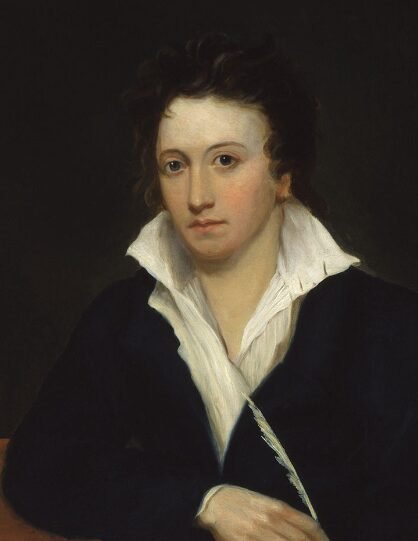
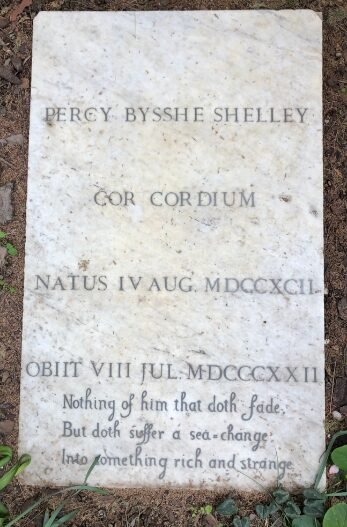
Percy Bysshe Shelley (4 August 1792 – 8 July 1822) was one of the major figures of English Romanticism, known for his profound poetry, radical political beliefs, and deep philosophical ideas. Though his works were not widely appreciated during his short lifetime, Shelley’s influence on later generations of poets, writers, and thinkers has been significant. His poetry, noted for its lyrical beauty and innovative style, continues to be revered for its emotional depth and intellectual power.

An idealized bronze statue of Shelley by Amelia Robertson Hill (1882), displayed at Tate Britain, London, England
Early Life and Education
Shelley was born in Field Place, Horsham, Sussex, into a wealthy family. His father, Sir Timothy Shelley, was a member of parliament, and his mother, Elizabeth Pilfold, came from a prominent family. The family’s affluence afforded Shelley a privileged upbringing and an education at prestigious institutions. He attended Syon House Academy as a young boy and later enrolled at Eton College in 1804.

Portrait of Sir Timothy Shelley by English portrait painter George Romney (1791)
During his time at Eton, Shelley developed a reputation as a rebellious and unconventional student. He showed a passion for literature and science but clashed with authority figures due to his nonconformist attitudes. He became known as “Mad Shelley” for his eccentric behavior and radical opinions. In 1810, Shelley entered University College, Oxford, where he continued his intellectual and creative pursuits.
Radical Ideas and Expulsion from Oxford
It was at Oxford that Shelley’s radical views began to take shape, particularly his religious skepticism and support for political reform. In 1811, at the age of 18, Shelley co-authored a pamphlet with his friend Thomas Jefferson Hogg titled The Necessity of Atheism. The pamphlet questioned the existence of God and attacked organized religion, which was seen as scandalous in conservative 19th-century England. The publication caused an uproar, and Shelley was expelled from Oxford for refusing to deny his authorship of the pamphlet or recant his views.
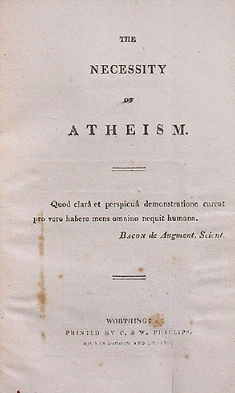
1811 title page of The Necessity of Atheism
This expulsion was a pivotal moment in Shelley’s life, marking his transition into a lifelong commitment to challenging societal norms and advocating for personal and political freedom. His relationship with his family also deteriorated as a result of his controversial beliefs, and he was effectively disinherited by his father.
Early Marriage and Political Activism
Following his expulsion from Oxford, Shelley eloped to Scotland with Harriet Westbrook, a 16-year-old schoolmate of his sisters. The marriage, which took place in 1811, was motivated in part by Shelley’s desire to rescue Harriet from what he believed was an oppressive family environment. The couple moved to Ireland in 1812, where Shelley became actively involved in political causes, particularly Irish independence and social reform. He published An Address to the Irish People, urging the Irish to seek freedom from British rule and advocating for nonviolent resistance.
Shelley’s early political writings reflected his strong support for republicanism, liberty, and equality. He viewed oppressive governments and institutions, particularly monarchies and organized religions, as enemies of human freedom and progress. These themes would remain central to much of his later work.
Despite their initial passion, Shelley’s marriage to Harriet began to deteriorate due to personal and ideological differences. In 1814, he abandoned Harriet and became romantically involved with Mary Godwin, the daughter of philosopher William Godwin and feminist author Mary Wollstonecraft. Mary would later become the author of Frankenstein, and their relationship would prove to be one of the most influential in Shelley’s life.
Relationship with Mary Shelley
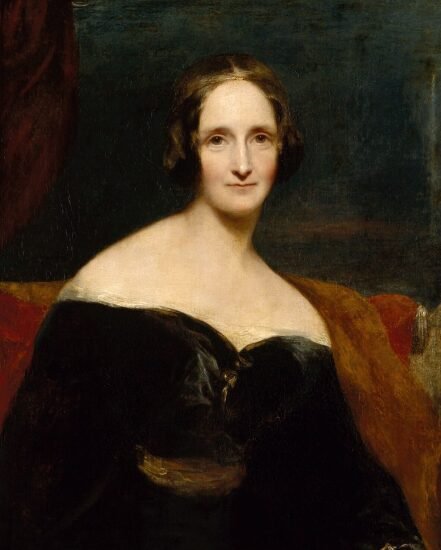
Mary Shelley – Wife of Percy Bysshe Shelley. Image: Irish painter Richard Rothwell’s 1840 portrait of Mary Shelley at the Royal Academy featured lines from Percy Shelley’s The Revolt of Islam, calling her a “child of love and light.”
Shelley’s relationship with Mary was tumultuous but also highly intellectually stimulating. The couple left England in 1814 and traveled across Europe, eventually settling in Geneva, Switzerland. It was during their stay in Geneva that Mary Shelley began writing Frankenstein in 1816, with Shelley providing emotional and intellectual support during its creation.
Shelley’s relationship with Mary was not without tragedy. In 1816, Shelley’s first wife, Harriet, committed suicide by drowning. Shelley and Mary married soon after, but they faced legal battles over the custody of Shelley’s children from his first marriage, which they ultimately lost. Additionally, the couple suffered the loss of several of their own children, which profoundly affected them both.
Despite these personal difficulties, Shelley’s time with Mary was one of his most productive literary periods. The couple surrounded themselves with other literary figures, including Lord Byron and Leigh Hunt, and engaged in deep discussions about politics, philosophy, and the role of poetry in society. Shelley’s own writing during this period reflected his evolving thoughts on freedom, justice, and the human condition.
Major Works and Themes
Shelley’s poetry is known for its lyrical quality, innovative use of language, and exploration of complex philosophical themes. His works often reflect his idealistic vision of human nature, his belief in the power of love and imagination, and his commitment to political and social reform.
“Ozymandias” (1818)
One of Shelley’s most famous works is the sonnet Ozymandias, written in 1818. The poem reflects on the impermanence of power and the inevitable decline of even the greatest empires. Through the image of a ruined statue in the desert, Shelley explores the themes of hubris, mortality, and the fleeting nature of human achievements. Ozymandias remains one of the most anthologized poems in English literature and is often interpreted as a critique of authoritarian rule.
“Ode to the West Wind” (1819)
Another of Shelley’s well-known works is Ode to the West Wind, composed in 1819. In this poem, Shelley invokes the power of the wind as a symbol of change and transformation. The poem is both an expression of the poet’s personal longing for renewal and a broader meditation on the forces of nature and revolution. Shelley’s plea for the wind to “scatter” his words “among mankind” reflects his desire for his poetry to inspire political and social change.
“To a Skylark” (1820)
To a Skylark (1820) is another of Shelley’s celebrated poems, in which he praises the bird for its purity, joy, and connection to nature. The skylark serves as a metaphor for the poet’s aspiration to achieve the same level of transcendence and freedom in his own work. The poem is a reflection on the nature of creativity and the role of the poet in society.
Prometheus Unbound (1820)

1820 title page of Prometheus Unbound
Shelley’s dramatic poem Prometheus Unbound (1820) is considered one of his most ambitious and important works. Inspired by the myth of Prometheus, who defied the gods to bring fire to humanity, the poem explores themes of rebellion, freedom, and the triumph of the human spirit. Prometheus Unbound reflects Shelley’s belief in the power of love and imagination to overthrow tyranny and oppression. The work is often seen as an expression of Shelley’s idealism and his faith in the potential for human progress.
“The Mask of Anarchy” (1819)
Written in response to the Peterloo Massacre in 1819, The Mask of Anarchy is a political ballad that condemns the British government’s violent suppression of peaceful protestors. In this poem, Shelley advocates for nonviolent resistance and calls for the oppressed to rise up against tyranny. The poem’s refrain, “Ye are many—they are few,” has become a rallying cry for social movements throughout history. Though it was not published during Shelley’s lifetime, The Mask of Anarchy is now considered one of the most important works of political poetry in the English language.
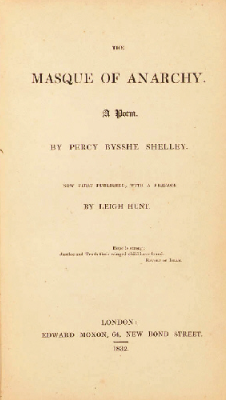
1832 first edition of the Masque of Anarchy
“Adonais” (1821)
Adonais (1821) is an elegy written by Shelley in memory of his friend and fellow poet, John Keats, who had died of tuberculosis at the age of 25. In this deeply personal work, Shelley mourns the loss of Keats and meditates on the nature of death, immortality, and the enduring power of art. The poem is often regarded as one of Shelley’s most moving and accomplished works, blending classical references with Romantic themes of beauty and transcendence.

“Ozymandias” is a sonnet by Percy Bysshe Shelley, first published in The Examiner in January 1818. Written for a friendly competition with poet Horace Smith, the poem reflects on the inevitable decline of power, using the ruined statue of Pharaoh Ramesses II (Ozymandias) to symbolize the fleeting nature of human achievement. Image: Younger Memnon, digitally placed atop its base still in Ramesseum
Other Notable Works
In addition to his major works, Shelley wrote numerous other poems, essays, and dramas that reflect his wide-ranging interests. His early narrative poem Alastor, or The Spirit of Solitude (1815) explores themes of isolation, imagination, and the search for meaning. Shelley’s verse drama The Cenci (1819) is a dark and tragic tale of family betrayal and violence, while his final major poem, The Triumph of Life (1822), offers a haunting meditation on human suffering and the passage of time.
Shelley’s philosophical and political writings, such as A Philosophical View of Reform and A Defence of Poetry, further demonstrate his commitment to radical ideas and his belief in the transformative power of art and literature.
Exile and Final Years in Italy
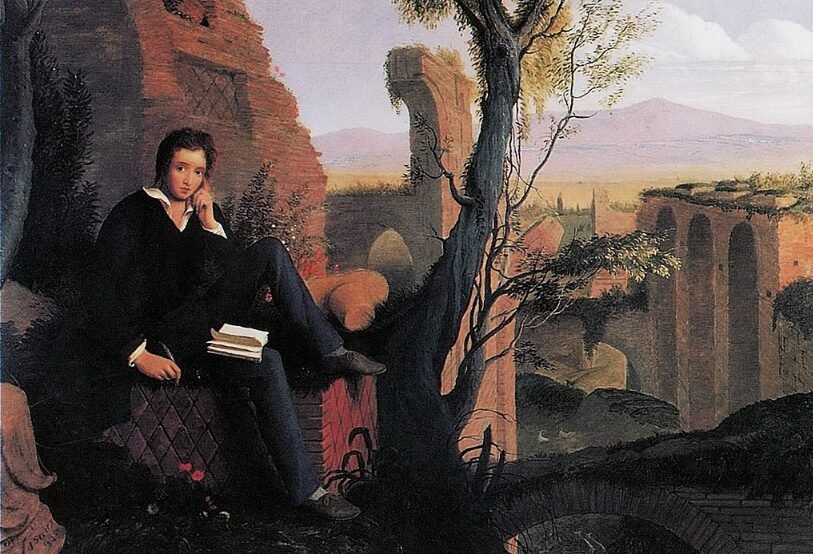
English portrait painter Joseph Severn’s 1845 painting, Posthumous Portrait of Shelley Writing Prometheus Unbound in Italy, portrays the poet at work during his time in Italy.
In 1818, Shelley and Mary left England permanently, seeking refuge in Italy. The move was partly motivated by the need to escape personal and financial difficulties, as well as Shelley’s desire to distance himself from the conservative English society that had rejected his ideas. Italy became a creative haven for Shelley, and it was there that he produced many of his finest works.
Despite the beauty of his surroundings, Shelley’s time in Italy was marked by personal tragedy. The couple’s children died in infancy, and Shelley’s health began to decline. He suffered from bouts of depression and illness, but he continued to write prolifically during this period. His works from this time are often marked by a sense of melancholy and existential reflection, though they also express hope for the future of humanity.
Shelley’s final years were spent in the company of fellow expatriates, including Lord Byron and Leigh Hunt. The poets formed a close-knit community in Italy, sharing ideas and influencing one another’s work. However, Shelley’s life came to a tragic and premature end on 8 July 1822, when he drowned in a boating accident off the coast of Viareggio, Italy. He was just 29 years old.
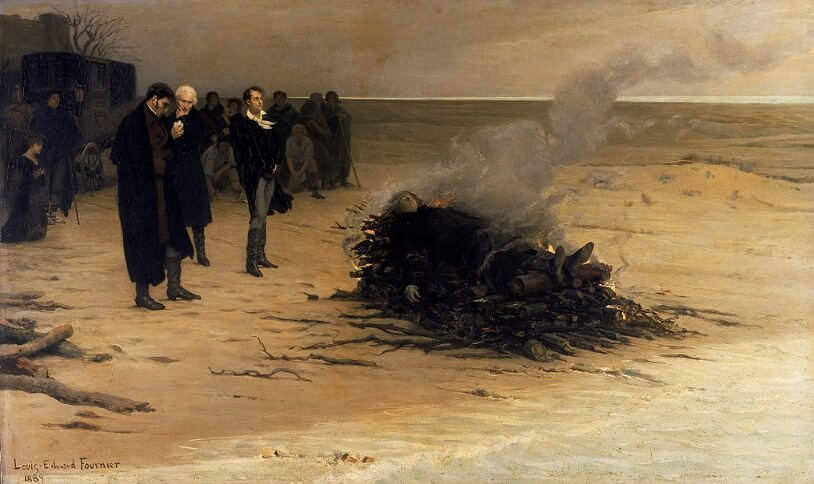
“The Funeral of Shelley” by French painter Louis Édouard Fournier (1889) shows British novelist Edward Trelawny, English poet Leigh Hunt, and George Gordon Byron.
Legacy and Posthumous Influence
Although Shelley was not widely recognized during his lifetime, his reputation grew steadily after his death. His works, which had often been censored or suppressed due to their controversial nature, gained a wider audience in the years following his passing. Shelley’s radical ideas and his belief in the power of art to inspire change resonated with many political and social movements, including the Chartists, Owenists, and later, socialists and anarchists.
Shelley’s influence extended beyond the realm of poetry. His writings on liberty, justice, and human rights inspired figures such as Karl Marx, Mahatma Gandhi, and George Bernard Shaw. Shelley’s vision of a world free from tyranny and oppression continues to inspire activists and artists to this day.
Percy Bysshe Shelley was an influential English Romantic poet known for his radical political, social, and religious views.
In the world of literature, Shelley’s innovative use of language, his exploration of the sublime, and his focus on the individual’s struggle for freedom influenced generations of poets and writers. Among those who admired Shelley’s work were Robert Browning, W.B. Yeats, and Thomas Hardy. His lyrical mastery and commitment to social justice made him one of the most important voices of the Romantic movement, and his works remain a central part of the English literary canon.
Conclusion
Percy Bysshe Shelley’s life was marked by personal tragedy, intellectual rebellion, and a passionate commitment to political and social ideals. Through his poetry and prose, Shelley sought to challenge the injustices of his time and envision a world where love, imagination, and freedom could triumph over oppression. Though he died young, his legacy as one of the greatest Romantic poets endures.
READ MORE: 10 Most Renowned English Poets and their Major Works