Amenmesse, also spelled Amenmesses or Amenmeses, was a short-reigning pharaoh of Ancient Egypt’s Nineteenth Dynasty. His reign, likely lasting only three to four years, remains enigmatic and marked by controversy. Historians date his rule approximately between 1202–1199 BC or 1203–1200 BC. Some sources also place his accession to the throne in 1200 BC. His name, Amenmesse, translates to “born of or fashioned by Amun,” a reflection of his connection to the deity. Additionally, his nomen included the epithet “Heqa-waset,” meaning “Ruler of Thebes.” His throne name was Menmire Setepenre.
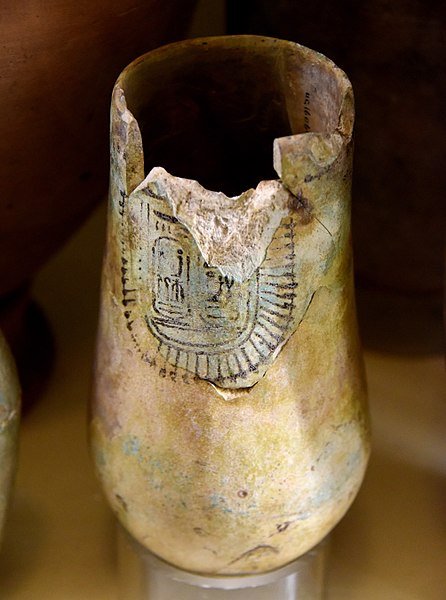
A jar inscribed with Amenmesse’s names, housed at the Petrie Museum.
Origins and Background
The origins of Amenmesse remain subject to debate, mostly because his family connections are not definitively recorded. His mother is traditionally identified as a Queen Takhat, though scholars have found multiple references to several women named Takhat in Ramesside records. One interpretation is that Takhat was a daughter of Merneptah, which would place Amenmesse among the pharaoh’s direct children. However, other interpretations suggest that she was either a daughter or granddaughter of Ramesses II, meaning Amenmesse could have been a grandson or great-grandson of the famed ruler.
Amenmesse is traditionally viewed as the fifth pharaoh of this royal line, although his exact position within the dynasty remains disputed among scholars.
The name “Amenmesse” itself translates to “born of or fashioned by Amun,” reflecting the era’s deep reverence for the Theban god Amun. Additionally, one of Amenmesse’s epithets, Heqa-waset, can be rendered as “Ruler of Thebes,” suggesting that his power base originated in Upper Egypt. He took the regal name Menmire Setepenre, emphasizing his devotion to the sun god Re and the state’s orthodox cultic practices.
Contest for the Throne
Amenmesse’s most significant historical legacy is the confusion he created within the line of succession. Officially, Merneptah’s rightful heir appears to have been Seti-Merneptah, who would later rule as Seti II. Nonetheless, the sequence of events that allowed Amenmesse to seize the throne remains blurred. Some scholars propose that he staged a coup during a vulnerable moment of Seti-Merneptah’s early reign or capitalized on a period when the legitimate heir was out of Egypt, possibly on a military campaign in Asia.
Some believe Amenmesse was a son of Merneptah and Queen Takhat, while others argue that he might have been one of the many descendants of the prolific Ramesses II.
This abrupt power struggle likely occurred in the second, third, or fourth year of Seti II’s nominal reign. Evidence points to Amenmesse having controlled Upper Egypt and Nubia, where his name and images appear on monuments, suggesting he exerted real authority. Meanwhile, Thebes, Egypt’s spiritual heartland, may have been divided between loyalty to Seti II and fear of Amenmesse’s growing influence.

Possible Rivalry with Seti II
Traditional accounts place Amenmesse’s rule before Seti II’s official reign. Yet a rising number of Egyptologists argue for an overlapping rule, proposing that Amenmesse never truly became Merneptah’s immediate successor. Instead, they believe Seti II took the throne at Merneptah’s death and governed Lower Egypt from the capital, while Amenmesse simultaneously asserted control in Thebes and Nubia.
According to this view, Amenmesse was effectively a rival king who, for a few years, held sway in the south. The erasure and subsequent restoration of Seti II’s royal cartouches in his Theban tomb indicate that Seti II initially started work on his own burial site, but Amenmesse’s faction vandalized it once they seized Thebes. Later, when Seti II regained control, he ordered the restoration of his tomb.
Court Politics and Corruption
Papyrus Salt 124 offers a glimpse into the intrigues of Amenmesse’s era, describing the killing of Neferhotep, a senior workman at Deir el-Medina. Allegedly, Paneb—Neferhotep’s adopted son—had sought to replace him and was willing to commit theft and murder to do so. The papyrus indicates that when Neferhotep was alive, he complained about Paneb’s behavior to high officials. However, once Amenmesse intervened, the vizier who had punished Paneb was dismissed.
This scenario illustrates a period of chaos and shifting allegiances. The exact nature of the “war” referenced in some documents remains ambiguous. However, it likely encompassed internal strife rather than a large-scale military conflict, reflecting the broader instability ignited by Amenmesse’s usurpation.
Family Ties and Uncertainties
Unraveling Amenmesse’s immediate family is equally perplexing. If Queen Takhat was his mother, she might also have been married to Merneptah or perhaps was of royal blood through Ramesses II. Some theories suggest Takhat may have been both a “King’s Daughter” and later a “King’s Mother,” which would place her at the fulcrum of two generations of Ramesside royalty.
Another point of confusion revolves around Amenmesse’s potential spouse or spouses. One possibility is that he was married to a woman named Baktwerel, found within the same tomb (KV10) in the Valley of the Kings, though there is no definitive evidence linking her to him. Others hypothesize that Twosret, the wife of Seti II, may have been Amenmesse’s sister. This complicated genealogical network reflects the dynastic complexities of the late Nineteenth Dynasty, where multiple claimants to the throne often overlapped.
Amenmesse’s Death and Tomb
Amenmesse was interred in Tomb KV10 in the Valley of the Kings. Despite the tomb’s initial design for a royal burial, all inscriptions and images referencing him were deliberately chiseled away or repurposed by Seti II’s agents once Amenmesse fell from power. Consequently, discovering conclusive evidence about his end has proven difficult.
Archaeologists found remnants of three mummies in KV10—a man and two women—but there is no certainty about their identities. The tomb suffered looting and partial reoccupation in antiquity, making it unclear whether the bodies might be Amenmesse, Queen Takhat, Baktwerel, or later intruders. Notably, Amenmesse’s mummy has never been definitively identified in any major royal cache, which strongly implies a posthumous erasure.
Aftermath and Damnatio Memoriae
Following Amenmesse’s defeat, Seti II embarked on a systematic campaign of damnatio memoriae, erasing references to his adversary and punishing those who had supported him. Officials close to Amenmesse, including certain high-ranking priests and administrators, lost their positions or saw their monuments destroyed. One figure particularly targeted was Khaemtir, a viceroy of Kush who possibly switched allegiance to Amenmesse. In contrast, other officials like Messuy—another prominent viceroy—were left unscathed, suggesting they had either died earlier or did not actively conspire with Amenmesse.
The hostility extended to monuments, statues, and tomb inscriptions. Whenever Seti II reclaimed a region, he or his representatives systematically eradicated Amenmesse’s cartouches, often reinscribing them with Seti’s own royal name. This thorough erasure underscores the intense rivalry between the two claimants and the official court’s need to reassert its legitimacy.
Connection to Literary Tales
A fascinating theory posits that the “Tale of Two Brothers,” first recorded under Seti II, may indirectly reflect the conflict between Amenmesse and Seti. While the story is mythological, the moral issues of betrayal, theft, and strife parallel the real-life struggles witnessed in Thebes and Deir el-Medina during Amenmesse’s tumultuous interlude.
In later discussions, some scholars have drawn parallels between Amenmesse’s story and the biblical narrative of Moses in Egypt, mostly based on partial similarities in names and the dramatic exodus of political power. However, these connections remain speculative, resting on fragmentary evidence.





