Khasekhemwy, the last pharaoh of Egypt’s Second Dynasty, ruled around 2690–2670 BC and was a transformative figure who helped unify Egypt after periods of civil strife. His name, which means “The Two Powerful Ones Appear,” reflects his unique role in symbolizing the unity of Upper and Lower Egypt.
King Khasekhemwy’s reign marked a critical transition in Egypt’s early history, bridging the Second and Third Dynasties and setting the foundation for Egypt’s Old Kingdom era, which is often considered the height of ancient Egyptian civilization. His accomplishments in political unification, architectural innovation, and cultural integration left an enduring legacy that influenced Egyptian society for centuries.
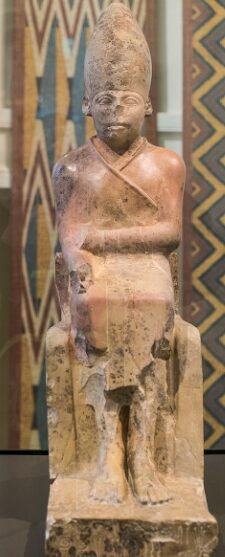
Khasekhemwy in the Ashmolean Museum in Oxford, England
Early Life and Ascension
The details of Khasekhemwy’s early life remain mostly unknown, as records from his time are scarce, but historians believe he was closely tied to his predecessor Seth-Peribsen.
There is some debate among Egyptologists regarding whether a ruler named Khasekhem ruled just before Khasekhemwy, potentially as the same individual with a name change to signify a shift in ideology and purpose.
Scholars generally accept that Khasekhem and Khasekhemwy were likely the same person, with Khasekhem adopting the name Khasekhemwy later in his reign to celebrate the reunification of Egypt.
By the end of the Second Dynasty, Egypt was divided, with followers of the gods Horus and Set vying for dominance over Upper and Lower Egypt. Khasekhemwy’s reign brought a resolution to this conflict, as he successfully unified the two regions.
Khasekhemwy’s decision to incorporate the symbols of both Horus and Set on his royal serekh (an enclosure for the king’s name) was unprecedented in Egyptian history. Previous rulers exclusively used the symbol of Horus, god of Upper Egypt, in their serekhs.
By incorporating Set alongside Horus, Khasekhemwy indicated his rule over both parts of Egypt and likely sought to foster harmony between the two factions. After his reign, however, the symbol of Set disappeared from the royal serekh, suggesting that subsequent rulers viewed Horus as the ultimate symbol of royal authority.
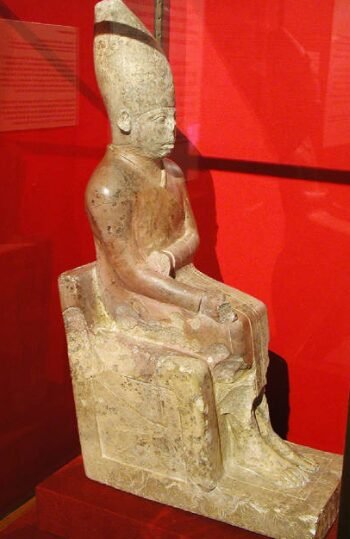
Khasekhemwy’s Horus name, Ḫꜥj-sḫm.wj, means “The Two Powerful Ones Appear,” symbolizing unified power. This name has multiple recorded variants, emphasizing his role as a figure embodying strength and continuity from Egypt’s ancestral deities. Image: Statue of Khasekhemwy, Ashmolean Museum
The Conflict between Horus and Seth over the Throne of Ancient Egypt
The Political Reunification of Egypt
One of Khasekhemwy’s most significant accomplishments was the reunification of Egypt after a period of civil conflict. Ancient records suggest that there was considerable strife between the followers of Horus and Set, with each faction controlling different parts of Egypt.
Khasekhemwy’s rule ended this divide, reuniting Egypt under a single leader. Evidence suggests that he may have initially faced opposition in the northern part of Egypt, Lower Egypt, where Set was widely worshipped. However, through either diplomacy or military campaigns, he managed to bring the north under his control and restored centralized governance.
An inscription on a stone vase describes Khasekhemwy as “fighting the northern enemy within Nekheb,” which implies that he faced opposition from Lower Egypt and may have had to engage in battle to assert his authority.
Nekheb, also known as El Kab, was a key center in Upper Egypt, and this reference implies that Lower Egyptian forces may have posed a threat to the region’s stability. By overcoming these challenges, Khasekhemwy effectively brought peace to the kingdom, ending internal divisions and establishing a stable platform for the Third Dynasty’s developments.
Architectural Innovations and Building Projects
Khasekhemwy was a pioneer in the use of stone for large-scale construction, a technique that set the stage for Egypt’s later monumental architecture. Although mudbrick had traditionally been used for large buildings, Khasekhemwy introduced stone into his construction projects, underscoring his reign’s stability and his desire for lasting achievements. He is known to have initiated several significant building projects across Egypt, especially at sites like Hierakonpolis, el-Kab, Abydos, and Saqqara.
One of his most notable architectural accomplishments was the construction of the Shunet el-Zebib enclosure at Abydos. Shunet el-Zebib, a massive mudbrick structure with thick walls and large open spaces, likely served ceremonial purposes, perhaps as a precursor to the mortuary temples of later pharaohs. This structure stands as one of the earliest examples of monumental mudbrick architecture and showcases early advancements in design and construction that would define Egyptian royal architecture.
Khasekhemwy is also credited with constructing the Gisr el-Mudir in Saqqara, an enclosure wall with a large open court, possibly a site for rituals or gatherings. The exact purpose of the Gisr el-Mudir remains unclear, but it is considered one of Egypt’s oldest stone constructions, highlighting Khasekhemwy’s experimentation with new building materials and techniques. These projects not only demonstrated his vision for Egypt’s future but also served as tangible symbols of a unified and powerful state.
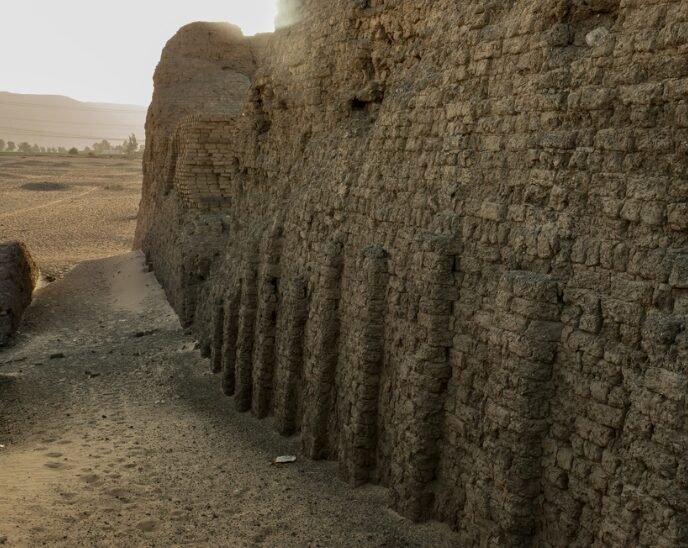
View of the Second Dynasty Pharaoh Khasekhemouy enclosure in Abydos, Upper Egypt.
Religious Symbolism and Integration of Deities
Khasekhemwy’s adoption of both Horus and Set symbols in his royal title was deeply symbolic and unique to his reign. Horus had long represented kingship in Egyptian ideology, symbolizing order, protection, and divine authority.
Set, on the other hand, was often seen as a god of chaos and represented Lower Egypt in this context. By uniting these two deities under his name, Khasekhemwy emphasized his role as the reconciler of opposing forces, portraying himself as a leader who could harmonize dualities within Egypt.
This choice also suggests that Khasekhemwy had a deep understanding of the cultural divisions within his kingdom and sought to resolve them by recognizing and respecting both gods. The blending of Horus and Set would not continue in the same way after his reign, as future kings returned to using Horus exclusively.
However, Khasekhemwy’s approach reflected a brief period in which Egypt’s cultural and religious landscape was influenced by a nuanced acceptance of duality, as he sought to unify the kingdom on multiple levels.
READ MORE: Most Revered Gods and Goddesses of Ancient Egypt
Family and Legacy
Khasekhemwy’s marriage to Queen Nimaathap further strengthened his dynasty. Nimaathap was titled “King Bearing Mother,” indicating her role as a prominent matriarch of the royal family and likely a respected figure within the kingdom.
It is believed that Nimaathap and Khasekhemwy were the parents of Djoser, one of Egypt’s most celebrated pharaohs, known for commissioning the Step Pyramid at Saqqara. Nimaathap’s title as the “King Bearing Mother” suggests her critical role in establishing a lineage that would carry Egypt into the Third Dynasty, a period marked by significant cultural and architectural achievements.

Pharaoh Djoser. Image: Limestone Ka statue of Djoser from his pyramid serdab
The legacy of Khasekhemwy’s family extended beyond Djoser, as his descendants continued to shape Egyptian history through monumental building projects and administrative reforms. His family’s connections to both Upper and Lower Egypt likely contributed to the stability and cohesion seen during the Third Dynasty, further solidifying his accomplishments in reunifying and strengthening Egypt.
Burial and the Tomb at Umm el-Qa’ab

Khasekhemwy’s tomb at Umm el-Qa’ab filled with sand
Khasekhemwy’s burial site at Umm el-Qa’ab in Abydos, known as Tomb V, reflects the grandeur and sophistication of his reign. His tomb was one of the largest and most complex structures built in the necropolis and marked the final royal burial at Umm el-Qa’ab. This trapezoidal tomb, measuring approximately 70 meters in length, featured 58 rooms and was built using quarried limestone, making it one of the oldest stone masonry structures known.
Archaeologists discovered various treasures within the tomb, including a golden scepter, intricately crafted stone vessels, copper tools, and fine pottery. These artifacts, along with carnelian beads and gold-covered pots, reflect the wealth and advanced craftsmanship of the period.
Although the tomb had been looted in antiquity, many of these high-quality items remained, revealing the sophistication of Khasekhemwy’s time. His burial at Abydos linked him to a sacred site revered as the burial ground of Osiris, the god of the afterlife, further enhancing his status as a ruler connected to divine forces.
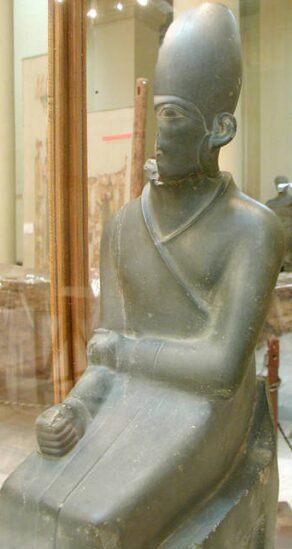
Statue of Pharaoh Khasekhemwy, Egyptian Museum, Cairo
The Enduring Legacy of Khasekhemwy’s Reign
Khasekhemwy’s contributions to Egypt’s early history were numerous and set the stage for the achievements of the Old Kingdom. His success in reuniting Egypt after civil strife created a stable foundation for the Third Dynasty, which saw the development of monumental architecture, such as the pyramids. His use of both Horus and Set’s symbols on his serekh, his innovative building projects, and his establishment of a unified state are all testaments to his vision and leadership.
By experimenting with stone in his architectural projects, Khasekhemwy laid the groundwork for Egypt’s monumental building tradition, inspiring future pharaohs like Djoser to pursue even grander construction projects. His unification of Egypt not only brought political stability but also fostered a sense of shared identity, allowing Egypt to progress toward the centralized governance and cultural flourishing that defined the Old Kingdom.
Khasekhemwy’s reign marks a pivotal point in Egyptian history, blending traditions of the past with innovative ideas that would shape the future. His accomplishments in consolidating power, fostering architectural progress, and symbolizing unity influenced Egyptian kingship’s ideological framework and created a lasting legacy. By bridging the Second and Third Dynasties, Khasekhemwy set the foundation for a period of unprecedented achievement, securing his place in Egypt’s history as a transformative ruler.
Frequently Asked Questions

Khasekhemwy, last pharaoh of Egypt’s Second Dynasty (c. 2690 BC), is noted for his military campaigns and construction of the mudbrick fort Shunet El Zebib. Image: Statue of Khasekhemwy, Ashmolean Museum in Oxford, England
What period did Khasekhemwy rule, and what dynasty did he belong to?
Khasekhemwy ruled around 2690–2670 BC as the last pharaoh of Egypt’s Second Dynasty.
How long did Khasekhemwy rule, according to the Palermo Stone?
Khasekhemwy ruled for approximately 18 years, as indicated by the Palermo Stone, which records biennial cattle counts.
Who was Khasekhemwy’s likely predecessor, and how is he connected to Khasekhem?
Khasekhemwy likely succeeded Seth-Peribsen. Some scholars believe Khasekhem and Khasekhemwy were the same individual, with Khasekhem adopting the name Khasekhemwy after uniting Egypt.
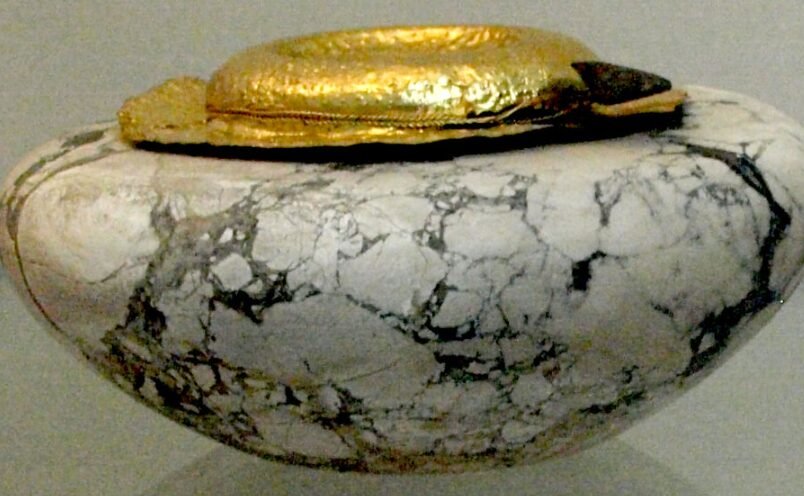
Limestone vessel with a gold cover from the tomb of Khasekhemwy
What did Khasekhemwy’s name, “The Two Powerful Ones Appear,” signify?
The name “The Two Powerful Ones Appear” symbolized the reunification of Upper and Lower Egypt and represented the unity between the gods Horus and Set.
What architectural projects is Khasekhemwy known for?
Khasekhemwy undertook notable building projects, including structures at el-Kab, Hierakonpolis, Abydos, and the large mudbrick Shunet el-Zebib enclosure at Abydos.

What does Khasekhemwy’s use of both Horus and Set symbols on his serekh indicate?
Using both symbols on his serekh indicated Khasekhemwy’s role in unifying Upper and Lower Egypt, symbolizing his attempt to reconcile the factions associated with each deity.
What is the significance of the Shunet el-Zebib structure built by Khasekhemwy?
Shunet el-Zebib, a large mudbrick enclosure at Abydos, represents one of the earliest examples of large-scale mudbrick construction, demonstrating architectural innovation during his reign.
What does the inscription on a stone vase reveal about Khasekhemwy’s reign?
The inscription describes Khasekhemwy “fighting the northern enemy within Nekheb,” suggesting his role in defending Upper Egypt from northern forces or internal resistance.
Who was Khasekhemwy’s wife, and what role did she play in Egypt’s Third Dynasty?
Khasekhemwy’s wife, Queen Nimaathap, was titled “King Bearing Mother,” positioning her as a royal matriarch who likely helped establish the Third Dynasty through her descendants.
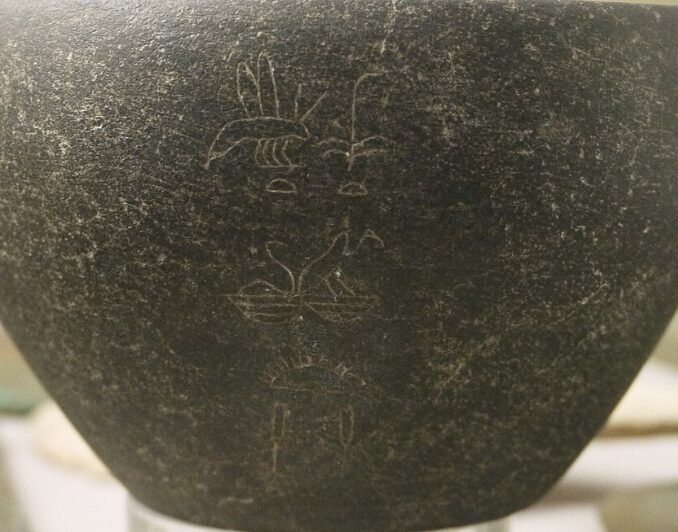
Stone vase inscribed with Khasekhemwy’s titles, housed at France’s National Archaeological Museum.
Where was Khasekhemwy buried, and why is his tomb significant?
Khasekhemwy was buried in Tomb V at Abydos, the last royal burial at Umm el-Qa’ab. This large, trapezoidal tomb with 58 rooms and quarried limestone masonry reflected early architectural complexity.
What items were found in Khasekhemwy’s tomb, and what do they reveal about his reign?
Artifacts including a golden scepter, stone vessels, copper tools, and luxury items were found, showcasing the wealth and craftsmanship of his period despite earlier tomb robbing.
What legacy did Khasekhemwy leave for Egypt’s Old Kingdom?
Khasekhemwy’s reign bridged Egypt’s Second and Third Dynasties, marked by reunification, architectural advancements, and the establishment of traditions that paved the way for the monumental achievements of the Old Kingdom.





