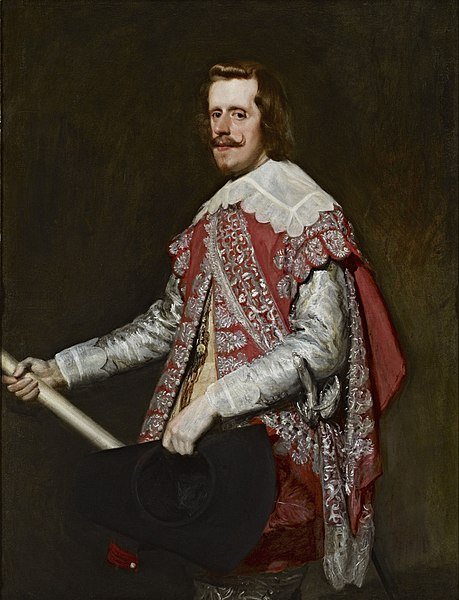
Philip IV of Spain
Philip IV was King of Spain from 1621 until his death in 1665 and King of Portugal as Philip III from 1621 to 1640. He is remembered for his patronage of the arts and his rule during the Thirty Years’ War.
READ MORE: 10 Most Famous Spanish Monarchs and their Reigns
Early Life and Ascension to the Throne
Philip IV was born on April 8, 1605, in the Royal Palace of Valladolid. As the eldest son of Philip III of Spain and Margaret of Austria, he was destined to inherit the vast Habsburg dominions. His childhood was spent under the influence of noble courtiers and advisors, particularly Baltasar de Zúñiga, who played a key role in his political education.
At the age of 16, following the death of his father in 1621, Philip ascended the Spanish throne, also inheriting the Portuguese crown as Philip III of Portugal. Unlike his father, Philip IV sought a more active role in governance but remained heavily influenced by his chief minister and royal favorite, Gaspar de Guzmán, Count-Duke of Olivares. This partnership would shape Spanish politics for the next two decades.
The Influence of Olivares and Political Challenges
From the outset of Philip’s reign, Olivares pursued ambitious reforms aimed at strengthening Spain’s central authority and expanding its military might. His most significant proposal, the Uníon de Armas, sought to distribute military obligations more evenly across Spain’s kingdoms. However, resistance from regional elites, particularly in Catalonia and Portugal, ultimately led to widespread unrest.
Under Olivares, Philip IV renewed Spain’s involvement in the Thirty Years’ War (1618–1648), hoping to maintain Habsburg dominance in Europe. Despite early successes, including the recapture of Breda (1624), prolonged military engagements drained Spain’s resources. By 1640, a Catalan revolt and the Portuguese Restoration War marked the decline of Spanish hegemony. The pressures of war and internal dissent ultimately led Philip to dismiss Olivares in 1643, replacing him with Luis de Haro, a less influential minister.
Military Conflicts and Foreign Policy
Philip IV’s reign was defined by Spain’s participation in Europe’s major wars, notably the Thirty Years’ War and the Franco-Spanish War (1635–1659). Spain initially fought alongside the Holy Roman Empire but faced mounting challenges as France emerged as a dominant power under Cardinal Richelieu and Louis XIV.
The Battle of Rocroi (1643) marked a turning point, as Spain’s once-invincible Army of Flanders suffered a devastating defeat against France. Although the Peace of Westphalia (1648) ended the Thirty Years’ War, Spain remained embroiled in conflict with France until the Treaty of the Pyrenees (1659), which saw the loss of Roussillon and Artois. As part of the peace settlement, Philip IV arranged the marriage of his daughter, Maria Theresa, to Louis XIV, setting the stage for future Franco-Spanish relations.
The Iberian Union and the Loss of Portugal
Philip IV inherited the Iberian Union (1580–1640), a personal union between Spain and Portugal established by Philip II. Despite initial stability, growing Portuguese resentment towards Spanish rule culminated in the Portuguese Restoration War (1640–1668). The revolt, led by John IV of Portugal, resulted in Philip’s loss of the Portuguese throne. Spanish forces struggled to reclaim control, but by 1668, the independence of Portugal was formally recognized.
Economic and Domestic Challenges
Spain under Philip IV suffered severe economic decline. The empire relied heavily on New World silver, but inflation, corruption, and military expenses drained the royal treasury. Several state bankruptcies, including the Great Potosí Mint Fraud (1649), further destabilized finances. Philip attempted tax reforms, but his inability to enforce equitable fiscal policies led to widespread dissatisfaction.
Plague outbreaks, including the Great Plague of Seville (1647–1652), devastated Spain’s population and economy. Agriculture and trade suffered, while military expenditures continued to rise. Philip’s government also struggled to manage revolts, including those in Naples and Sicily (1647), highlighting the weakening grip of Spanish central authority.
Personal Life and Marriages
Philip IV was married twice. His first wife, Elisabeth of France, whom he married in 1615, bore him several children, though only Balthasar Charles, the Prince of Asturias, survived infancy. However, the prince’s untimely death in 1646 deeply affected Philip, leaving the succession in jeopardy.
Following Elisabeth’s death in 1644, Philip remarried Maria Anna of Austria in 1649. Their most notable offspring was Charles II, who inherited the Spanish throne in 1665. However, Charles was physically and mentally weak, a result of generations of Habsburg inbreeding, which left Spain with an unstable succession.
Philip IV was known for his numerous extramarital affairs, fathering around 30 illegitimate children, the most famous being John Joseph of Austria, who later played a significant role in Spanish politics.
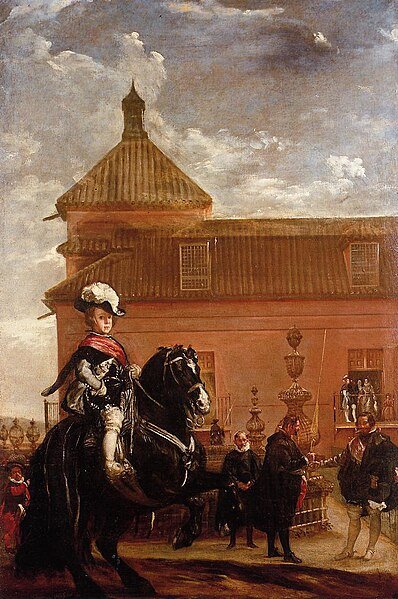
A 1636 portrait featuring Balthasar Charles, Prince of Asturias, with the Count-Duke of Olivares outside the Buen Retiro Palace.
Patronage of the Arts
Despite his political struggles, Philip IV is celebrated for his patronage of the arts, particularly his support of Diego Velázquez, who became his court painter. Velázquez created some of Spain’s most iconic artworks, including Las Meninas (1656), which provides a fascinating glimpse into the royal court.
Philip IV of Spain was a major patron of the arts, especially Diego Velázquez. His court became a cultural hub, commissioning paintings, plays, and grand architectural projects like the Buen Retiro Palace.
Philip’s love for theater and literature led to the flourishing of the Spanish Golden Age, with playwrights such as Pedro Calderón de la Barca and Lope de Vega enjoying royal sponsorship. The construction of the Buen Retiro Palace in Madrid showcased the grandeur of his court, emphasizing the monarchy’s artistic prestige despite Spain’s declining political influence.
Religion and Personal Beliefs
Philip IV was a deeply religious monarch, strongly committed to Catholicism and the defense of the Habsburg dynasty. In his later years, he sought spiritual guidance from Sor María de Ágreda, a mystical nun with whom he exchanged numerous letters. His personal piety, however, did not prevent him from indulging in numerous romantic liaisons.
Philip was also a fervent supporter of the doctrine of the Immaculate Conception, advocating for its recognition within Catholic dogma. He used religious symbolism to reinforce his kingship, commissioning works that portrayed him as a divinely ordained ruler.
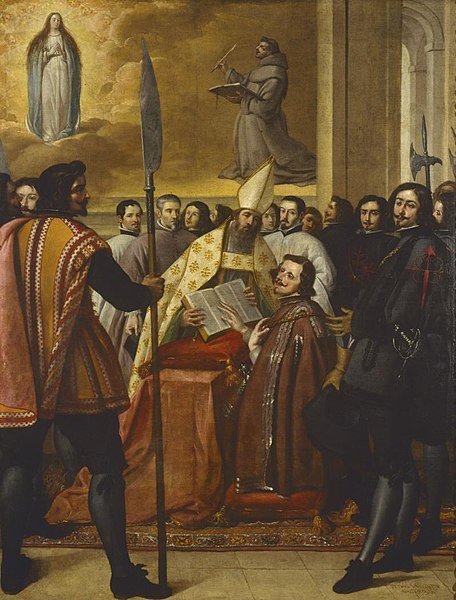
Philip pledging to defend the doctrine of the Immaculate Conception.
History of the Catholic Church: How and When Did Catholicism Begin?
The Final Years and Death
By the 1660s, Philip IV was physically weakened, overburdened by Spain’s military failures and domestic troubles. His health deteriorated rapidly, and he spent his final years preparing for his son Charles II’s troubled succession. The young prince was frail and sickly, raising concerns about the future of Spain.
Philip IV died on September 17, 1665, leaving Spain in a precarious state. His will appointed his second wife, Maria Anna of Austria, as regent for the four-year-old Charles, but internal court struggles plagued the regency period.
Legacy
Philip IV’s reign is often viewed as a turning point in Spain’s decline. While his patronage of the arts and culture was remarkable, his inability to address economic mismanagement, military overextension, and internal dissent contributed to Spain’s weakening global influence.
Despite his efforts to preserve the Habsburg empire, Spain’s military and financial exhaustion led to the loss of key territories. The War of the Spanish Succession (1701–1714), which erupted after Charles II’s death, ultimately sealed the end of Habsburg rule in Spain.
Nevertheless, Philip IV of Spain’s legacy endures through his contributions to Spanish art and literature, as well as his role in shaping the early modern European geopolitical landscape.





