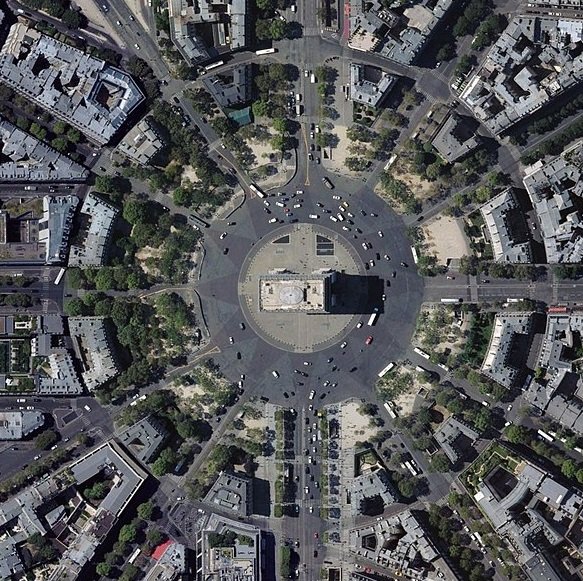
The twelve avenues radiating from Place Charles de Gaulle create six axes. The Axe historique stretches from the Avenue des Champs-Élysées to the Avenue de la Grande Armée.
The Place Charles de Gaulle, formerly known as Place de l’Étoile, is one of Paris’s most significant landmarks. At the intersection of twelve avenues, including the renowned Champs-Élysées, it is both a historical and cultural hub, crowned by the majestic Arc de Triomphe at its center. In the article below, World History Edu delves into its rich history, unique layout, and enduring legacy.
From Hunting Trails to Urban Planning
Originally called the Butte Chaillot (“Chaillot Mound”), the area was primarily a point of convergence for hunting trails. In 1777, the Marquis de Marigny undertook monumental roadworks, creating a star-shaped layout. This design, which persists to this day, led to the area’s historic name, Place de l’Étoile (“Square of the Star”).
The Wall of the Ferme Générale
In 1787, the Wall of the Ferme générale was constructed as a toll boundary for Paris. Two tollhouses, designed by Claude Nicolas Ledoux, flanked the Place de l’Étoile. These structures, known as the Barrière de l’Étoile or Barrière de Neuilly, remained until their demolition in 1859.
The Arc de Triomphe: A Monument of Triumph
Commissioned by Emperor Napoleon I in 1806 to honor French military victories, the Arc de Triomphe was completed in 1836 under King Louis Philippe I. This iconic structure became the centerpiece of the Place de l’Étoile, cementing its role as a symbol of national pride.
Haussmann’s Renovation
During the Second French Empire (1852–1870), the avenues radiating from the Place de l’Étoile were created under the direction of Baron Haussmann. These avenues, including Wagram, Marceau, and Kléber, were part of a broader urban renovation plan, transforming Paris into a modern city.
Renaming to Place Charles de Gaulle
In 1970, following the death of President Charles de Gaulle, the square was renamed Place Charles de Gaulle. Despite the change, locals and visitors often refer to it by its original name.
Architectural and Spatial Layout
The Place Charles de Gaulle spans 241 meters in diameter, covering an area of approximately 4.55 hectares. The square’s design revolves around twelve avenues radiating outward, forming a star-like pattern.
Standing at the center of the square, the Arc de Triomphe is accessible via a pedestrian underpass to avoid the bustling vehicular traffic. The monument is not just a landmark but also a repository of French history, with its intricate reliefs depicting battles and inscriptions honoring soldiers.
Significance of the Avenues
Twelve Radiating Avenues
The avenues encircling the Place Charles de Gaulle each carry historical significance. Clockwise from the north, these include:
- Avenue de Wagram
- Avenue Hoche
- Avenue de Friedland
- Avenue des Champs-Élysées
- Avenue Marceau
- Avenue d’Iéna
- Avenue Kléber
- Avenue Victor-Hugo
- Avenue Foch
- Avenue de la Grande Armée
- Avenue Carnot
- Avenue Mac-Mahon
Many of these avenues were renamed during the Second French Empire to honor key figures, events, or battles in French history.
Axe Historique
The historical axis of Paris, known as the Axe historique, cuts through the Place Charles de Gaulle. It extends from the Avenue des Champs-Élysées to the Avenue de la Grande Armée, creating a visual and symbolic link between the past and present.
Cultural and Historical Importance
Beneath the Arc de Triomphe lies the Tomb of the Unknown Soldier, established in 1921 to honor unidentified soldiers who died in World War I. The eternal flame at the tomb has become a focal point for national commemorations.
Whether viewed from above, at street level, or through the lens of history, the Place Charles de Gaulle continues to captivate and inspire all who encounter it.
The Place Charles de Gaulle embodies French history, from the military triumphs of Napoleon to the architectural vision of Haussmann and the modern era’s political tributes. It is a place where history, architecture, and patriotism converge.
Geographical and Administrative Details
The Place Charles de Gaulle is situated at the intersection of three arrondissements:
- The 8th arrondissement encompasses the area between Avenue de Wagram and Avenue Marceau.
- The 16th arrondissement covers the area between Avenue Marceau and Avenue de la Grande Armée.
- The 17th arrondissement includes the area between Avenue de la Grande Armée and Avenue de Wagram.
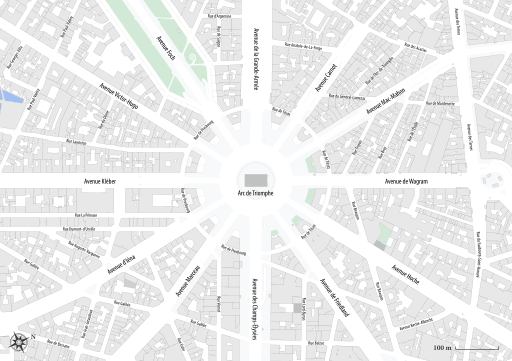
Twelve avenues extend from Place Charles de Gaulle, formerly Place de l’Étoile, forming a star with the Arc de Triomphe at the center.
Did you know…?
The Place Charles de Gaulle has inspired works of literature, including Patrick Modiano’s novel La Place de l’Étoile. The book’s title pays homage to the square’s historic name while delving into themes of identity and memory.
A Modern Perspective
Today, the Place Charles de Gaulle remains one of Paris’s top tourist attractions. Visitors flock to the Arc de Triomphe to witness panoramic views of the city and explore its historical exhibits.
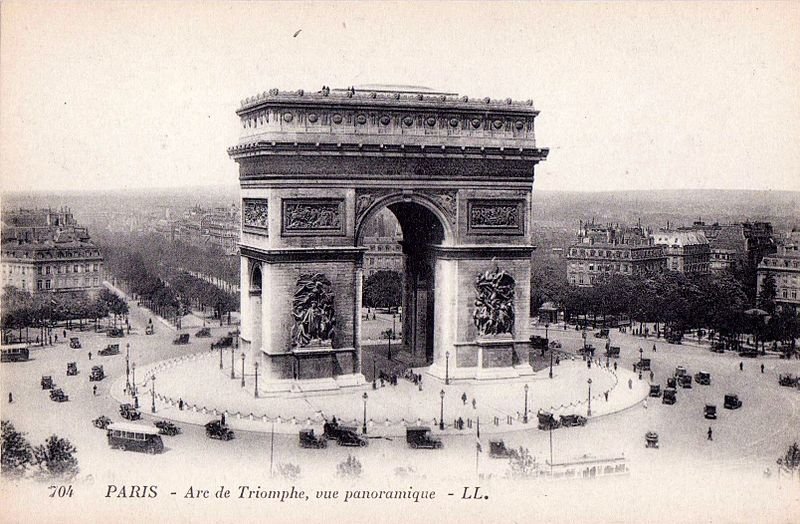
The Place de l’Étoile, around 1920.
The square exemplifies the intersection of historical preservation and modern urban planning. Its symmetrical design and harmonious integration into Paris’s broader cityscape make it an architectural marvel.

Frequently Asked Questions
Why was it renamed Place Charles de Gaulle?
It was renamed in 1970 to honor President Charles de Gaulle after his death.
What structure stands at its center?
The Arc de Triomphe, commissioned by Napoleon I and completed in 1836, is located at the center.
What is its historical significance?
Originally a hunting trail convergence, it became a monumental junction during the Second Empire and includes the Tomb of the Unknown Soldier since 1921.
What is the “Axe historique”?
It is a straight urban axis that cuts through the Arc de Triomphe, extending from the Champs-Élysées to the Avenue de la Grande Armée.
How large is the Place Charles de Gaulle?
It spans a diameter of 241 meters, covering approximately 4.55 hectares, making it the second largest square in Paris.
Which arrondissements encompass it?
It spans the 8th, 16th, and 17th arrondissements of Paris.





